格物
- 学名
- Quercus petraea
- 分类等级
- 种
- 上级类群
- 栎属
- 大类
- 被子植物
- 命名
- Franz Kaspar Lieblein,1784 年
- 保护状况(IUCN)
- 无危物种
- 异名
- Quercus sessiliflora
- 数据库
- NCBI 分类 · GBIF · IUCN 红色名录
百科正文
无梗花栎是爱尔兰的国树,也是威尔士非官方的代表标志,因此在威尔士亦称威尔士橡树(Welsh Oak),同时也被认为是康沃尔郡的郡树,因此亦称康沃尔橡树(Cornish Oak)。
描述
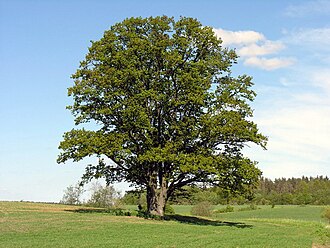
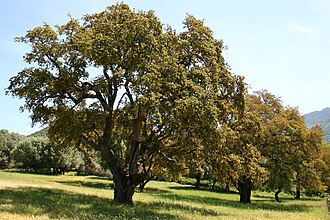
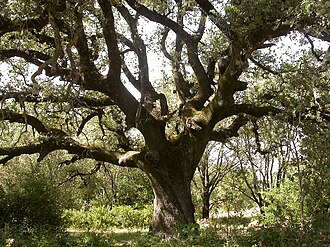
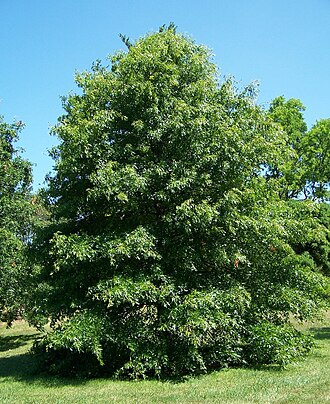
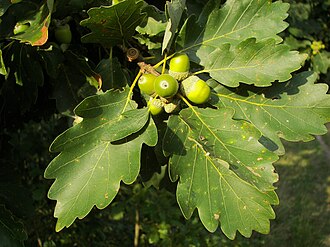
无梗花栎是一种大型落叶乔木,随着缓慢的生长,其高度可达25—40米(82—131英尺)。叶子长达7—14厘米(2.8—5.5英寸),宽达4—8厘米(1.6—3.1英寸)。其橡子长达2—3厘米(0.79—1.18英寸),宽达1—2厘米(0.39—0.79英寸)。
无梗花栎在四月至五月间开花,九月至十月间种子成熟。其花为葇荑花序,且雌雄同株。无梗花栎偏好生长在重粘土中,且在碱性到高酸性的土壤中都可以生长。
用途
食用
无梗花栎的种子可以食用,例如将其磨成粉末做成增稠剂或者混入谷类面包中。但是种子中有会产生苦味的鞣质,故需要用火烤或者水洗等方法将之除去。其烘烤过的种子可以做成咖啡代替品,其树皮中含有可食用的胶质。
药用
无梗花栎有很长的药用历史,它可以做成抗炎药、抗菌剂、收敛剂、解充血药、止血剂和补药,其中树皮是最常用的一种成分,有时也会使用其种子。用其树皮煮的药剂可以治疗慢性腹泻、痢疾、间歇热和出血。
其他
无梗花栎的叶子上的物质可以使蛞蝓和蛴螬退却,尽管这些生物并不寄生在无梗花栎上。其栎瘿中可能会寄生各种昆虫的幼体,当这些昆虫化蛹之后,便可以使用这些栎瘿来生产鞣质、用作染料以及生产墨水。其树皮可以用作堆肥促进剂,木质部分则可以生产焦油、醋酸、木馏油和鞣质。而且因其结实耐用,故而还可以用作建筑材料、制作家具等。
以上内容摘自维基百科「無梗花櫟」,按 CC BY-SA 4.0 使用,去掉了参考文献、外部链接等尾部小节,公式改写成了纯文本。全文、配图和出处见原文。
英文维基百科补充中文条目比较短,下面是英文条目「Quercus petraea」的原文
Quercus petraea, commonly known as the sessile oak, Welsh oak, Cornish oak, Irish oak or durmast oak, is a species of deciduous oak tree in the flowering plant family Fagaceae. It is native to most of Europe and into Anatolia and Iran. The sessile oak is the national tree of Ireland, and an unofficial emblem in Wales and Cornwall.
Sessile oak is a significant source of Timber in Europe, and historically was important in ship construction. Most trees reach a height of 20-40 m, and can live for several centuries.
Description
The sessile oak is a large deciduous tree up to 40 metres (130 feet) tall, in the white oak section of the genus (Quercus sect. Quercus) and similar to the pedunculate oak (Q. robur), with which it overlaps extensively in range. The leaves are 7–14 centimetres (2+3⁄4–5+1⁄2 inches) long and 4–8 cm (1+1⁄2–3 in) broad, evenly lobed with five to six lobes on each side and a 1 cm-long (1⁄2 in) petiole. Sessile oak is monoecious, with both male and female flowers found on the same tree. The female flowers are found on bracts. The male flowers are grouped into catkins, produced in the spring. The fruit is an acorn 2–3 cm (3⁄4–1+1⁄4 in) long and 1–2 cm (1⁄2–3⁄4 in) broad, which matures in about six months.
Comparison with pedunculate oak
Significant botanical differences from pedunculate oak (Q. robur) include the stalked leaves, and the stalkless (sessile) acorns from which one of its common names is derived. (With the pedunculate oak, it is the acorns which are pedunculate, i.e. on stalks, while the leaves are not.) It occurs in upland areas of altitudes over 300 m (984 ft) with higher rainfall and shallow, acidic, sandy soils. Its specific epithet petraea means "of rocky places". Q. robur, on the other hand, prefers finer, richer, and deeper soils at lower altitude.
Distribution
Sessile oak is found throughout Europe, and is most common in upland areas with heavy soils (rocky and well draining) that is neutral to slightly acidic.
Taxonomy
Quercus petraea was first described by Heinrich Gottfried von Mattuschka in 1777 as a variety of Quercus robur, Quercus robur var. petraea. It was raised to a full species by Franz Kaspar Lieblein in 1784.
Subspecies
- As of March 2023, Plants of the World Online accepted five subspecies:
- Quercus petraea subsp. austrotyrrhenica Brullo, Guarino & Siracusa
- Quercus petraea subsp. huguetiana Franco & G.López
- Quercus petraea subsp. petraea
- Quercus petraea subsp. pinnatiloba (K.Koch) Menitsky
- Quercus petraea subsp. polycarpa (Schur) Soó
Diseases and pests
Acute oak decline
Sudden oak death
The Welsh oak longhorn beetle (Pyrrhidium sanguineum) is named after its host tree; the larvae feed at the bark interface of dead wood.
Uses
Sessile oak is one of the most important species in Europe both economically and ecologically. Oak timber is traditionally used for building, ships and furniture. Today the best woods are used for quality cabinetmaking, veneers and barrel staves. Rougher material is used for fence construction, roof beams and specialist building work. The wood also has antimicrobial properties. It is also a good fuel wood. During autumns with good acorn crops (the mast years), animals are traditionally grazed under the trees to fatten them.
Notable individual trees
Pontfadog Oak
Known as "Wales's national tree", the Pontfadog Oak was a sessile oak considered to be the oldest oak tree in the UK. Located near Chirk in North Wales, its girth was measured as over 16 metres (53 ft) in 1881 and it was understood to be over 1,200 years old, an age that was due to regular pollarding for much of its life. The hollow trunk had a girth of 12.9 m (42 ft 5 in).
The tree died in April 2013 when it blew down in high winds. However, the Crown Estate propagated a sapling from the original tree and planted it in Windsor Great Park. A further five saplings have been cloned from the Pontfadog Oak, three of which will be planted at the National Botanic Garden of Wales, with the other two going to sites near Pontfadog; one at Chirk Castle and the other at Erddig, as part of a woodland memorial to those who died during the COVID-19 pandemic.
Fuck Tree
The Fuck Tree is a sessile oak tree located in Hampstead Heath, north London. The tree is located in an established gay cruising area and is famous for its slender trunk which facilitates gay sex. Hampstead Heath has been used for gay cruising since the Victorian era, with the Fuck Tree being the most famous tree in the heath.
以上节选摘自英文维基百科「Quercus petraea」,按 CC BY-SA 4.0 使用,去掉了参考文献、外部链接等尾部小节,公式改写成了纯文本。篇幅所限,较长的小节只摘了开头一部分,有的小节没有收;全文、配图和出处见原文。