格物

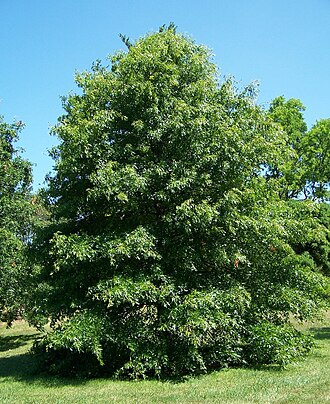
图:Giuseppe Frizzi · Public domain · Wikimedia Commons
- 学名
- Quercus cerris
- 分类等级
- 种
- 上级类群
- 栎属
- 大类
- 被子植物
- 命名
- 卡尔·林奈,1753 年
- 中文别名
- 山羊栎
- 保护状况(IUCN)
- 无危物种
- 异名
- Quercus aegilops、Quercus ambrozyana、Quercus asplenifolia、Quercus austriaca、Quercus cana、Quercus crinita、Quercus haliphlaeos
- 数据库
- NCBI 分类 · GBIF · IUCN 红色名录
百科正文
描述
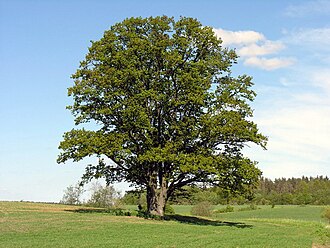
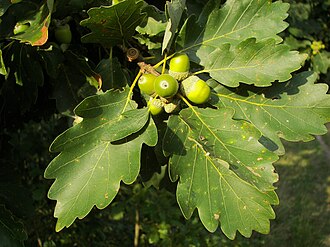
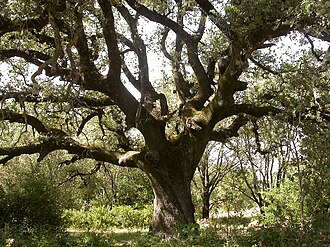
土耳其栎是一种大型落叶乔木,高度可达25—40米(82—131英尺),直径可达2米(6英尺7英寸),树皮深灰色有深深的沟痕。成熟的土耳其栎底部树皮发黄。叶子光滑,长达7—14厘米(2.8—5.5英寸),宽3—5厘米(1.2—2.0英寸),每侧有6-12个叶裂,不一定很对称。
其花为风媒葇荑花序,在授粉后18个月成熟。橡子长达2.5—4厘米(0.98—1.57英寸),宽约2厘米(0.79英寸),底部黄色渐变为顶部棕绿色,覆盖有4—8毫米(0.16—0.31英寸)的绒毛。橡子很苦,但是是松鶏、鸽子和松鼠的食物。
这种树上常栖息有瘿蜂Andricus quercuscalicis,但是其对英国的橡树却有危害。
用途
土耳其栎在大约120,000年前就进入了北欧和不列颠,18世纪再次引入英国。其栎瘿是鸟类的食物。
土耳其栎广泛种植于欧洲各地,生长速度相对其他树种更快,因此常被用作观赏树木。
杂交
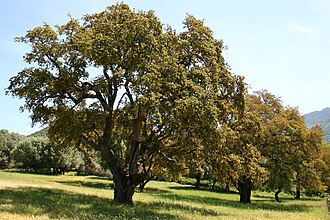
土耳其栎与栓皮栎(Q. suber)杂交产生Q. × crenata Lam.。在野生环境下也可以看到,有明显的杂种优势。
以上内容摘自维基百科「土耳其櫟」,按 CC BY-SA 4.0 使用,去掉了参考文献、外部链接等尾部小节,公式改写成了纯文本。全文、配图和出处见原文。
英文维基百科补充中文条目比较短,下面是英文条目「Quercus cerris」的原文
Quercus cerris, the Turkey oak or Austrian oak, is a species of oak in the beech family (Fagaceae). It is native to southern and south-eastern Europe, Asia Minor, and the Levant, but has been introduced outside its range. It is the type species of Quercus sect. Cerris, a section of the genus characterised by shoot buds surrounded by soft bristles, bristle-tipped leaf lobes, and acorns that usually mature in 18 months.
Taxonomy and evolution
Turkey oak was formally described by Carl Linnaeus in his 1753 Species Plantarum. The species epiphet — cerris — derives from the Latin name for the species, cerrus, which in turn may have come from a root meaning 'hard', or from a Berber term for oak.
Within the genus Quercus, Quercus cerris is classified in section Cerris of the subgenus Cerris, which is distributed in Eurasia, with a centre of diversity in the eastern Mediterranean. Within sect. Cerris, Turkey oak is in turn classified in the subsection Cerris, alongside Q. castaneifolia and Q. look, which are endemic to the Hyrcanian forests and the Levant, respectively.
After the last glacial, Turkey oak was restricted to areas south of the Alps, however, fossil galls preserved at the site of Raalte, the Netherlands, described in 2008, yielded indirect evidence that Turkey oak was present in northwestern Europe during the Eemian interglacial (130-115 thousand years ago), which preceded the last glacial.
Description
Quercus cerris is a large deciduous tree growing to 25–40 metres (82–131 feet) tall with a trunk up to 2 m (6+1⁄2 ft) in diameter. The bark is dark gray and deeply furrowed. On mature trees, the bark fissures are often streaked orange near the base of the trunk. The glossy leaves are 7–14 centimetres (2+3⁄4–5+1⁄2 inches) long and 3–5 cm wide, with 6–12 triangular lobes on each side; the regularity of the lobing varies greatly, with some trees having very regular lobes, others much less regular.
The flowers are wind-pollinated catkins, maturing about 18 months after pollination; the fruit is a large acorn, 2.5–4 cm (1–1+1⁄2 in) long and 2 cm broad, bicoloured with an orange basal half grading to a green-brown tip; the acorn cup is 2 cm deep, densely covered in soft 'mossy' bristles from 4–8 millimetres (1⁄8–3⁄8 in) in length.
Distribution and ecology
First year acorns are very bitter, but are eaten by jays and pigeons; squirrels usually only eat them when other food sources have run out.
The species' range extended to northern Europe and the British Isles before the previous ice age, about 120,000 years ago. It was reintroduced in the UK and Ireland in the eighteenth century as an ornamental tree, its gall wasps now provide early food for birds.
The tree harbours the gall wasp Andricus quercuscalicis whose larvae seriously damage the acorns of native British oaks. In 1998, the Ministry of Defence ordered the felling of all Turkey oaks on its United Kingdom bases.
Cultivation
Turkey oak is widely planted and is naturalised in much of Europe. This is partly for its relatively fast growth. It is used as an ornamental, and as a coastal windbreak. Several cultivars have been selected, including 'Variegata', a variegated cultivar, and 'Woden', with large, deeply lobed leaves.
Turkey oak readily hybridises with cork oak (Q. suber), the resulting hybrid being named Q. × crenata Lam. This hybrid occurs both naturally where its parents' ranges overlap in the wild, and has also arisen in cultivation. It is a very variable medium to large tree, usually semi-evergreen, sometimes nearly completely so, and often with marked hybrid vigour; its bark is thick and fissured but never as thick as that of the cork oak. Numerous cultivars are available, often grafted onto Turkey oak root stock. These include 'Ambrozyana', evergreen except in severe winters, originating from the Arboretum in Slovakia, home of the late Count Ambrozy; 'Diversifolia', with the leaves extremely deeply cut leaving a narrow strip down the centre, and very corky bark; 'Fulhamensis' (Fulham oak), raised at Osborne's nursery in Fulham c.1760; and 'Lucombeana' (Lucombe oak), raised by William Lucombe at his nursery in Exeter c. 1762.
Cultivation and uses
The wood has many of the characteristics of other oaks, but is very prone to crack and split and hence is relegated to such uses as fencing.
以上节选摘自英文维基百科「Quercus cerris」,按 CC BY-SA 4.0 使用,去掉了参考文献、外部链接等尾部小节,公式改写成了纯文本。篇幅所限,较长的小节只摘了开头一部分,有的小节没有收;全文、配图和出处见原文。