格物

图:Suyash Dwivedi · CC BY-SA 4.0 · Wikimedia Commons
- 学名
- Piper betle
- 分类等级
- 种
- 英文名
- betel
- 上级类群
- 胡椒属
- 大类
- 被子植物
- 命名
- 卡尔·林奈,1753 年
- 中文别名
- 荖藤、蒟酱、印度胡椒、芦子、蒌叶(芦子、菊酱)
- 用途
- 药用植物、食物、增味剂、stimulant foodstuff、精神药品
- 数据库
- NCBI 分类 · GBIF
百科正文
用途
藤和叶子可以做药材,叶子里面还含有芳香油。果穗称为荖花,叶片称为荖叶,两者均为槟榔嗜食族的配料;清代已有文献记载,蒌叶常与砺灰(石灰)一起与槟榔嚼食。籽实可做酱,称作蒟酱。
2025年台湾卫生福利部食药署将其列为可食用的食品原料。
以上内容摘自维基百科「蒌叶」,按 CC BY-SA 4.0 使用,去掉了参考文献、外部链接等尾部小节,公式改写成了纯文本。全文、配图和出处见原文。
英文维基百科补充中文条目比较短,下面是英文条目「Betel」的原文
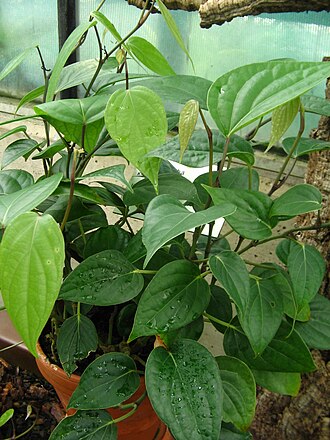
Betel (Piper betle) is a species of flowering plant in the pepper family Piperaceae, native to Southeast Asia. It is an evergreen, dioecious vine, with glossy heart-shaped leaves and white catkins. Betel plants are cultivated for their leaves, which are most commonly used as flavoring for chewing areca nut in so-called betel quid (often confusingly referred to as "betel nut"), which is carcinogenic, contains a psychostimulant drug, and is associated with a wide range of serious health conditions.
Etymology
The term betel was derived from the Malayalam/Tamil word vettila via Portuguese.
Distribution
Piper betle is originally native to Southeast Asia, from India, Philippines, Timor-Leste and Indonesia and Peninsular Malaysia to Indochina, Vietnam, Cambodia, Laos, Thailand, Myanmar and Bangladesh.. Its cultivation has spread along with the Austronesian migrations and trade to other parts of Island Southeast Asia, Papua New Guinea and Melanesia, Micronesia, South Asia, the Maldives, Mauritius, Réunion Island, and Madagascar. It was introduced during the Colonial Era to the Caribbean by Indian indentured immigrants.
Cultivation
The betel leaf is cultivated mostly in South and Southeast Asia, from India to Papua New Guinea. It needs a compatible tree or a long pole for support. Betel requires well-drained fertile soil. Waterlogged, saline and alkali soils are unsuitable for its cultivation.
In Bangladesh, farmers called barui prepare a garden called a barouj in which to grow betel. The barouj is fenced with bamboo sticks and coconut leaves. The soil is plowed into furrows of 10 to 15 m length, 75 cm in width and 75 cm depth. Oil cakes, manure, and leaves are thoroughly incorporated with the topsoil of the furrows and wood ash.
Cultural significance
The primary use of betel leaf is as a wrapper for the chewing of areca nut, or in modern times, tobacco, where it is mainly used to add flavour. The practice is thought to have originated in the Philippines around 5,000 years ago, where the oldest remains of areca nuts and calcium from crushed sea shells have been found in the Duyong Cave archaeological site. It spread along with the Austronesian migrations to the rest of Southeast Asia, Taiwan, South China, and South Asia. It is unknown when or why betel leaves were first combined with areca nuts, since areca nuts can be chewed alone.
Health effects
Red betel leaf is sometimes used as an antibacterial mouthwash. While chewing or consuming betel leaf on its own has no known negative effect and have been shown to be chemopreventive in animal models, it is most often used to wrap betel quid for chewing, which also contains the carcinogenic and mildly narcotic areca nut. Habitual use of this popular product (sometimes inaccurately referred to as "betel nut") damages the oral cavity and is associated with a wide range of adverse systemic health effects, including harm to the cardiovascular and central nervous systems.
Chemical composition
Chemistry of betel leaf varies geographically and is mostly chavibetol dominant. Safrole is a major component of Sri Lankan Piper betle. Eugenol, isoeugenol, and germacrene D are other dominant compounds in other chemotypes.
Leaves also contain eugenol, chavicol, hydroxychavicol, and caryophyllene.
Stems contain phytosterols (β-sitosterol, β-daucosterol, stigmasterol etc.), alkaloids (piperine, pellitorine, piperdardine, guineensine etc.), lignan (pinoresinol) and other components. Some of them are oleanolic acid, dehydropipernonaline, piperolein-B, bornyl cis-4-hydroxycinnamate and bornyl p-coumarate.
Genome
The whole genome of Piper Betle has been available since 2023 on NCBI with the Accession number JAURVB000000000
Economics
Betel vines are cultivated throughout southeast Asia, in plots typically 20 to 2,000 square metres (0.005 to 0.5 acre) in size.
Malaysian farmers cultivate four types of betel plants: sirih India, sirih Melayu, sirih Cina and sirih Udang. The harvest is then sold in bundles of leaves, each bundle costing in 2011 between MYR 0.30 and 0.50 ($0.07 and $0.12).
In Sri Lanka, betel is grown all over the country. Commercial production of betel, with bigger leaves with dark green colour combined with thickness, known as "kalu bulath", is confined to a few districts, such as Kurunagala, Gampaha, Kegalle, Kalutara and Colombo.
以上节选摘自英文维基百科「Betel」,按 CC BY-SA 4.0 使用,去掉了参考文献、外部链接等尾部小节,公式改写成了纯文本。篇幅所限,较长的小节只摘了开头一部分,有的小节没有收;全文、配图和出处见原文。