 格物
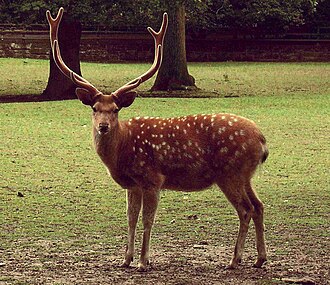
图:Altaileopard; modified by Wildfeuer · CC BY-SA 3.0 · Wikimedia Commons
- 学名
- Cervus nippon
- 分类等级
- 种
- 英文名
- sika deer
- 上级类群
- 鹿属
- 大类
- 哺乳动物
- 命名
- 昆拉德·雅各布·特明克,1836 年
- 保护状况(IUCN)
- 无危物种
- 栖息地
- 稀树草原、森林
- 体重
- 5.75 千克(出生体重)
- 数据库
- NCBI 分类 · GBIF · IUCN 红色名录
百科正文
分布地区
分布于东亚。范围北从西伯利亚到朝鲜半岛、中华人民共和国东北部吉林、越南北部,在日本、台湾等西太平洋岛屿也有分布。而日本的梅花鹿主要分布于北海道,19世纪曾经被猎到几乎绝种。20世纪中开始立法保护,族群在1950年代到1980年代快速恢复。由于缺乏天敌(日本狼已灭绝),狩猎被鼓励来控制族群,限制鹿群对农业的伤害。梅花鹿也被引进到澳大利亚、欧洲和美国。原先的目的是作为动物公园观赏用的动物,但现在许多变成野生。
生物特征
成鹿体长约1.5米。体重70-100千克。毛色夏季为栗红色,有许多白斑,状似梅花;冬季为烟褐色,白斑不显著。颈部有鬣毛。雌性无角,雄性第二年起生角,每年增加一叉,五岁后分四叉止。
听觉及嗅觉发达,喜爱群居,擅长奔跑。岁半至两岁半成熟。每年9-11月交配,5-7月产子,每胎有一只或两只小鹿。
以上内容摘自维基百科「梅花鹿」,按 CC BY-SA 4.0 使用,去掉了参考文献、外部链接等尾部小节,公式改写成了纯文本。全文、配图和出处见原文。
英文维基百科补充中文条目比较短,下面是英文条目「Sika deer」的原文
The sika deer (Cervus nippon), also known as the northern spotted deer or the Japanese deer, is a species of deer native to much of East Asia and introduced to other parts of the world. Previously found from northern Vietnam in the south to the Russian Far East in the north, it was overhunted to the brink of extinction in the 19th century. Protection laws were enacted in the mid-20th century, leading to a rapid recovery of their population from the 1950s to the 1980s.
Etymology
The name "sika deer" comes from shika (鹿), the Japanese word for "deer", and in Japan, the species is known as the nihonjika (ニホンジカ (日本鹿), "Japan deer"). In Chinese, it is known as Chinese: 梅花鹿; pinyin: méihuālù, "plum blossom deer", referring to the white fur spots on the deer's back resembling plum blossoms.
Taxonomy
The sika deer is a member of the genus Cervus, a group of deer also known as the "true" deer, within the larger deer family, Cervidae. Formerly, sika were grouped together in this genus with nine other diverse species; these animals have since been found to be genetically different, and reclassified elsewhere under different genera. Currently, deer species within the genus Cervus are the sika, the red deer (C.
Description
The sika deer is one of the few deer species that does not lose its spots upon reaching maturity. Spot patterns vary with region. The mainland subspecies have larger and more obvious spots, in contrast to the Taiwanese and Japanese subspecies, whose spots are nearly invisible. Many introduced populations are from Japan, so they also lack significant spots.
The color of the pelage ranges from mahogany to black, and white individuals are also known.
Behavior
Sika deer can be active throughout the day, though in areas with heavy human disturbance, they tend to be nocturnal. Seasonal migration is known to occur in mountainous areas, such as Japan, with winter ranges being up to 700 m (2,300 ft) lower in elevation than summer ranges.
Lifestyles vary between individuals, with some occurring alone, while others are found in single-sex groups. Large herds gather in autumn and winter. Males spend most years alone, occasionally forming herds together.
Habitat
Sika deer are found in the temperate and subtropical forests of eastern Asia, preferring areas with dense understory and occasional clearings and where snowfall does not exceed 10–20 cm (4–8 in), though in their native range, they have been known to frequent areas with a maximum snow depth up to 50 cm (19.6 in). They tend to forage in patchy clearings of forests.
Population
Sika deer inhabit temperate and subtropical woodlands, often in areas suitable for farming and other human exploitation. Their range encompasses some of the most densely populated areas in the world, where forests were cleared hundreds of years ago. Their population status varies significantly in different countries. Although the species as a whole is thriving, it is endangered and extinct in many areas.
Hunting
Across its original range and in many areas to which it has been introduced, the sika is regarded as a particularly prized and elusive sportsman's quarry. In Britain, Ireland, and mainland Europe, sika display very different survival strategies and escape tactics from the indigenous deer. They have a marked tendency to use concealment in circumstances when red deer, for example, would flee, and have been seen to squat and lie belly-flat when danger threatens.
Deer farming
Velvet antler
Velvet antler (dried precalcified antlers) is a popular ingredient in traditional Chinese medicine, and sika deer were domesticated by deer farms in China long ago for the antler trade, along with several other species. In Taiwan, both Formosan sika deer and Formosan sambar deer (Cervus unicolor swinhoei) have been farmed for velvet antlers. Japan is the only country in East Asia where sika deer were not farmed for velvet antlers.
Cultural significance
In Shinto, the Shika Deer is considered a kind of messenger between mortals and the kami.
以上节选摘自英文维基百科「Sika deer」,按 CC BY-SA 4.0 使用,去掉了参考文献、外部链接等尾部小节,公式改写成了纯文本。篇幅所限,较长的小节只摘了开头一部分,有的小节没有收;全文、配图和出处见原文。