 格物
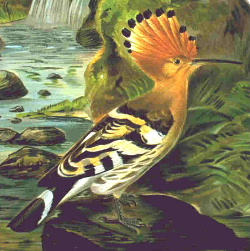
图:This image comes from the book: Naumann, Naturgeschichte der… · Public domain · Wikimedia Commons
- 学名
- Upupidae
- 分类等级
- 科
- 上级类群
- 犀鸟目
- 大类
- 鸟类
- 命名
- 威廉·埃尔福德·里奇,1820 年
- 数据库
- NCBI 分类 · GBIF
下级类群(1)
- 戴胜属 Upupa 属
百科正文
分类
1758年瑞典博物学家卡尔·林奈在他的自然系统第十版中就提到了戴胜属。模式种是戴胜(Upupa epops)。
- 本属包括以下物种:
- 非洲戴胜 Upupa africana Bechstein, 1811
- †圣赫勒拿岛戴胜 Upupa antaios Olson, 1975†
- 戴胜 Upupa epops Linnaeus, 1758
戴胜华南亚种 Upupa epops longirostris Jerdon, 1862
- 戴胜指名亚种 Upupa epops epops
- Upupa erythrorhynchos Latham, 1790
- Upupa magna Gmelin, 1788
- Upupa marginata Cabanis & Heine, 1860
- Upupa paradisea Linnaeus, 1758
以上内容摘自维基百科「戴勝屬」,按 CC BY-SA 4.0 使用,去掉了参考文献、外部链接等尾部小节,公式改写成了纯文本。全文、配图和出处见原文。
英文维基百科补充中文条目比较短,下面是英文条目「Hoopoe」的原文
Hoopoes are colourful birds found across Africa, Asia, and Europe, notable for their distinctive "crown" of feathers which can be raised or lowered at will. Two living and one extinct species are recognized, though for many years both extant species were lumped as a single species—Upupa epops. In fact, some taxonomists still consider the species to be conspecific. On the other hand, some authorities recognize three living species, with the African hoopoe (U. africana) treated as separate from the common hoopoe (U. epops). The common hoopoe is common in its range and has a large population, so it is evaluated as Least Concern on the IUCN Red List of Threatened Species. However, their numbers are declining in Western Europe. Conversely, the hoopoe has been increasing in numbers at the tip of the South Sinai, Sharm el-Sheikh. There are dozens of nesting pairs that remain resident all year round.
Taxonomy
The genus Upupa was introduced in 1758 by the Swedish naturalist Carl Linnaeus in the tenth edition of his Systema Naturae. The type species is the common hoopoe (Upupa epops). Upupa and ἔποψ (epops) are respectively the Latin and Ancient Greek names for the hoopoe; both, like the English name, are onomatopoeic forms which imitate the cry of the bird.
The hoopoe was classified in the clade Coraciiformes, which also includes kingfishers, bee-eaters, and rollers. A close relationship between the hoopoe and the wood hoopoes is also supported by the shared and unique nature of their stapes. In the Sibley-Ahlquist taxonomy, the hoopoe is separated from the Coraciiformes as a separate order, the Upupiformes. Some authorities place the wood hoopoes in the Upupiformes as well. Now the consensus is that both hoopoe and the wood hoopoes belong with the hornbills in the Bucerotiformes.
Distribution and habitat
Hoopoes are widespread in Europe, Asia, and North Africa, Sub-Saharan Africa and Madagascar. Most European and north Asian birds migrate to the tropics in winter. In contrast, the African populations are sedentary all year. The species has been a vagrant in Alaska; U. e. saturata was recorded there in 1975 in the Yukon Delta. Hoopoes have been known to breed north of their European range, and in southern England during warm, dry summers that provide plenty of grasshoppers and similar insects, although as of the early 1980s northern European populations were reported to be in the decline, possibly due to changes in climate.
The hoopoe has two basic requirements of its habitat: bare or lightly vegetated ground on which to forage and vertical surfaces with cavities (such as trees, cliffs or even walls, nestboxes, haystacks, and abandoned burrows) in which to nest.
Behaviour and ecology
In what was long thought to be a defensive posture, hoopoes sunbathe by spreading out their wings and tail low against the ground and tilting their head up; they often fold their wings and preen halfway through. They also enjoy taking dust and sand baths. Adults may begin their moult after the breeding season and continue after they have migrated for the winter. The hoopoe has a high crest, which usually rests horizontally but will lift straight up when the bird is hyped up or frightened.
Diet and feeding
The diet of the hoopoe is mostly composed of insects, although small reptiles, frogs and plant matter such as seeds and berries are sometimes taken as well. It is a solitary forager which typically feeds on the ground. More rarely they will feed in the air, where their strong and rounded wings make them fast and manoeuverable, in pursuit of numerous swarming insects.
Relationship with humans
The diet of the hoopoe includes many species considered by humans to be pests, such as the pupae of the processionary moth, a damaging forest pest which few other birds will eat because of its irritating hairs. For this reason, the species is afforded protection under the law in many countries.
In folklore, myth and religion
The hoopoe has a long presence in Near Eastern culture, folklore, mythology and religion. In Ancient Egypt, the hoopoe was used in the iconography as a symbolic code to indicate the child was the heir and successor of his father. It also had a symbolic standing in Minoan Crete.
There is both a Jewish Midrashic and Aggadah reference to the hoopoe bird, the Queen of Sheba and King Solomon. The hoopoe tells King Solomon that the Queen of Sheba is a sun worshipper. King Solomon then sends the hoopoe to Sheba, with a note attached to its wing, telling the queen that she must become his subject.
以上节选摘自英文维基百科「Hoopoe」,按 CC BY-SA 4.0 使用,去掉了参考文献、外部链接等尾部小节,公式改写成了纯文本。篇幅所限,较长的小节只摘了开头一部分,有的小节没有收;全文、配图和出处见原文。