 格物
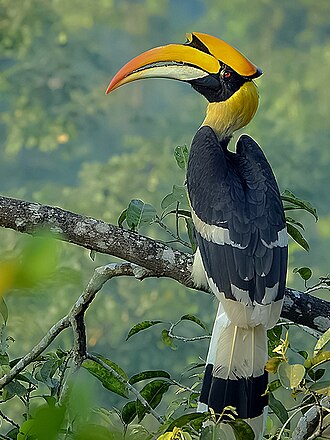
图:Shantanu Kuveskar · CC BY-SA 4.0 · Wikimedia Commons
- 学名
- Bucerotidae
- 分类等级
- 科
- 英文名
- hornbill
- 上级类群
- 犀鸟目
- 大类
- 鸟类
- 命名
- 康斯坦丁·萨米埃尔·拉菲内克-施马尔茨,1815 年
- 数据库
- NCBI 分类 · GBIF
下级类群(12)
百科正文
特征
犀鸟是一种珍贵而漂亮的大型鸟类,嘴的长度占了身长的1/3到一半,在它的头上长有一个铜盔状的突起,叫做盔突,就好像犀牛角一样,因而得名犀鸟。
犀鸟体长约75厘米;背面羽毛纯黑,具绿色金属光泽;翼缘和飞羽先端白色。
习性
犀鸟科为杂食性鸟类,以水果、昆虫和小型脊椎动物为食。它们一般喜欢栖息在密林深处的参天大树(如热带雨林茂密的树)上,吃的是树上的果实,还有昆虫等等。
在繁殖季节多成对活动,而在非繁殖季节则大群活动。每年夏天,成对的犀鸟,会选择高大树干的洞穴作巢产卵。产完卵后的它们就把洞口堵上,只留下一个可以使雌鸟伸出嘴尖的小洞。这样起到保护雌鸟并使其安心孵化小犀鸟的作用。而雄犀鸟则负责为妻子和小鸟不断的提供充足的食物,保证雌鸟的营养和满足小犀鸟生长发育的需要。
分布
犀鸟科共有约57种,分布在非洲撒哈拉沙漠以南地区和南亚、东南亚的热带地区,其中六个种在中国有分布。
中国的犀鸟大多生活在云南西南部如勐腊县,金平县,以及广西南部,有白喉犀鸟,棕颈犀鸟,冠斑犀鸟,双角犀鸟四种,均为国家二级保护动物。千多年前的香港,曾经是热带雨林,均可能是犀鸟的分布地。现时在香港公园、九龙公园、海洋公园、香港动植物公园饲养的犀鸟当中,前两者所养的是双角犀鸟,后者为红喙犀鸟。
马来西亚的犀鸟大多生活在砂拉越,沙巴,柔佛州等地区,而还有一些政治社团用犀鸟的图案做为标志。
以上内容摘自维基百科「犀鸟科」,按 CC BY-SA 4.0 使用,去掉了参考文献、外部链接等尾部小节,公式改写成了纯文本。全文、配图和出处见原文。
英文维基百科补充中文条目比较短,下面是英文条目「Hornbill」的原文
Hornbills are birds found in tropical and subtropical Africa, Asia and Melanesia of the family Bucerotidae. They are characterized by a long, down-curved bill which is frequently brightly coloured and sometimes has a horny casque on the upper mandible. Hornbills have a two-lobed kidney. They are the only birds in which the first and second neck vertebrae (the atlas and axis respectively) are fused together; this probably provides a more stable platform for carrying the bill. The family is omnivorous, feeding on fruit and small animals. They are monogamous breeders nesting in natural cavities in trees and sometimes cliffs. A number of mainly insular species of hornbill with small ranges are threatened with extinction, mainly in Southeast Asia.
In the Neotropical realm, toucans occupy the hornbills' ecological niche, an example of convergent evolution. Despite their close appearances, the two groups are not very closely related, with toucans being related to several families of barbet, while hornbills (and their close relatives, the ground hornbills) are allied with the hoopoes and wood-hoopoes.
Description
Hornbills show considerable variation in size and colors. The smallest species is the black dwarf hornbill (Tockus hartlaubi), at 99.1 g (3.50 oz) and 32 cm (1 ft 1 in) in length. The largest and most massive species appears to be the southern ground hornbill which has an average weight of 3.77 kg (8.3 lb), and can weigh up to 6.3 kg (14 lb) and span about 180 cm (5 ft 11 in) across the wings.
Distribution and habitat
The Bucerotidae include about 62 living species, though a number of cryptic species may yet be split, as has been suggested for the red-billed hornbill. Their distribution includes Sub-Saharan Africa and the Indian subcontinent to the Philippines and the Solomon Islands, but no genus is found in both Africa and Asia. Most are arboreal birds, but the large ground hornbills (Bucorvus), as their name implies, are terrestrial birds of open savanna. Of the 24 species found in Africa, 13 are birds of the more open woodlands and savanna, and some occur even in highly arid environments; the remaining species are found in dense forests.
Behaviour and ecology
Hornbills are diurnal, generally travelling in pairs or small family groups. Larger flocks sometimes form outside the breeding season. The largest assemblies of hornbills form at some roosting sites, where as many as 2400 individual birds may be found.
Diet
Hornbills are omnivorous birds, eating fruit, insects and small animals. They cannot swallow food caught at the tip of the beak as their tongues are too short to manipulate it, so they toss it back to the throat with a jerk of the head.
Taxonomy
The family Bucerotidae was introduced (as Buceronia) by the French polymath Constantine Samuel Rafinesque in 1815; it comes from the genus name Buceros given by Carl Linnaeus in 1758 from Ancient Greek βοῦς (boûs), meaning "ox", and κέρας (kéras), meaning "horn", and thus, "ox horn".
There are two subfamilies: the Bucorvinae contain the two ground hornbills in a single genus, and the Bucerotinae contain all other taxa. Traditionally they are included in the order Coraciiformes (which includes also kingfishers, rollers, hoopoes and bee-eaters).
Relationship with humans
Cultural significance
Most species' casques are very light, containing much airspace. However, the helmeted hornbill has a solid casque made of a material known as hornbill ivory, which is greatly valued as a carving material in China and Japan. It was used as a medium for the art of netsuke, and also used for hunting purposes in places like India. The Iban people of Borneo regards the Rhinoceros hornbill (known as Kenyalang) as the king of the worldly birds, who acts as the intermediary between the man and the God.
The Wreathed hornbill (Undan) is believed by the Iban people to be the guide of dead souls to the lower world.
以上节选摘自英文维基百科「Hornbill」,按 CC BY-SA 4.0 使用,去掉了参考文献、外部链接等尾部小节,公式改写成了纯文本。篇幅所限,较长的小节只摘了开头一部分,有的小节没有收;全文、配图和出处见原文。