 格物
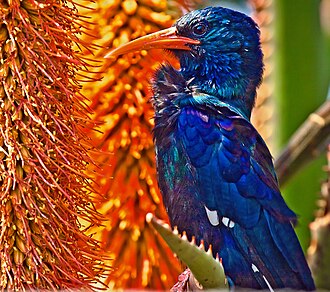
图:Axel Bührmann from Fourways, GAUTENG, South Africa · CC BY-SA 2.0 · Wikimedia Commons
生命之树 › 真核生物 › 动物界 › 真后生动物亚界 › 两侧对称动物 › 后口动物总门 › 脊索动物门 › 脊椎动物亚门 › 有颌下门 › 肉鳍鱼总纲 › 四足形类 › 希望螈目 › 四足总纲 › 爬行动物 › 坚尾龙类 › 鸟纲 › 今鸟亚纲 › 今颚下纲 › 新鸟总目 › 佛法僧总目 › 犀鸟目
林戴胜科科
Phoeniculidae
林戴胜科 是犀鸟目的一个科,现存2属8种,分布于撒哈拉以南的非洲热带地区。体羽具有金属光泽,喙细长侧扁而向下弯曲,以昆虫等为食。擅长在树上攀援。
林戴胜属(Phoeniculus)
绿林戴胜
紫林戴胜
黑嘴林戴胜
白头林戴胜
栗头林戴胜
弯嘴戴胜属(Rhinopomastus)
黑弯嘴戴胜
弯嘴戴胜
小弯嘴戴胜
摘自维基百科「林戴胜科」,CC BY-SA 4.0
- 学名
- Phoeniculidae
- 分类等级
- 科
- 上级类群
- 犀鸟目
- 大类
- 鸟类
- 命名
- 夏尔·吕西安·波拿巴,1831 年
- 数据库
- NCBI 分类 · GBIF
百科正文
- 林戴胜属(Phoeniculus)
- 绿林戴胜(Phoeniculus purpureus)
- 紫林戴胜(Phoeniculus damarensis)
- 黑嘴林戴胜(Phoeniculus somaliensis)
- 白头林戴胜(Phoeniculus bollei)
- 栗头林戴胜(Phoeniculus castaneiceps)
- 弯嘴戴胜属(Rhinopomastus)
- 黑弯嘴戴胜(Rhinopomastus aterrimus)
- 弯嘴戴胜(Rhinopomastus cyanomelas)
- 小弯嘴戴胜(Rhinopomastus minor)
有时将弯嘴戴胜属独立出来为一个科——弯嘴戴胜科(Rhinopomastidae),也有学者主张将林戴胜科和戴胜科一起合为一个目——戴胜目(Upupiformes)。
以上内容摘自维基百科「林戴胜科」,按 CC BY-SA 4.0 使用,去掉了参考文献、外部链接等尾部小节,公式改写成了纯文本。全文、配图和出处见原文。
英文维基百科补充中文条目比较短,下面是英文条目「Wood hoopoe」的原文
The wood hoopoes or scimitarbills are a small African bird family, Phoeniculidae. They live south of the Sahara Desert and are not migratory. While the family is now restricted to Sub-Saharan Africa, fossil evidence shows that it once had a larger distribution. Fossils attributed to this family have been found in Miocene rocks in Germany.
The wood hoopoes are related to the kingfishers, the rollers, and the hoopoe, forming a clade with this last according to Hackett et al. (2008). A close relationship between the hoopoe and the wood hoopoes is also supported by the shared and unique nature of their stapes. The wood hoopoes most resemble the true hoopoes with their long down-curved bills and short rounded wings. According to genetic studies, the two genera, Phoeniculus and Rhinopomastus, appear to have diverged about ten million years ago, so some systematists treat them as separate subfamilies or even separate families.
Description
The wood hoopoes are a morphologically distinct group, unlikely to be mistaken for any other. These species are medium-sized (23–46 centimetres or 9–18 inches long, much of which is the tail). They have metallic plumage, often blue, green or purple, and lack a crest. The sexes are similar in all but two species, the forest wood hoopoe and the common scimitarbill. Their bills are either red or black, although young red-billed species also have black bills and bill colour is correlated with age. The legs are scarlet or black, short, with thick tarsi. They climb tree trunks in the manner of a woodpecker, and when feeding on the ground they hop rather than walking like the true hoopoe. Their tails are long and strongly graduated (the central feathers are the longest), and marked conspicuously with white, as are their wings.
Range and behaviour
These are birds of open woodland, savannah, or thornbrush, and are mainly arboreal. They require large trees both for feeding on as well as to provide hollows for nesting and nocturnal roosting. Two species are found exclusively in rainforest, the forest wood hoopoe and the white-headed wood hoopoe. All the other species are found in more open woodland and bush.
They feed on arthropods, especially insects, which they find by probing with their bills in rotten wood and in crevices in bark. They nest in unlined tree holes, laying two to four eggs, which are blue, grey, or olive, and unmarked in most species.
Hoopoes hunt for prey primarily on the ground as they use their tongue-like beaks to pick up insects on the soil or grass. The Hoopoe's tongue occupy 2/3 length of the beak.
Species
There are eight species.
Family: Phoeniculidae
以上内容摘自英文维基百科「Wood hoopoe」,按 CC BY-SA 4.0 使用,去掉了参考文献、外部链接等尾部小节,公式改写成了纯文本。全文、配图和出处见原文。