 格物

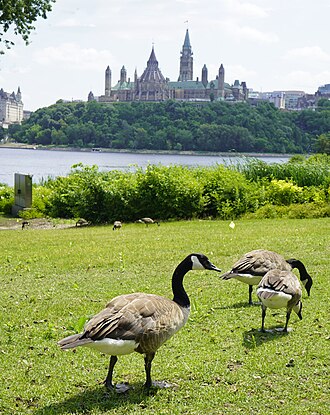
图:Michael Gil from Toronto, ON, Canada · CC BY 2.0 · Wikimedia Commons
- 学名
- Branta
- 分类等级
- 属
- 上级类群
- 雁亚科
- 大类
- 鸟类
- 命名
- 乔瓦尼·安东尼奥·斯科波利,1769 年
- 数据库
- NCBI 分类 · GBIF
下级类群(6)


百科正文
分类
种
该属的种包括:
†Branta hylobadistes:史前化石
以上内容摘自维基百科「黑雁属」,按 CC BY-SA 4.0 使用,去掉了参考文献、外部链接等尾部小节,公式改写成了纯文本。全文、配图和出处见原文。
英文维基百科补充中文条目比较短,下面是英文条目「Branta」的原文
The black geese or white-cheeked geese of the genus Branta are waterfowl belonging to the true goose and swan subfamily Anserinae. They occur in the northern coastal regions of the Palearctic and all over North America, migrating to more southerly coasts in winter, and as resident birds in the Hawaiian Islands. Alone in the Southern Hemisphere, a self-sustaining feral population derived from introduced Canada geese is also found in New Zealand.
The black geese derive their vernacular name for the prominent areas of black coloration found in all species and their secondary name from the markings on their cheeks. They can be distinguished from all other true geese by their legs and feet, which are black or very dark grey. Furthermore, they have black bills and large areas of black on the head and neck, with white (ochre in one species) markings that can be used to tell apart most species. As with most geese, their undertail and uppertail coverts are white. They are also on average smaller than other geese, though some very large taxa are known, which rival the swan goose and the black-necked swan in size.
The Eurasian species of black geese have a more coastal distribution compared to the grey geese (genus Anser) which share the same general area of occurrence, not being found far inland even in winter (except for occasional stray birds or individuals escaped from captivity). This does not hold true for the American and Pacific species, in whose ranges grey geese are, for the most part, absent.
Taxonomy
The genus Branta was introduced by the Austrian naturalist Giovanni Antonio Scopoli in 1769. The name is a Latinised form of Old Norse Brandgás meaning burnt as in "burnt (black) goose". The type species is the brant goose (Branta bernicla).
Ottenburghs and colleagues published a study in 2016 that established the phylogenetic relationships between the species.
Species list
The genus contains six living species.
Two species have been described from subfossil remains found in the Hawaiian Islands, where they became extinct in prehistoric times:
†Nēnē-nui or wood-walking goose, Branta hylobadistes (prehistoric)
Similar but hitherto undescribed remains are also known from Kauaʻi and Oʻahu.
†Giant Hawaii goose, Branta rhuax (prehistoric), formerly Geochen rhuax
The relationships of the enigmatic Geochen rhuax, formerly known only from parts of a single bird's skeleton which was damaged due to apparently dying in a lava flow, were long unresolved. After reexamination of the subfossil material and comparisons with other subfossil bones from the island of Hawaiʻi assigned to the genus Branta, it was redescribed as Branta rhuax in 2013. While a presumed relation between B. rhuax and the shelducks, proposed by Lester Short in 1970, has thus been refuted, bones of a shelduck-like bird have been found more recently on Kaua‘i.
Similarly, two bones found on Oʻahu indicate the erstwhile presence of a gigantic waterfowl on this island. Its relationships relative to this genus and those of the moa-nalos, enormous goose-like dabbling ducks, are completely undeterminable at present.
Early fossil record
Several fossil species of Branta have been described. Since the true geese are hardly distinguishable by anatomical features, the allocation of these to this genus is somewhat uncertain.
- Branta woolfendeni Bickart 1990 (Late Miocene of Arizona, U.S.)
- Branta thessaliensis Boev & Koufos, 2006 (Late Miocene of Perivolaki, Greece)
- Branta dickeyi Miller 1924 (Late Pliocene – Late Pleistocene of Western U.S.)
- Branta esmeralda Burt 1929 (Early Pliocene of Nevada, U.S.)
- Branta howardae Miller 1930 (Early Pliocene of California, U.S.)
- Branta propinqua Shufeldt 1892 (Middle Pleistocene of Fossil Lake, Oregon, U.S.)
- Branta hypsibata (Cope) 1878 (Middle Pleistocene of Fossil Lake, Oregon, U.S.)
The former "Branta" minuscula is now placed with the prehistoric American shelducks, Anabernicula. On the other hand, a goose fossil from the Early to the Middle Pleistocene of El Salvador is highly similar to Anser and, given its age and biogeography, it is likely to belong to either that genus or Branta.
以上内容摘自英文维基百科「Branta」,按 CC BY-SA 4.0 使用,去掉了参考文献、外部链接等尾部小节,公式改写成了纯文本。全文、配图和出处见原文。