格物
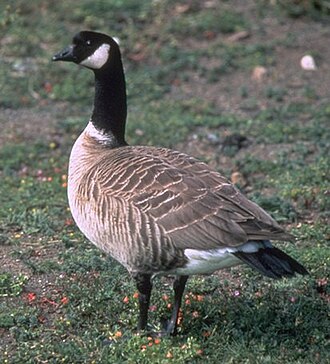
图:Roy Lowe/U.S. Fish and Wildlife Service · Public domain · Wikimedia Commons
- 学名
- Branta hutchinsii
- 分类等级
- 种
- 英文名
- Cackling Goose
- 上级类群
- 黑雁属
- 大类
- 鸟类
- 命名
- 约翰·理查森 (博物学家),1832 年
- 中文别名
- 小加拿大雁
- 保护状况(IUCN)
- 无危物种
- 数据库
- NCBI 分类 · GBIF · IUCN 红色名录
百科正文
描述
小美洲黑雁具明显的黑色的头部和颈部,与及白色“帽带”,同样具有此种特征的种类,只有较大的加拿大雁(Branta canadensis)和相似大小的白颊黑雁(B. leucopsis),可依此特征与所有其他种野雁区分开来。小美洲黑雁有多达5种亚种,其外型大小与羽毛特征都略有不同。雌性外型几乎相同,但重量略轻,叫声也不同。
以往很难将小美洲黑雁与加拿大雁区分开来,两者长期以来被认为是同一个物种,小美洲黑雁和较小的加拿大雁亚种,被称为小的加拿大雁。最小的小美洲黑雁(B. h. minima),重量约1.4千克(3.1磅),远轻于所有的加拿大雁;但理查德森小美洲黑雁(B. h. hutchinsii),重量可达3千克(6.6磅),可与某些加拿大雁相近。
已灭绝的科曼多尔群岛和千岛群岛之种群(B. h. asiatica),与现存的亚种B. h. leucopareia相异与否,目前仍有争议。
白颊黑雁的不同点,在于有黑色的胸部,与及灰色的身体,而非棕色。
以上内容摘自维基百科「小加拿大雁」,按 CC BY-SA 4.0 使用,去掉了参考文献、外部链接等尾部小节,公式改写成了纯文本。全文、配图和出处见原文。
英文维基百科补充中文条目比较短,下面是英文条目「Cackling goose」的原文
The cackling goose (Branta hutchinsii) is a species of goose found in North America and East Asia.
Systematics
The genus name Branta is a Latinised form of Old Norse Brandgás, "burnt (black) goose", and the specific epithet hutchinsii commemorates English surgeon Thomas Hutchins who was employed by the Hudson's Bay Company.
The cackling goose was originally considered the same species or a subspecies of the Canada goose, but in July 2004 the American Ornithologists' Union's (AOU) Committee on Classification and Nomenclature split the two into two species, making cackling goose into a full species with the scientific name Branta hutchinsii. The British Ornithologists' Union (BOU) followed suit in June 2005.
The AOU has divided the many associated subspecies between both animals. To the present species were assigned:
- Richardson's cackling goose (B. h. hutchinsii)
- Aleutian cackling goose (B. h. leucopareia)
- Small cackling goose (B. h. minima)
- Taverner's cackling goose (B. h. taverneri)
†Bering cackling goose (B. h. asiatica)—doubtfully distinct from B. h. leucopareia; extinct (c.1929)
The distinctions between the two geese have led to a great deal of confusion and debate among ornithologists.
Description
The black head and neck with white "chinstrap" distinguish this goose from all other geese except the larger Canada goose (Branta canadensis) and the similarly sized barnacle goose (B. leucopsis). There are up to five subspecies of cackling goose of varying sizes and plumage details. The female looks virtually identical but is slightly lighter and has a different voice. Some are hard to distinguish from the Canada goose, with which the cackling goose was long assumed to form one species, the cackling goose and the smaller Canada goose subspecies being called the lesser Canada goose. The smallest 1.4 kg (3.1 lb) cackling geese (B. h. minima) are much smaller than any Canada goose, but the subspecies B. h. hutchinsii, at up to 3 kg (6.6 lb), grows to the same size as some Canada geese. The distinctness of the extinct population of the Komandorski and Kuril Islands B. h. asiatica is controversial. The barnacle goose differs in having a black breast and grey, rather than brownish, body plumage.
- Measurements:
- Length: 24.8–25.6 in (63–65 cm)
- Weight: 49.3–84.0 oz (1,400–2,380 g)
- Wingspan: 42.5–43.7 in (108–111 cm)
Range
This species is native to North America, breeding in Northern Canada and Alaska in a variety of tundra habitats, where the nest is usually located in an elevated area near water. The eggs are laid in a shallow depression, lined with plant materials and down. However, as the nests are made close-to, or directly on, the ground, the eggs (along with lone nesting females and newly-hatched goslings) are particularly vulnerable to predation by certain mammalian carnivores. Depending on the region, potential threats may vary from free-ranging domestic or feral cats and dogs, to foxes, coyotes, rats and other animals, such as some species of snakes. Thus, as a result, both geese—especially the male—in a nesting pair become highly aggressive and defensive of the nesting site, even chasing people away who may happen to walk by.
A pair may mate for life (up to around 20 years). Adult geese are often seen leading their goslings in a line with one parent at the front, and the other at the back of the "parade".
Like most geese, the cackling goose is naturally migratory, with their overwintering range being most of the U.S.
Feeding
These birds feed mainly on plant material. When feeding in water, they submerge their heads and necks to reach aquatic plants, sometimes tipping forward like a dabbling duck. Flocks of these birds often feed on leftover cultivated grains in fields, especially during migration or in winter. They also eat some insects, molluscs and crustaceans.
Status
By the early 20th century, over-hunting and loss of habitat in the late 19th and early 20th centuries had resulted in a serious decline in the numbers of this bird in its native range. With improved game laws and habitat restoration and preservation programs, their populations have recovered in most of their range, although some local populations may still be declining, especially of the subspecies minima and leucopareia. Though the taxonomic distinctness of the Komandorski and Kuril Islands populations, which used to winter in Japan, is controversial, it is without doubt that they disappeared around 1929.
以上节选摘自英文维基百科「Cackling goose」,按 CC BY-SA 4.0 使用,去掉了参考文献、外部链接等尾部小节,公式改写成了纯文本。篇幅所限,较长的小节只摘了开头一部分,有的小节没有收;全文、配图和出处见原文。