 格物
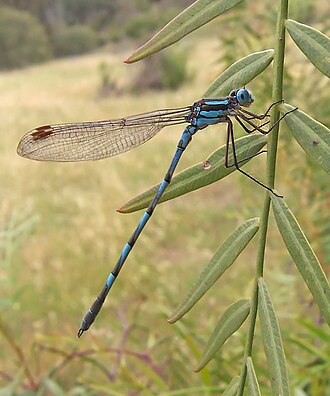
图:Fir0002 · CC BY-SA 3.0 · Wikimedia Commons
- 学名
- Zygoptera
- 分类等级
- 亚目
- 上级类群
- 蜻蜓目
- 大类
- 昆虫
- 命名
- 埃德蒙·德谢利斯·隆尚,1854 年
- 异名
- Cephalozygoptera
- 数据库
- NCBI 分类 · GBIF
分类阶元
- 域真核生物
- 未标等级无定形生物 Amorphea
- 演化支后鞭毛生物 Opisthokonta
- 总界动物总界 Holozoa
- 未标等级蜷丝生物 Filozoa
- 未标等级领鞭毛动物 Choanozoa
- 界动物界 Animalia
- 亚界真后生动物亚界 Eumetazoa
- 未标等级副同源异形基因动物 Parahoxozoa
- 亚界两侧对称动物 Bilateria
- 下界原口动物 Protostomia
- 总门蜕皮动物总门 Ecdysozoa
- 门节肢动物门 Arthropoda
- 未标等级有颚类 Mandibulata
- 未标等级泛甲壳类 Pancrustacea
- 亚门六足亚门 Hexapoda
- 纲昆虫纲 Insecta
- 未标等级双髁类 Dicondylia
- 亚纲有翅亚纲 Pterygota
- 下纲古翅下纲 Palaeoptera
- 总目蜻蛉总目 Odonatoptera
- 目蜻蜓目 Odonata
- 亚目均翅亚目 Zygoptera
下级类群(6)
百科正文
生物特性
豆娘的稚虫水虿生长于水中,身体侧扁长形,尾端有叶片状的尾腮,具有呼吸与运动的功能。隐匿于水草或石块缝隙。
由于豆娘的体态优美、颜色鲜艳,且其翅膀颜色多变,故很多爱好者喜爱观赏。
而蜻蜓与豆娘的主要差别有以下:
眼睛的距离:蜻蜓的复眼大部分是彼此相连或只有小距离的分开;豆娘的两眼有相当大距离的分开,形状如同哑铃一般。
翅膀的形状:属差翅亚目的蜻蜓,其前后翅形状大小不同,差异甚大;属均翅亚目的豆娘,其前后翅形状大小近似,差异较小。
腹部的形状:蜻蜓的腹部形状较为扁平,也较粗;豆娘的腹部形状较为细瘦,呈圆棍棒状。
停栖方式:蜻蜓在停栖时,会将翅膀平展在身体的两侧;一般豆娘在停栖时,会将翅膀合起来直立于背上。
以上内容摘自维基百科「豆娘」,按 CC BY-SA 4.0 使用,去掉了参考文献、外部链接等尾部小节,公式改写成了纯文本。全文、配图和出处见原文。
英文维基百科补充中文条目比较短,下面是英文条目「Damselfly」的原文
Damselflies are flying insects of the suborder Zygoptera in the order Odonata. They are similar to dragonflies, which form the suborder Anisoptera, but are usually smaller and have slimmer bodies. Most species fold the wings along the body when at rest, unlike dragonflies which hold the wings flat and away from the body. Damselflies have existed since the Late Jurassic, and are found on every continent except Antarctica.
All damselflies are predatory insects: both nymphs and adults actively hunt and eat other insects. The nymphs are aquatic, with different species living in a variety of freshwater habitats including acidic bogs, ponds, lakes and rivers. The nymphs moult repeatedly, at the last moult climbing out of the water to undergo metamorphosis. The skin splits down the back, they emerge and inflate their wings and abdomen to gain their adult form. Their presence on a body of water indicates that it is relatively unpolluted, but their dependence on freshwater makes them vulnerable to damage to their wetland habitats.
Some species of damselfly have elaborate courtship behaviours. Many species are sexually dimorphic, the males often being more brightly coloured than the females. Like dragonflies, they reproduce using indirect insemination and delayed fertilisation. A mating pair form a shape known as a "heart" or "wheel", the male clasping the female at the back of the head, the female curling her abdomen down to pick up sperm from secondary genitalia at the base of the male's abdomen. The pair often remain together with the male still clasping the female while she lays eggs within the tissue of plants in or near water using a robust ovipositor.
Artificial fishing flies that mimic damselfly nymphs are used in wet-fly fishing. Damselflies are sometimes represented in personal jewellery such as brooches.
以上节选摘自英文维基百科「Damselfly」,按 CC BY-SA 4.0 使用,去掉了参考文献、外部链接等尾部小节,公式改写成了纯文本。篇幅所限,较长的小节只摘了开头一部分,有的小节没有收;全文、配图和出处见原文。