格物
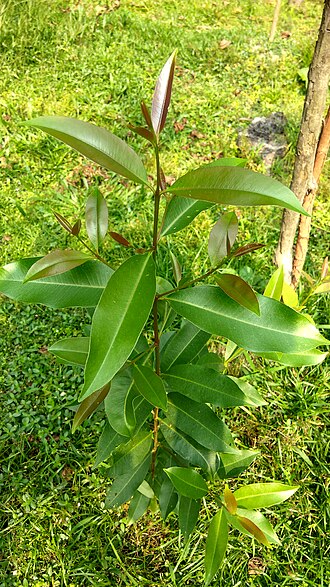
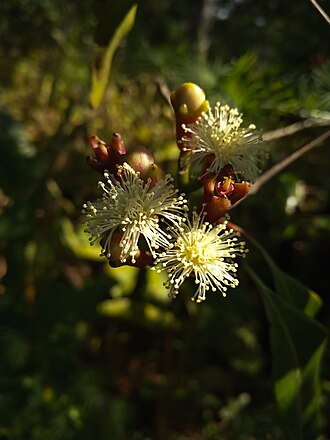
图:কামরুল ইসলাম শাহীন · CC BY-SA 4.0 · Wikimedia Commons
- 学名
- Syzygium cumini
- 分类等级
- 种
- 上级类群
- 蒲桃属
- 大类
- 被子植物
- 命名
- Homer Collar Skeels
- 中文别名
- 堇宝莲、乌墨、乌楣、海南蒲桃、西洋果、野冬青果
- 保护状况(IUCN)
- 无危物种
- 异名
- Caryophyllus corticosus
- 用途
- 药用植物、建筑材料、食物、木材
- 数据库
- NCBI 分类 · GBIF · IUCN 红色名录
百科正文
形态
属多年生乔木,生长缓慢,树长可至三十米,树龄可超过100岁,叶阔椭圆形,对生。花白,芳香。浆果大如雀卵,熟时为紫色或黑色,略酸。
分布
本种分布于南亚及东南亚亚热带及热带地区,包括印度、印度尼西亚、澳大利亚、中南半岛、马来西亚、台湾以至于中国大陆南部及东南沿海如云南、广东、福建一带。
生长于海拔190米至1,800米的地区,多生长在平地次生林和荒地上。
文化
佛教
相传释迦牟尼未出家前,曾在阎浮树下沈思,后决定出家学道,因此为佛教圣树之一。
南赡部洲因为盛产此树而得名。
以上内容摘自维基百科「閻浮樹」,按 CC BY-SA 4.0 使用,去掉了参考文献、外部链接等尾部小节,公式改写成了纯文本。全文、配图和出处见原文。
英文维基百科补充中文条目比较短,下面是英文条目「Syzygium cumini」的原文
Syzygium cumini, also known as Java plum, Malabar plum, jambolan, black plum, jamun, jambul, is an evergreen tropical tree in the flowering plant family Myrtaceae, and favored for its fruit, timber, and ornamental value. It is native to the Indian subcontinent and Southeast Asia. It can reach heights of up to 30 m (100 ft) and can live more than 100 years. A rapidly growing plant, it is considered an invasive species in many world regions.
Syzygium cumini has been introduced to areas including islands of the Pacific and Indian Oceans, Australia, Hong Kong and Singapore.
The tree was introduced to Florida and is grown in tropical and subtropical regions worldwide. Its fruits are eaten by various native birds and small mammals, such as jackals, civets, and fruit bats.
Description
Its dense foliage provides shade and is grown for its ornamental value. At the base of the tree, the bark is rough and dark grey, becoming lighter grey and smoother higher up. The wood is water resistant after being kiln-dried. Because of this, it is used in railway sleepers and to install motors in wells. It is sometimes used to make cheap furniture and village dwellings, though it is relatively hard for carpentry.
The aromatic leaves are pinkish when young, changing to a leathery, glossy dark green with a yellow midrib as they mature. The leaves are used as food for livestock, as they have good nutritional value.
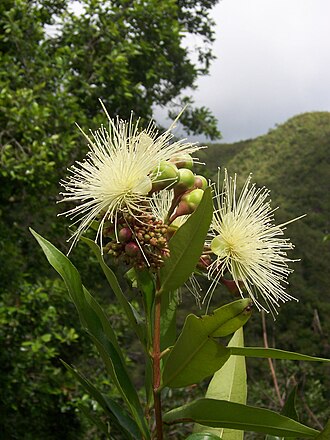
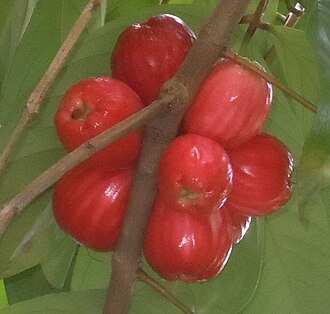
Syzygium cumini trees start flowering from March to April. The flowers are fragrant and small, about 5 mm (0.2 in) in diameter. The fruits develop by May or June and resemble large berries; the fruit of Syzygium species is described as "drupaceous". The fruit is oblong, ovoid. Unripe fruit looks green. As it matures, its color changes to pink, then to shining crimson red and finally to black color. A variant of the tree produces white-coloured fruit.
Distribution
Syzygium cumini is native to the Indian subcontinent (the Andaman Islands, Bangladesh, Nepal, India, Pakistan, Assam state, the Laccadive Islands and Sri Lanka); China (Hainan province, South-Central and Southeast China); Indonesia (Java, the Maluku Islands, Sulawesi); Southeast Asia (Cambodia, Laos, Malaysia, Thailand, Vietnam and Myanmar); Australia (Queensland).
Invasive species
This species is considered invasive in Florida, South Africa, parts of the Caribbean, several islands of Oceania, and Hawaii.
Culinary uses
Jambolan fruits have a sweet or slightly acidic flavor, are eaten raw, and may be made into sauces or jam. Fruits may be made into juice, jelly, sorbet, syrup (e.g., kala khatta), or fruit salad.
Nutrition
Raw fruit is 83% water, 16% carbohydrates, 1% protein, and contains negligible fat. In a reference amount of 100 g (3.5 oz), the raw fruit provides 60 calories and a moderate content of vitamin C, with no other micronutrients in appreciable amounts (table).
Uses
The 1889 book The Useful Native Plants of Australia states that this plant (referred to by the synonym Eugenia jambolana) was called durobbi by some Indigenous Australians. Dietrich Brandis also wrote of the plant:
"The fruit is much eaten by the natives of India: in appearance it resembles a damson, has a harsh but sweetish flavour, somewhat astringent and acid. Is much eaten by birds; a favourite food of the large bat (flying fox). A kind of vinegar is prepared from it, which is used in diseases of the spleen."
The fruit has been used in traditional medicine.
Cultural and religious significance in India
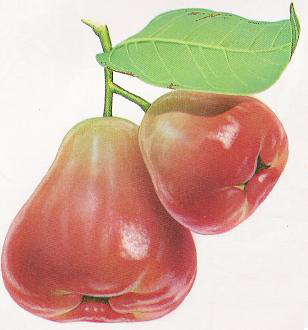
In the Majjhima Nikāya, three parallel texts (MN 36, MN 85 and MN 100) claim that the Buddha remembered an experience of sitting in the cool shade of a jambu tree when he was a child. While his father was working, he entered into a meditative state which he later understood to be the first stage of Jhāna meditation. The texts claim that this was a formative experience, which later encouraged him to explore and practise Jhāna meditation, and that this then led to his Awakening. The Pāli word jambu is understood by Pāli dictionaries to refer to the Syzygium cumini which they often translate as the Rose-apple tree.
Krishna was said to have four symbols of the jambu fruit on his right foot as mentioned in the Srimad Bhagavatam commentary (verse 10.30.25), "Sri Rupa Chintamani" and "Ananda Candrika" by Srila Visvanatha Chakravarti Thakura.
In Maharashtra, Syzygium cumini leaves are used in marriage pandal decorations. A song from the 1977 film Jait Re Jait mentions the fruit in the song "Jambhul Piklya Zaadakhali".
以上节选摘自英文维基百科「Syzygium cumini」,按 CC BY-SA 4.0 使用,去掉了参考文献、外部链接等尾部小节,公式改写成了纯文本。篇幅所限,较长的小节只摘了开头一部分,有的小节没有收;全文、配图和出处见原文。