格物
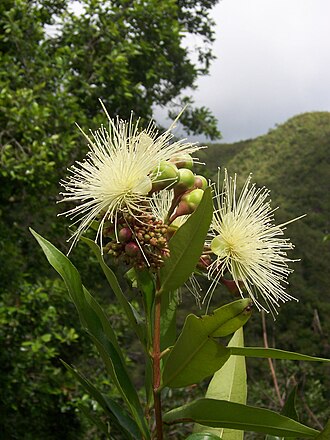
图:B.Navez · CC BY-SA 3.0 · Wikimedia Commons
- 学名
- Syzygium jambos
- 分类等级
- 种
- 上级类群
- 蒲桃属
- 大类
- 被子植物
- 命名
- Arthur Hugh Garfit Alston
- 中文别名
- 水桃树、水石榴、水蒲桃、蒲桃种子、乌墨
- 保护状况(IUCN)
- 无危物种
- 用途
- 果实、药用植物、建筑材料、柴火、食物
- 数据库
- NCBI 分类 · GBIF · IUCN 红色名录
百科正文
蒲桃可以作为防风植物栽培,果实可以食用。泰文说法又称为“古代莲雾”。味道闻起来像莱姆,吃起来清香微甜,属于季节交替才会出现的水果。
形态
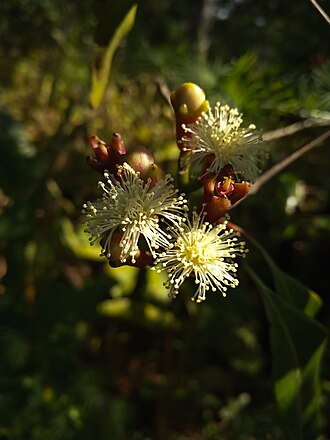
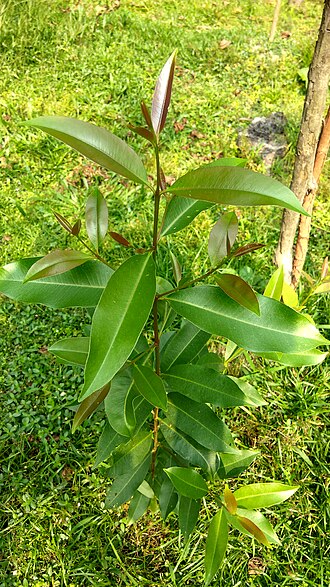
蒲桃叶披针形对生,有透明腺点;夏日开花,白色较大花,雄蕊长,多数;萼片宿存;圆球形或卵形浆果,淡绿色或淡黄色,味道香甜,有1-2粒种子。
以上内容摘自维基百科「蒲桃」,按 CC BY-SA 4.0 使用,去掉了参考文献、外部链接等尾部小节,公式改写成了纯文本。全文、配图和出处见原文。
英文维基百科补充中文条目比较短,下面是英文条目「Syzygium jambos」的原文
Syzygium jambos is a species of rose apple originating in Southeast Asia and occurring widely elsewhere, having been introduced as an ornamental and fruit tree.
Description
Syzygium jambos is a large evergreen shrub or small-to-medium-sized tree, typically 3 to 15 metres (10 to 49 feet) high, with a tendency to low branching. Its leaves and twigs are glabrous and the bark, though dark brown, is fairly smooth too, with little relief or texture. The leaves are lanceolate, 2 to 4 centimetres (3⁄4 to 1+5⁄8 inches) broad, 10 to 20 cm (4 to 8 in) long, pointed, base cuneate with hardly any petiole, lively red when growing, but dark, glossy green on attaining full size. The flowers are in small terminal clusters, white or greenish white, the long, numerous stamens giving them a diameter of 5–8 cm (2–3+1⁄4 in). In temperate regions the tree is summer-flowering.
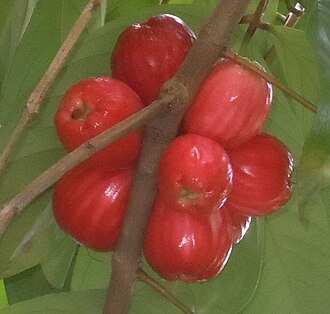
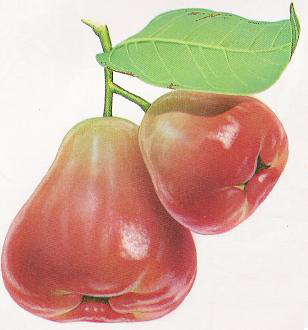
The fruit is shaped like some kinds of guava; in fact, the fruit is so like the guava in appearance that people unfamiliar with it may mistake it for a guava on sight. However, the fragrance, flavour and texture are different, and instead of containing dozens of small, hard seeds set in a jelly-like tissue, as a guava does, the fruit of S. jambos usually contains one or two large, unarmoured seeds about 1 cm in diameter, lying loose in a slightly fluffy cavity when ripe. Shaking a fruit to feel whether the seeds rattle, gives some indication whether it is ripe. The skin is thin and waxy. The flowers are described by some as fragrant, though this appears to be a variable attribute. The ripe fruit, however, has a strong, pleasant floral bouquet, hence such common names as "Rose apple" and "pomarrosa".
Taxonomy
Botanical names
- Syzygium jambos
- Family: Myrtaceae
- Genus: Syzygium
- Species: jambos
- Synonym: Eugenia jambos
- Synonym: Jambosa jambos
- Synonym: Jambosa vulgaris
- Synonym: Myrtus jambos
The tree has variously been allocated to the genus Jambosa, Eugenia and Syzygium, where it now seems to have been permanently accepted. There have been a few species ascribed to it, but currently several varieties with various fruit colours all are recognised as Syzygium jambos.
Common names
Syzygium jambos has several common names, reflecting the large number of regions in which it occurs as a garden or fruit tree or as an invader. The names include ಪನ್ನೇರಳೆ, Guljamun, madhura nelli, Malabar Plum, Panineer Champakka, Mountain Apple (champoo), chom pu or chom-phu. Terms like "plum rose", "water apple", "pera de agua", "Cloud apple", "Wax apple", "Malay apple", "jambrosade", "PauTêe"(Penang Hokkien spelled with Taiwanese Romanisation System), "pomarrosa", or the English equivalent, "rose apple". Several of these names are applied to other species of Syzygium, while "jambu" can also mean a guava. The name Jambu for this fruit is in all likelihood limited to one or two of the twenty-odd major Indian languages, while most other languages use similar words (Jaamun, Jaambhool, etc.) for another fruit, smaller than the rose apple, and dark purple in colour like the fruit of the eggplant. In Bangla, the fruit is called "golap-jaam" (Bengali: গোলাপজাম) and in Odia, it is called "golapajamu" (Odia: ଗୋଲାପଜାମୁ), which literally translate to "rose jaamun", in reference to its distinct aroma. In Karnataka, the English common name is "rose apple", and the vernacular name is Pannerale (Kannada: ಪನ್ನೇರಳೆ; Panneer hannu), while the name for the other one is Nerale. Such a confusion of common names in horticulture is nothing unusual.
In Myanmar, it is called Lily fruit (နှင်းသီး).
In the Philippines, it is locally called as yambo, dambo or tampoy.
Distribution and habitat
It has also been introduced widely on every continent except Antarctica, and it has become established and invasive in several regions. Concern has been expressed because of the threat to various ecosystems, including those on several Hawaiian islands, Réunion, Pitcairn, the Galápagos Islands, parts of Australia and the warmer regions of the Americas. However, in Hawaii, it has been almost wiped out by the introduced rust Puccinia psidii.
Uses
Rich in vitamin C, the fruit can be eaten raw or cooked in various regional recipes. In South-East Asian countries, rose apple fruit is frequently served with spiced sugar.
The wood is dense and accordingly is used as a source of charcoal.
The tree is variously rich in tannins that are of some antimicrobial interest. Some parts of the tree are used in regional traditional medicine.
以上节选摘自英文维基百科「Syzygium jambos」,按 CC BY-SA 4.0 使用,去掉了参考文献、外部链接等尾部小节,公式改写成了纯文本。篇幅所限,较长的小节只摘了开头一部分,有的小节没有收;全文、配图和出处见原文。