格物
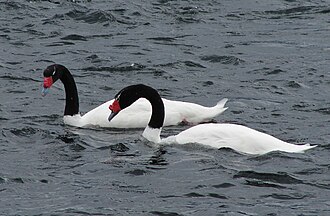
图:Jason Quinn · CC BY-SA 3.0 · Wikimedia Commons
- 学名
- Cygnus melancoryphus
- 分类等级
- 种
- 英文名
- Black-necked Swan
- 上级类群
- 天鹅属
- 大类
- 鸟类
- 命名
- 胡安·伊格纳西奥·莫利纳,1782 年
- 保护状况(IUCN)
- 无危物种
- 数据库
- NCBI 分类 · GBIF · IUCN 红色名录
百科正文
体长1至1.4米,体重3.5-6.7公斤;雄性身型较雌性大。生活于淡水和咸淡水沼泽。
保育状况
它们被列为《濒危野生动植物种国际贸易公约》附录二的物种,被限制出口及贸易。
以上内容摘自维基百科「黑颈天鹅」,按 CC BY-SA 4.0 使用,去掉了参考文献、外部链接等尾部小节,公式改写成了纯文本。全文、配图和出处见原文。
英文维基百科补充中文条目比较短,下面是英文条目「Black-necked swan」的原文
The black-necked swan (Cygnus melancoryphus) is a species of South American waterfowl in the tribe Cygnini of the subfamily Anserinae. It is found in Argentina, Brazil, Chile, Uruguay, and the Falkland Islands. The black-necked swan is the smallest true swan on average, weighing between 3.5–8.7 kg (7.7–19.2 lb) as adults, but it is still the largest species of waterfowl native to South America.
Taxonomy and systematics
The black-necked swan has occasionally been placed by itself in the genus Sthenelides. Its closest relatives are the black swan (C. atratus) and mute swan (C. olor). It is monotypic.
Description
The black-necked swan is the only member of its genus that breeds in the neotropics and is the largest waterfowl native to South America. Adults can range 102 to 126 cm (40 to 50 in) in length. In wingspan, male black-necked swans averaged 160 cm (5.2 ft) in one study. In a separate study, The wingspan of males in two populations was found to range 158–178 cm (5.18–5.84 ft). Out of black-necked swans from the Carlos Anwandter Nature Sanctuary, excluding those in poor body condition, adult males were found to weigh 4.8 to 8 kg (11 to 18 lb) and females 4.1 to 7 kg (9.0 to 15.4 lb). Overall, adults weigh between 3.5–8.7 kg (7.7–19.2 lb). The black-necked swan is the lightest true swan on average.
In appearance, the sexes are alike. Adults' body plumage is white and the neck and head black; the latter usually has a white stripe behind the eye. They have a prominent red knob at the base of their bill.
Distribution and habitat
The black-necked swan is found in the southern tier of South America. It nests from Tierra del Fuego north to central Chile, Uruguay, and Rio Grande do Sul in extreme southern Brazil. It withdraws from the southern half of Argentina in winter and is then found as far north as Brazil's São Paulo state. It is a year-round resident of the Falkland Islands. Vagrants have been found on Juan Fernández Island, the South Orkney Islands, the South Shetland Islands, and the Antarctic Peninsula.
The black-necked swan inhabits freshwater marshes and swamps, shallow lakes, brackish lagoons, and sheltered coastal sites. On the mainland of South America, it is often found near human habitation but shuns built-up areas in the Falklands. It is generally found at low elevations but non-breeding flocks can be found as high as 900 to 1,250 metres (3,000 to 4,100 ft) in the Andes of southern Argentina.
Behavior
Feeding
The black-necked swan's diet is almost entirely vegetarian. It feeds on aquatic plants like Chara, Potamogeton, Typha; algae such as Aphantotece and Rhyzoclonium; and presumably small numbers of aquatic invertebrates. In parts of Chile its principal food is Egeria densa. It forages mostly by immersing its head and neck and by surface feeding, but also upends to reach deeper. In times of drought it has been observed grazing in meadows and pastures.
Breeding
The black-necked swan's breeding season varies geographically. In the far south of its range, it breeds from July to November but ends as early as September in the northern parts. In the Falklands, it breeds between August and November. The exact timing of breeding appears dependent on rainfall. The species is believed to form long-term pair bonds. Its nest is a mound of vegetation constructed by both members of a pair on a small islet or partially floating in a reedbed. The clutch size is four to eight eggs.
Diseases
Black-necked swans can contract avian influenza. In March 2023 influenza A virus subtype H5N1 was detected in black-necked swan populations in Carlos Anwandter Nature Sanctuary, Chile and Estación Tapia, Uruguay. As on May 30, 2023, three more black-necked swans were found dead due to influenza H5N1 in Lagoa da Mangueira, Taim Ecological Station, Brasil. This raises the total at that station to 63.
Status and conservation
The IUCN has assessed the black-necked swan as being of Least Concern. It has a very large range, and though its population size is not known, it is believed to be stable. No immediate threats have been identified. It is widespread and generally common. Large-scale hunting in the 18th and 19th centuries extirpated it from much of Chile but it has recolonized those areas. Some egg collecting and hunting still occur, however. The species occurs in several protected areas in mainland Argentina, in which country the population is estimated at 50,000.
以上节选摘自英文维基百科「Black-necked swan」,按 CC BY-SA 4.0 使用,去掉了参考文献、外部链接等尾部小节,公式改写成了纯文本。篇幅所限,较长的小节只摘了开头一部分,有的小节没有收;全文、配图和出处见原文。