格物
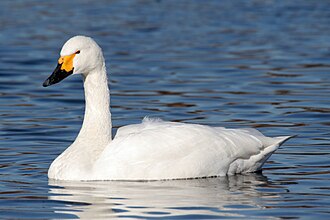
图:Maga-chan · CC BY-SA 2.5 · Wikimedia Commons
- 学名
- Cygnus columbianus
- 分类等级
- 种
- 上级类群
- 天鹅属
- 大类
- 鸟类
- 命名
- 乔治·奥德,1815 年
- 保护状况(IUCN)
- 无危物种
- 异名
- Cygnus bewickii
- 特有于
- 纳姆达帕国家公园
- 体重
- 7.258 千克(成年体重、雄性);6.305 千克(成年体重、雌性)
- 数据库
- NCBI 分类 · GBIF · IUCN 红色名录
百科正文
生态环境
喜欢在泥泞水塘、湖泊或泥滩等生境中活动,常在水中缓慢前进,嘴往两旁甩动以寻找食物。
分布地域
繁殖于北欧及亚洲极北部,在欧洲、中亚、中国的长江流域东南沿海及日本越冬;迁徙时可见于中国的东北、新疆、内蒙古北部。分布于北美洲北部的Whistling Swan(有学者译做"啸声天鹅")也被作为小天鹅的一个亚种。
特征
体型硕大,长颈,和优雅高贵的气质是天鹅属生物共有的特征。与分布地域接近并经常在相似生境混群出现的大天鹅相比,小天鹅体型稍小,并且嘴黑但基部黄色区域较大天鹅小,上嘴侧的黄色不成前尖且嘴上中线黑色,但这一显著特征由于观察条件的限制有时并不能够明确辩识。小天鹅的叫声似大天鹅但音量较大。群鸟合唱声如鹤,为悠远的klah声。
食物
小天鹅主要取食浅水区域的各种水草的根种子地下块茎等部位,偶食少量水生昆虫和田螺等,经剖检发现,小天鹅的胃内多有野藕野菱角水草及大量的砾石。民间有“天鹅一脖子扎到底”的说法,指的就是天鹅的觅食方式,常常是身体浮在水面上,利用修长的脖子深入水中取食。
保护情况
中国国家重点保护等级: 二级 生效年代: 1989年
中国濒危动物红皮书等级: 易危 生效年代: 1996年
濒危因素
环境污染
局部地区如意外的石油泄漏及其它有害化工废水的排放等。天鹅繁殖、栖息多在湖区、沼泽、湿地,由于农牧业发展,有机农药积聚湖区。
栖息地破坏
持续干旱使湖泊水平下降,湿地面积下降,失去觅食和繁殖场所。低湿使食物减少从而导致产卵日期推迟,数量下降,繁殖力下降,成活数下降,使种群数量大幅度下降。农业的发展,造成过度种植、放牧、兴建水库、围湖造田、施放农药和化肥等,造成栖息及觅食场所减少,栖息环境受到破坏。
种内生物学特点
由于迁徙和集群越冬,寄生虫感染率较高。当发生突发性传染性疾病时,传染快,无法控制,易大批死亡。天敌主要威胁卵和幼鸟,如鸥类、狐狸、渡鸦、金雕等。
以上内容摘自维基百科「小天鹅」,按 CC BY-SA 4.0 使用,去掉了参考文献、外部链接等尾部小节,公式改写成了纯文本。全文、配图和出处见原文。
英文维基百科补充中文条目比较短,下面是英文条目「Tundra swan」的原文
The tundra swan (Cygnus columbianus) is a species of swan which breeds in the arctic, and overwinters in North America, Europe, and Asia. It is the smallest of the Holarctic swans, at 115–150 cm (45–59 in) in length, 168–211 cm (66–83 in) in wingspan and 3.4–9.6 kg (7.5–21.2 lb) in weight. Typically, the plumage of adults is entirely white, with solid black feet, a black beak that has varying amounts of yellow, and a thin streak of pink along the mouthline, although colour variation is common.
In the summer, they mainly eat aquatic vegetation, while at other times of year they often eat leftover crops, such as potatoes. They have few natural predators, although sometimes Arctic foxes, parasitic jaegers, and glaucous gulls will prey upon their eggs and chicks. Their main cause of death is poaching. During the breeding season, tundra swans become aggressive, and may attack passing animals and other tundra swans; outside of the breeding season, they can form groups. They make a high-pitched honk, similar to a black goose.
Tundra swans live for an average of 10 years in the wild. They mate in spring, and are monogamous, mating for life. In May, they build a nest beside water using plant material, and lay 2–7 eggs, which incubate for about 30 days. The young fledge quickly after 60–75 days, twice as fast as the young of mute swans. They remain with their parents for their first winter migration. Sometimes, in their winter grounds, the families are joined offspring from previous breeding seasons.
Taxonomy
C. columbianaus contains 2 subspecies, which are also sometimes considered their own species: Bewick's swan (Cygnus bewickii) of the Palaearctic and the whistling swan (C. columbianus) proper of the Nearctic. Birds from eastern Russia (roughly east of the Taymyr Peninsula) were sometimes separated as the subspecies C. c. jankowskii, but this is not widely accepted as distinct, with most authors including it in C. c. bewickii.
Etymology
Bewick's swan was named in 1830 by William Yarrell after the engraver Thomas Bewick, who specialised in illustrations of birds and animals.
Description
C. columbianus is the smallest of the Holarctic swans, at 115–150 cm (45–59 in) in length, 168–211 cm (66–83 in) in wingspan and a weight range of 3.4–9.6 kg (7.5–21.2 lb). In adult birds, the plumage of both subspecies is entirely white, with black feet, and a bill that is mostly black, with a thin salmon-pink streak running along the mouthline and – depending on the subspecies – more or less yellow in the proximal part. The iris is dark brown. In birds living in waters that contains large amounts of iron ions (e.g. bog lakes), the head and neck plumage acquires a golden or rusty hue.
Distribution
As their common name implies, the tundra swan breeds in the tundra of the Arctic and subarctic, where they inhabit shallow pools, lakes and rivers. These birds, unlike mute swans (C. olor) but like the other Arctic swans, are migratory birds. The winter habitat of both subspecies is grassland and marshland, often near the coast; they like to visit fields after harvest to feed on discarded grains and while on migration may stop over on mountain lakes. According to National Geographic, when migrating these birds can fly at altitudes of 8 km (5.0 mi) in a V formation.
Ecology and biology
About 15% of the adults die each year from various causes, and thus the average lifespan in the wild is about 10 years. The oldest recorded tundra swan was over 24 years old.
Diet
In summer, their diet consists mainly of aquatic vegetation, e.g. mannagrass (Glyceria), Potamogeton pondweeds and marine eelgrass (Zostera), acquired by sticking the head underwater or upending while swimming; they also eat some grass growing on dry land. At other times of year, leftover grains and other crops such as potatoes, picked up in open fields after harvest, make up much of their diet.
Conservation status
The whistling swan is the most common swan species of North America, estimated to number almost 170,000 individuals around 1990. Its numbers seem to be slowly declining in the west of its range since the late 19th century, coincident with the expansion of human settlement and habitat conversion in the birds' wintering areas; the eastern whistling swan populations on the other hand seem to be increasing somewhat, and altogether its numbers seem to have slightly risen in the late 20th century (the population was estimated at 146,000 in 1972).
以上节选摘自英文维基百科「Tundra swan」,按 CC BY-SA 4.0 使用,去掉了参考文献、外部链接等尾部小节,公式改写成了纯文本。篇幅所限,较长的小节只摘了开头一部分,有的小节没有收;全文、配图和出处见原文。