 格物
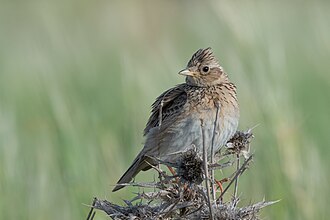
图:El Golli Mohamed · CC BY-SA 4.0 · Wikimedia Commons
生命之树 › 真核生物 › 动物界 › 真后生动物亚界 › 两侧对称动物 › 后口动物总门 › 脊索动物门 › 脊椎动物亚门 › 有颌下门 › 肉鳍鱼总纲 › 四足形类 › 希望螈目 › 四足总纲 › 爬行动物 › 坚尾龙类 › 鸟纲 › 今鸟亚纲 › 今颚下纲 › 新鸟总目 › 雀形目 › 鸣禽亚目 › 百灵科 › 云雀属
云雀种
Alauda arvensis
云雀 又称叫天子、告天子、告天鸟、阿兰、大鹨、天鹨、朝天子等,隶属于雀形目,百灵科。云雀体形似蒙古百灵,但个体较小,体长约19cm 左右,上体黑褐色,翅、尾各羽外缘淡棕色。最外侧一对尾羽近纯白色,紧挨着的一对外羽瓣为白色。下体白色,胸部淡棕色并有多数黑褐色斑点。其生活习性与蒙古百灵基本相似,云雀羽色虽不华丽,但鸣声婉转,歌声嘹亮,能与蒙古百灵媲美,素有“南灵”之称,是中国著名的笼鸟,在国外也深受养鸟者欢迎。
摘自维基百科「云雀」,CC BY-SA 4.0
- 学名
- Alauda arvensis
- 分类等级
- 种
- 英文名
- Eurasian Skylark
- 上级类群
- 云雀属
- 大类
- 鸟类
- 命名
- 卡尔·林奈,1758 年
- 保护状况(IUCN)
- 无危物种
- 数据库
- NCBI 分类 · GBIF · IUCN 红色名录
百科正文
形态特征
云雀属于小型鸣禽,体长大约15~20厘米。雌雄羽色相似,上体沙棕色或皮黄色,有的沾有灰褐色、具黑褐色羽干纹,其中头、枕、后颈及尾上覆羽黑褐色干羽较细,背部黑褐色羽干纹较粗。羽缘棕色或红棕色,头顶羽毛稍延长形成短的羽冠,具细纹,受惊时羽冠耸起较明显。眼先和眉纹白色或棕白色,颊和耳羽淡棕色杂以黑色细纹。翅上覆羽黑褐色具棕色羽缘和先端。飞羽黑褐色,尾上覆羽水棕色,最外侧一对飞羽近白色。其余尾羽黑褐色具白色羽缘。下体白色,胸多棕白色密缀黑褐色羽干纹,两胁微沾棕色,有的亦具棕褐色纵纹。内侧飞羽(三级飞羽)较长;尾羽中等长度,具浅叉,外侧尾羽常具白色。虹膜深褐色;嘴黑褐色;脚肉褐色。
与鹨类的区别在尾及腿均较短,具羽冠且立势不如其直。与日本云雀容易混淆。与小云雀易混淆但体型较大,后翼缘较白且叫声也不同。
大小量度:体重♂23~45g,♀25~40g;体长♂151~192mm,♀163~189mm;嘴峰♂10~13mm,♀10~13mm;翅♂102~118mm,♀98~116mm;尾♂62~81mm,♀63~78mm;跗跖♂20~26mm,♀20~26mm。(注:♂雄性;♀雌性)
以上内容摘自维基百科「云雀」,按 CC BY-SA 4.0 使用,去掉了参考文献、外部链接等尾部小节,公式改写成了纯文本。全文、配图和出处见原文。
英文维基百科补充中文条目比较短,下面是英文条目「Eurasian skylark」的原文
The Eurasian skylark (Alauda arvensis), commonly referred to in Europe as the lark, is a passerine bird in the lark family, Alaudidae. It is a widespread species found across Europe and the Palearctic with introduced populations in Australia, New Zealand, Canada, and on the Hawaiian Islands. It is a bird of open farmland and heath, known for the song of the male, which is delivered in hovering flight from heights of 50 to 100 metres (160 to 330 ft). The sexes are alike. It is streaked greyish-brown above and on the breast and has a buff-white belly.
The female Eurasian skylark builds an open nest in a shallow depression on open ground well away from trees, bushes and hedges. She lays three to five eggs which she incubates for around 11 days. The chicks are fed by both parents but leave the nest after eight to ten days, well before they can fly. They scatter and hide in the vegetation but continue to be fed by the parents until they can fly at 18 to 20 days of age. Nests are subject to high predation rates by larger birds and small mammals. The parents can have several broods in a single season.
Taxonomy and systematics
The Eurasian skylark was described by the Swedish naturalist Carl Linnaeus in 1758 in the tenth edition of his Systema Naturae and retains its original binomial name of Alauda arvensis. It is one of the four species placed in the genus Alauda. The genus name is from the Latin alauda, "lark". Pliny thought the word was originally of Celtic origin. The specific arvensis is also Latin, and means "of the field". The results of a molecular phylogenetic study of the lark family Alaudidae published in 2013 suggested that Eurasian skylark is most closely related to the Oriental skylark Alauda gulgula.
Description
The Eurasian skylark is 18–19 cm (7.1–7.5 in) in length. Like most other larks, the Eurasian skylark is a rather dull-looking species, being mainly brown above and paler below. It has a short blunt crest on the head, which can be raised and lowered. In flight it shows a short tail and short broad wings. The tail and the rear edge of the wings are edged with white, which are visible when the bird is flying away, but not if it is heading towards the observer. The male has broader wings than the female.
Distribution and habitat
This lark breeds across most of Europe and Asia and in the mountains of north Africa. It is mainly resident in the west of its range, but eastern populations are more migratory, moving further south in winter. Even in the milder west of its range, many birds move to lowlands and the coast in winter. Asian birds, subspecies A. a. pekinensis, appear as vagrants in Alaska.
Introduced populations
In the 19th century multiple batches of Eurasian skylarks were released in New Zealand beginning in 1864 in Nelson (in the South Island) and in 1867 in Auckland (in the North Island). The wild population increased rapidly and had spread throughout both the North and South Islands by the 1920s.
Behaviour and ecology
Breeding
Eurasian skylarks first breed when they are one year of age. Nesting may start in late March or early April. The nest is probably built by the female alone and is a shallow depression in the ground lined with grasses. The clutch is 3 to 5 eggs. The eggs of the nominate subspecies average 23.4 mm × 16.8 mm (0.92 in × 0.66 in) in size and weigh around 3.35 g (0.118 oz). They have a grey-white or greenish background and are covered in brown or olive spots. They are incubated only by the female beginning after the last egg is laid and hatch synchronously after 11 days.
In culture
When the word "lark" is used without specification, it usually refers to this species. A collective noun for Eurasian skylarks is an "exaltation". Although the Oxford English Dictionary describes this usage as "fanciful", it traces it back to a quotation from John Lydgate dating from about 1430. The verb "skylark", originally used by sailors, means "play tricks or practical jokes; indulge in horseplay, frolic". The verb and noun "lark", with similar meaning, may be related to "skylark" or to the dialect word "laik" (New Shorter OED).
以上节选摘自英文维基百科「Eurasian skylark」,按 CC BY-SA 4.0 使用,去掉了参考文献、外部链接等尾部小节,公式改写成了纯文本。篇幅所限,较长的小节只摘了开头一部分,有的小节没有收;全文、配图和出处见原文。