格物
- 学名
- Corvus brachyrhynchos
- 分类等级
- 种
- 英文名
- American Crow
- 上级类群
- 鸦属
- 大类
- 鸟类
- 命名
- 克里斯蒂安·路德维希·布雷姆,1822 年
- 保护状况(IUCN)
- 无危物种
- 数据库
- NCBI 分类 · GBIF · IUCN 红色名录
百科正文
短嘴鸦的平均体重约为496.1克。栖息地包括温带草原、亚热带或热带的(低地)干燥疏灌丛、牧草地、亚热带或热带的湿润低地林、寒带疏灌丛、温带疏灌丛、亚热带或热带的(低地)干草原和亚热带或热带严重退化的前森林。
分类
短嘴鸦的西北亚种分布在阿拉斯加南部的海岸地区及离岸岛屿,南经英属哥伦比亚至华盛顿,曾被视为单独的物种西北鸦(学名:Corvus caurinus),分布在北美洲西北部,体型及脚较为细小,喙也较幼长,叫声也明显不同。
以上内容摘自维基百科「短嘴鸦」,按 CC BY-SA 4.0 使用,去掉了参考文献、外部链接等尾部小节,公式改写成了纯文本。全文、配图和出处见原文。
英文维基百科补充中文条目比较短,下面是英文条目「American crow」的原文
The American crow (Corvus brachyrhynchos) is a large passerine bird species of the family Corvidae. It is a common bird found throughout much of North America, only absent from the tundra biome. The American crow is the New World counterpart to the carrion crow and the hooded crow of Eurasia, occupying similar ecological niches.
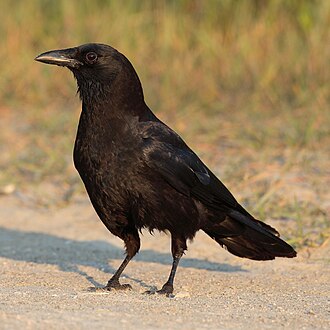
The American crow has all-black plumage, with iridescent feathers. It looks similar to other all-black corvids. It is highly intelligent, similar to other Corvidae, and is adaptable to human environments.
The American crow can be distinguished from the common raven by its smaller size and a slightly less pronounced beak, and from the carrion crow by its size, as the carrion crow is larger and of a stockier build. The American crow can be difficult to distinguish from the fish crow; however, the fish crow tends to fluff its throat feathers when calling. The American crow is an omnivore, feeding on insects, seeds, and nuts while also preying on small animals. It also rarely feeds on carrion, leading to associations with death, thieves, and bad luck in some cultures; however, in Native American and some Gaelic cultures, crows are considered good luck due to their intelligence.
The American crow is common, widespread, and susceptible to the West Nile virus, making it a useful bioindicator for tracking the virus's spread. Direct transmission of the virus from crows to humans is impossible. According to BirdLife International, there are 31 million American crows as of 2012.
Taxonomy and systematics
The American crow was described by German ornithologist Christian Ludwig Brehm in 1822. Its scientific name means literally 'short-billed crow', from Ancient Greek βραχυ- brachy- ('short-') and ρυνχος rhynchos ('billed').
A 2012 genetic analysis of the genus Corvus calculated that the American crow diverged from a lineage that gave rise to the collared, carrion, and hooded crows around 5 million years ago.
"American crow" has been designated the official name by the International Ornithologists' Union (IOU).
Description
The American crow is a large, distinctive bird with iridescent black feathers all over. Its legs, feet, and bill are also black. They measure 40–53 cm (16–21 in) in length, of which the tail makes up about 40%. The wing chord is 24.5 to 33 cm (9.6 to 13.0 in), with the wingspan ranging from 85 to 100 cm (33 to 39 in). The bill length can be from 3 to 5.5 cm (1.2 to 2.2 in), varying strongly according to location. The tarsus is 5.5 to 6.5 cm (2.2 to 2.6 in) and the tail is 13.5 to 19 cm (5.3 to 7.5 in). The body mass can vary from 316 to 620 g (11.1 to 21.9 oz).
Behavior and ecology
Studying the behavior of American crows is laborious due to the difficulty in catching them, resulting in much of their behavior, including daily routine, migration, molting, survivorship, age of first breeding, nestling development, and the nature of nesting helpers, being poorly studied.
Diet
The American crow is omnivorous. It will feed on invertebrates of all types, carrion, scraps of human food, fruits, nuts such as walnuts and almonds, seeds, eggs and nestlings, stranded fish on the shore, and various grains.
Status and management
The intelligence and adaptability of the American crow have insulated it from threats, and it is instead considered an agricultural pest. In 2012, BirdLife International estimated the American crow population to be around 31 million. The large population and vast range result in the least concern status for the American crow, meaning that the species is not threatened with extinction.
Crows have been killed in large numbers by humans, both for recreation and as part of organized campaigns of extermination.
Role in human cultures
Crows are used as a motif in some human cultures, often associated with death, thieves, graveyards, bad luck, and other negative connotations. American crows are sometimes considered a pest, often due to their loud calls. However, in other cultures, like Native American folklore, crows are considered good luck, noted for their intelligence. Similarly, they are also seen by some neo-pagan and indigenous cultures as signs of good luck or even signs of certain gods, such as Apollo, Odin, and others.
以上节选摘自英文维基百科「American crow」,按 CC BY-SA 4.0 使用,去掉了参考文献、外部链接等尾部小节,公式改写成了纯文本。篇幅所限,较长的小节只摘了开头一部分,有的小节没有收;全文、配图和出处见原文。