格物

图:Frank Vassen from Brussels, Belgium · CC BY 2.0 · Wikimedia Commons
- 学名
- Corvus albus
- 分类等级
- 种
- 英文名
- Pied Crow
- 上级类群
- 鸦属
- 大类
- 鸟类
- 命名
- 菲利普·路德维希·施塔蒂乌斯·米勒,1776 年
- 保护状况(IUCN)
- 无危物种
- 体重
- 21.8 克(出生体重)
- 数据库
- NCBI 分类 · GBIF · IUCN 红色名录
百科正文
分布地区
津巴布韦、加蓬、赞比亚、埃塞俄比亚、南非、几内亚比绍、厄立特里亚、贝宁、塞内加尔、尼日尔、乍得、马里、科特迪瓦、安哥拉、索马里、赤道几内亚、毛里塔尼亚、斯威士兰、卢旺达、喀麦隆、塞舌尔、科摩罗、英属印度洋领地(引进种)、纳米比亚、塞拉利昂、加纳、中非共和国、吉布提、尼日利亚、利比里亚、也门、肯尼亚、坦桑尼亚、布隆迪、刚果民主共和国、博茨瓦纳、刚果、几内亚、冈比亚、马约特、苏丹、马拉维、马达加斯加、布基纳法索、多哥、乌干达、莱索托和莫桑比克。
栖息地
非洲白颈鸦的平均体重约为551.5克。栖息地包括温带草原、淡水泉、绿洲、亚热带或热带的(低地)干燥疏灌丛、牧草地、城市、亚热带或热带的旱林、亚热带或热带的(低地)干草原、耕地、淡水湖、污水处理区、干燥的稀树草原、河流、溪流、亚热带或热带的高海拔草原、乡村花园和种植园。
以上内容摘自维基百科「非洲白颈鸦」,按 CC BY-SA 4.0 使用,去掉了参考文献、外部链接等尾部小节,公式改写成了纯文本。全文、配图和出处见原文。
英文维基百科补充中文条目比较短,下面是英文条目「Pied crow」的原文
The pied crow (Corvus albus) is a widely distributed African bird species in the crow genus of the family Corvidae.
Structurally, the pied crow is better thought of as a small crow-sized raven, especially as it can hybridise with the Somali crow (dwarf raven) where their ranges meet in the Horn of Africa. Its behaviour, though, is more typical of the Eurasian carrion crows, and it may be a modern link (along with the Somali crow) between the Eurasian crows and the common raven.
Description
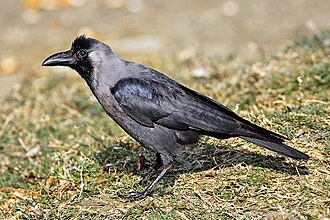
It is about the size of the European carrion crow or a little larger (46–50 cm in length), but has a proportionately larger bill, slightly longer tail and wings, and longer legs. As its name suggests, its glossy black head and neck are interrupted by a large area of white feathering from the shoulders down to the lower breast. The tail, bill, and wings are black, too. Its eyes are dark brown. The white plumage of immature birds is often mixed with black. It resembles the white-necked and thick-billed ravens, but has a much smaller bill.
Measurements
- Length 46 – 52 cm
- Wing 328 to 388 mm (17 unsexed birds)
- Weight 520 g
Identification
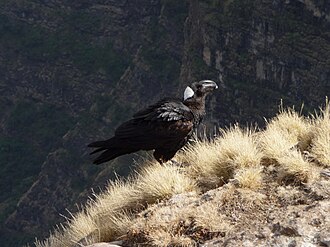
In southern Africa, its range overlaps with the white-necked raven. The pied crow is slightly smaller and has a white chest and belly with a black, more delicate beak compared to the black chest and belly of the larger white-necked raven, which also has a white-tipped and weightier beak.
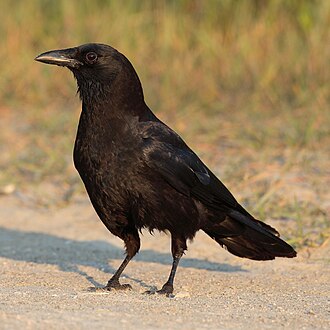
It is larger than the black crow.
Voice
The voice is often described as a harsh ar-ar-ar-ar or karh-karh-karh.
Taxonomy
The pied crow was first described in 1776 by Statius Muller. Its specific name is the Latin adjective albus, meaning "white".
The Maasai people call it ol-korrok from the sound of its call. It is considered annoying, but not a bird of ill omen.
Distribution and habitat
This species, Africa's most widespread member of the genus Corvus, can be found in sub-Saharan Africa, specifically Nigeria, Ghana, Senegal, Sudan, Somalia, Eritrea, Zambia, Botswana, Mozambique and Zimbabwe, South Africa and on the large island of Madagascar, the Comoros Islands, Aldabra, Assumption Island, Cosmoledo, Astove Island, Zanzibar, Pemba, and Fernando Po. It does not occur in the equatorial rainforest region. It inhabits mainly open country with villages and towns nearby. This bird is rarely seen very far from human habitation, though it is not as tied to the urban way of life as the house crow (Corvus splendens) of Asia, and may be encountered far from human habitation in Eritrea.
Behaviour
Pied crows are generally encountered in pairs or small groups, although an abundant source of food may bring together large numbers of birds. The species behaves in a similar manner to the hooded and carrion crows. In Dakar, birds have been observed mobbing passing ospreys and snake eagles, but avoiding black kites.
Diet
All of its food is obtained from the ground, trees, etc., including injured wildlife such as insects and other small invertebrates, small reptiles, small mammals, young birds and eggs, grain, peanuts, carrion, and any scraps of human food and fruit. It has been recorded killing and eating roosting fruit bats, and is frequently seen (sometimes in huge numbers) scavenging around slaughterhouses.
Digestion in the small intestine
The small intestines within the African pied crows include duodena, jejuna, and ilea, which are vital components for nutrient absorption, such as fats, proteins, and carbohydrates consumed by the crow.
Pancreatic ducts and two bile ducts make up the duodenum, so provide greater support for nutrient digestion. The wall of the small intestine is lined with four main tunics - tunica mucosa, tunica submucosa, tunica musclaris, and tunica serosa. The primary purpose of the said tunics is to protect the inner environment of the small intestine against foreign invaders that could otherwise harm the crow.
Pied crows tend to operate with restricted digestive capacity despite being capable of consuming greater than half their body weight of food per day. To maintain their slender weight, these birds rely on this reduced digestive capacity to aid in food regulation to ensure they can fly swiftly.
Pied crows obtain a characteristic looping and spiraling of their small intestines, which enhances their digestion and absorption of nutrients. These birds also obtain restricted gut retention time for food, but to combat this, they also have increased mucosal surface area evident within their digestive tracts.
Reproduction
The nest is usually built in tall, isolated trees, though sometimes smaller specimens are used, depending on availability.
以上节选摘自英文维基百科「Pied crow」,按 CC BY-SA 4.0 使用,去掉了参考文献、外部链接等尾部小节,公式改写成了纯文本。篇幅所限,较长的小节只摘了开头一部分,有的小节没有收;全文、配图和出处见原文。