格物
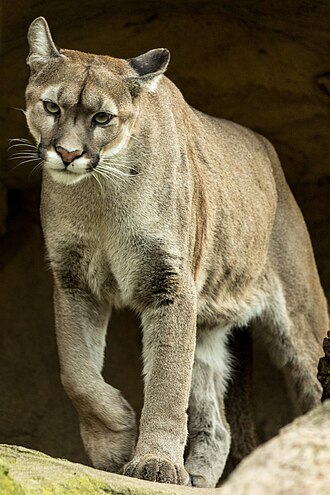
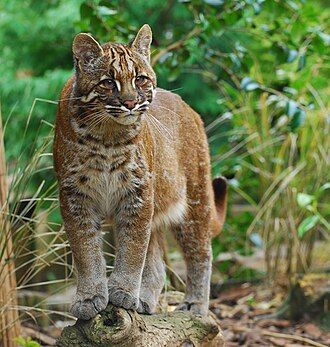
图:Carlos · CC BY 2.0 · Wikimedia Commons
- 学名
- Puma
- 分类等级
- 属
- 上级类群
- 猫亚科
- 大类
- 哺乳动物
- 命名
- 第七代男爵威廉·贾丁爵士,1834 年
- 数据库
- NCBI 分类 · GBIF
下级类群(3)
- 美洲金猫属 Puma concolor 种
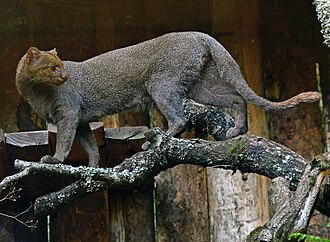
- 细腰猫 Puma yagouaroundi 种
- Puma pardoides 种
百科正文
下属物种
本属包括以下物种:
美洲狮 Puma concolor (Linnaeus, 1771)
细腰猫 Puma yagouaroundi (É.Geoffroy Saint-Hilaire, 1803)
欧亚美洲狮 Puma pardoides †
Puma pumoides †
以上内容摘自维基百科「美洲金猫属」,按 CC BY-SA 4.0 使用,去掉了参考文献、外部链接等尾部小节,公式改写成了纯文本。全文、配图和出处见原文。
英文维基百科补充中文条目比较短,下面是英文条目「Puma (genus)」的原文
Puma ( or) is a genus in the family Felidae whose only extant species is the cougar (also known as the puma, mountain lion, and panther, among other names), and may also include several poorly known Old World fossil representatives (for example, Puma pardoides, or Owen's panther, a large, cougar-like cat of Eurasia's Pliocene). In addition to these potential Old World fossils, a few New World fossil representatives are possible, such as Puma pumoides and the two species of the so-called "American cheetah", currently classified under the genus Miracinonyx.
Description
Pumas (also commonly known as cougars and mountain lions) are large, secretive cats. They are able to reach larger sizes than some other "big" cat individuals. Despite their large size, they are more closely related to smaller feline species than to lions or leopards. The two subspecies of pumas have similar characteristics but tend to vary in color and size. Pumas are the most adaptable felines in the Americas and are found in a variety of different habitats, unlike other cat species.
Distribution and habitat
Members of the genus Puma are primarily found in the mountains of North and South America, where a majority of individuals can be found in rocky crags and pastures lower than the slopes grazing herbivores inhabit. Though they choose to inhabit those areas, they are highly adaptive and can be found in a large variety of habitats, including forests, tropical jungle, grasslands, and even arid desert regions. With the expansion of human settlements and land clearance, the cats are being pushed into smaller, more hostile areas. However, their high adaptability will likely allow them to avoid disappearing from the wild forever.
Anatomy and appearance
Subspecies of the genus Puma include cats that are the fourth-largest in the cat family. Adult males can reach around 7.9 feet (2.4 m) from nose to tip of tail, and a body weight typically between 115 and 220 pounds (52 and 100 kg). Females can reach around 6.7 feet (2.0 m) from nose to tail, and a body weight between 64 and 141 pounds (29 and 64 kg). They also have tails ranging from 25 to 37 inches (0.6 to 0.9 m) long. The heads of these cats are round, with erect ears. They have powerful forequarters, necks, and jaws which help grasp and hold prey. They have four retractable claws on both fore and hind paws.
The majority of pumas are found in more mountainous regions, so they have a thick fur coat to help retain body heat during freezing winters. Depending on subspecies and the location of their habitat, the puma's fur varies in color from brown-yellow to grey-red. Individuals that live in colder climates have coats that are more grey than individuals living in warmer climates with a more red color to their coat. Pumas are incredibly strong and fast predators with long bodies and powerful short legs. The hindlimbs are larger and stronger than the forelimbs, enabling them to be great leapers. They are able to leap as high as 18 feet (5 m) into the air and as far as 40 to 45 feet (12 to 14 m) horizontally.
Conservation
Although they have been pushed into smaller habitats by human settlement expansion, members of the genus have been designated least-concern species by the IUCN, indicating low risk of becoming extinct in their natural environments in the near future. This is due to their high adaptiveness to changing habitat conditions. In fact, many feel the pumas' ability to adapt to different environments explains their current numbers. However, in many large metropolitan areas such as Los Angeles, California, pumas' habitats have been fragmented by urban development and massive freeways. These barriers have made it nearly impossible for populations of mountain lions in specific areas of mountain ranges to reach one another to breed and increase genetic diversity. While populations remain, the proportion of kittens that are inbred is rising every year. This poses a threat to these already-reduced communities of mountain lions that are forced to adapt quickly to ever-shrinking habitats and increasingly frequent run-ins with humans. Many researchers from the National Park Service are using their findings to propose ideas to cities like Los Angeles, which harbors large populations of urban wildlife, to increase conservation efforts in areas on both sides of freeways, and begin the process of building wildlife crossings for wildlife to safely cross freeways.
以上节选摘自英文维基百科「Puma (genus)」,按 CC BY-SA 4.0 使用,去掉了参考文献、外部链接等尾部小节,公式改写成了纯文本。篇幅所限,较长的小节只摘了开头一部分,有的小节没有收;全文、配图和出处见原文。