格物
- 学名
- Acinonyx
- 分类等级
- 属
- 上级类群
- 猫亚科
- 大类
- 哺乳动物
- 命名
- 乔舒亚·布鲁克斯,1828 年
- 异名
- Cynailurus
- 数据库
- NCBI 分类 · GBIF
下级类群(2)
百科正文
历史分布
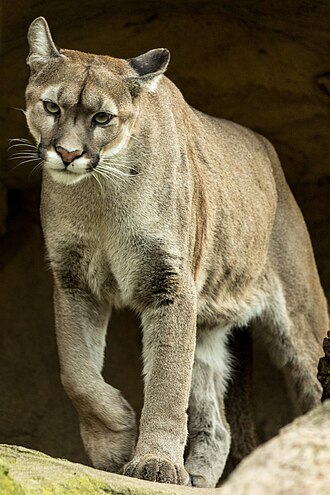
猎豹属的成员最早出现于上新世晚期的非洲、欧洲与亚洲,在10,000年前除了猎豹以外的其他成员均已绝种。在北美洲有外形相似的北美猎豹,然而北美猎豹在血缘关系上其实更近似于美洲狮。
分类
猎豹属最早由乔舒亚·布鲁克斯于1828年提出。在1993年,猎豹属被放入单系群 Acinonychini 之下。然而分子系统发生学显示猎豹属为美洲金猫属的姐妹群,因此现今将猎豹属归于猫亚科之下。
- 在 18 世纪晚期至 20 世纪早期之间,共描述了以下这些猎豹的种与亚种:
- 猎豹 Acinonyx jubatus — Schreber 1775
- 东南非猎豹 Acinonyx jubatus jubatus — 指名亚种
亚洲猎豹 Acinonyx jubatus venaticus — Griffith, 1821
东北非猎豹 Acinonyx jubatus soemmeringii — Fitzinger, 1855
西北非猎豹 Acinonyx jubatus hecki — Hilzheimer 1913
令外,也有发现以下猎豹属的化石种:
巨猎豹 Acinonyx pardinensis † — Croizet et Jobert 1828
间猎豹 Acinonyx intermedius † — Thenius 1954
Acinonyx aicha † — Geraads 1997
Acinonyx kurteni † — Christiansen et Mazák 2008:在中国地质年代为上新世的地层发现一具颅骨,被认为是猎豹属最古老的成员。然而于 2012 年,A. kurteni 遭到除名,因为其模式标本被发现是由数个中新世化石碎片所拼凑而成的伪造品。
以上内容摘自维基百科「獵豹屬」,按 CC BY-SA 4.0 使用,去掉了参考文献、外部链接等尾部小节,公式改写成了纯文本。全文、配图和出处见原文。
英文维基百科补充中文条目比较短,下面是英文条目「Acinonyx」的原文
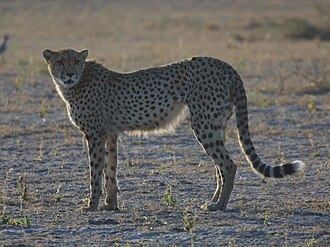
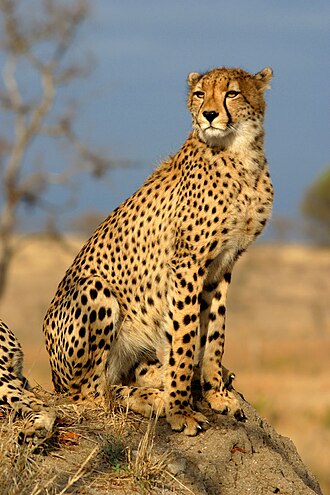
Acinonyx is a genus of feline, the only living species of which is the cheetah (A. jubatus) that inhabits the open grasslands of Africa and Asia in parts of Iran. This genus represents a highly adapted lineage within the felids, which specialize in speed and open-terrain hunting. Evidence suggest that the Acinonyx genus evolved from other feline ancestors early on, to become specialized in stealth and running.
The main reasons for all but one species going extinct revolve around climate changes, humans driving these species out of their habitats, and their prey populations shrinking. Climate changed dramatically, starting in the Pleistocene period, making it difficult to survive in open terrain and grasslands upon which these cats depend. Human civilization also began to change and expand, resulting in lots of these species losing their homes or hunting grounds. This also forced some species to be isolated, making reproducing more difficult. Food scarcity became another consequence of human expansion as their prey were being forced from their habitats or hunted by humans. These problems played a huge role in the extinction of the historic Acinonyx species.
Fossil remains related to cheetah-like cats were excavated that date back to the late Pliocene and Middle Pleistocene, indicating a wide time range. These cats occurred across much of the old world 10,000 years ago. Some extinct species such as A. pardinensis and A. intermedius were found in parts of Europe and Asia. Several similar species classified in the genus Miracinonyx lived in North America at the same time; these may have been more closely related to the genus Puma.
A primary characteristic of this genus are bodies adapted for speed and swiftness; however, the species at the time were much different in morphology. Species found from 10,000 years ago show that these cats had a larger and more vigorous build than the cheetah, which has specialized in hunting fast prey, with a much slimmer build, enabling a quick pursuit. Acinonyx species are also unable to retract their claws fully, which can be a disadvantage in some cases. However, claws also give extra traction while running.
Taxonomy
Acinonyx was proposed by Joshua Brookes in 1828.
The word Acinonyx is constructed from Greek roots. the first portion, "akinetos", translates to "unmoved" or "motionless" and the second portion "onyx" to "nail" or "claw". which represents one the main traits used to recognize this genus, not being able to retract their claws fully.
Between the late 18th century and the early 20th century, the following Acinonyx species and subspecies were described:
Felis jubatus by Johann Christian Daniel von Schreber in 1777 was based on earlier descriptions by Comte de Buffon and Thomas Pennant.
Felis venatica by Griffith in 1821 was based on a sketch of a cheetah from India.
Cynailurus soemmeringi by Fitzinger in 1855 was a live male cheetah brought by Theodor von Heuglin to Tiergarten Schönbrunn from Kordofan in southern Sudan.
Acinonyx hecki by Hilzheimer in 1913 was a captive cheetah from Senegal in the Berlin Zoological Garden, named in honour of the zoo's director.
In 1993, Acinonyx was placed in the monophyletic subfamily Acinonychinae. Molecular phylogenetic analysis has shown that it is the sister group of the genus Puma, and it is now placed within the subfamily Felinae.
- In addition, the following fossil Acinonyx species were described:
- Acinonyx pardinensis by Croizet et Jobert in 1828
- Acinonyx intermedius by Thenius in 1954
- Acinonyx aicha by Geraads in 1997
- Acinonyx pleistocaenicus by Zdansky in 1925
The Asiatic cheetah ("Acinonyx jubatus venaticus") is part of the last surviving lineages that are outside of Africa. Recent genetic studies have shown that this subspecies separated from African populations roughly 32,000 to 67,000 years ago, suggesting a prolonged adaptation to dry landscapes.
The "Linxia Cheetah" ("A. kurteni") was initially described by Christiansen and Mazák in 2009 on the basis of a skull from Pliocene strata in China, and touted as the most primitive member of the genus. In 2012, "A. kurteni" was invalidated as a species when the holotype was determined to be a forgery composed of Miocene-aged fragments.
The extended duration and broad range of fossil records suggests the long evolutionary presence across the old world into the present day.
以上节选摘自英文维基百科「Acinonyx」,按 CC BY-SA 4.0 使用,去掉了参考文献、外部链接等尾部小节,公式改写成了纯文本。篇幅所限,较长的小节只摘了开头一部分,有的小节没有收;全文、配图和出处见原文。