 格物

图:This picture was realized by Richard Bartz by using a Canon … · CC BY-SA 2.5 · Wikimedia Commons
生命之树 › 真核生物 › 动物界 › 真后生动物亚界 › 两侧对称动物 › 后口动物总门 › 脊索动物门 › 脊椎动物亚门 › 有颌下门 › 肉鳍鱼总纲 › 四足形类 › 希望螈目 › 四足总纲 › 爬行动物 › 坚尾龙类 › 鸟纲 › 今鸟亚纲 › 今颚下纲 › 鸡雁小纲 › 雁形目 › 鸭科
鸭亚科亚科
Anatinae
鸭亚科 是雁形目鸭科下的一个亚科,其下的物种通常被称为钻水鸭,别称塘鸭。在水面浮游时倒竖 身体将上半身潜入水面以下觅食,亦会伸长脖子将喙保持在水面附近以与水面大约平行的角度搜寻觅食。鸭亚科还包含已灭绝的Moa-nalo,是和浅层水鸭演化关系接近的另一支序。
摘自维基百科「鴨亞科」,CC BY-SA 4.0
- 学名
- Anatinae
- 分类等级
- 亚科
- 上级类群
- 鸭科
- 大类
- 鸟类
- 命名
- 威廉·埃尔福德·里奇,1819 年
- 数据库
- NCBI 分类
下级类群(14)



百科正文
分类
鸭亚科的系统分类地位与其下应包含哪些物种仍有争议。这里显示的分类是只有包括浅层水鸭与已灭绝的Moa-nalo,另一派的观点则认为鸭亚科应包括大部分的鸭,浅层水鸭则被进一步归为此亚科下的鸭族。这种争议反映了鸭科主要之序间关系的争议。
水鸭
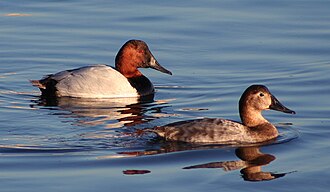
水鸭,或作野鸭、钻水鸭、潜水鸭等,常用来指各地未被驯化的鸭亚科物种。视乎各地的主流鸭亚科物种,“水鸭”可能会用来指代不同物种,例如亚洲的绿头鸭或北美洲的疣鼻栖鸭。在部分唐人聚居的城镇,唐人商店或超市在贩卖时需要特别标明售卖的是“中国水鸭”还是“加拿大水鸭”。甚或比如在香港,根据当地负责监管农产品贩卖的渔农自然护理署的网站的资料,当地所售卖的“水鸭”可能是指下列四个物种的其中一种:
- 琵嘴鸭、
- 白眉鸭、
- 红头潜鸭、
凤头潜鸭。
基于传统华人食疗认为“水鸭滋补”,“肉味浓浓、脂肪少”,“比饲养的营养丰富、无药物及增肉剂污染”,所以“是入秋进补佳品”。 野生水鸭更,所以华人都乐于为病人烹调水鸭料理。但由于捕猎方式的不同,欧美地区的水鸭经常都会标明鸭体内可能仍然藏有未被取走的子弹壳或弹沙。
以上内容摘自维基百科「鴨亞科」,按 CC BY-SA 4.0 使用,去掉了参考文献、外部链接等尾部小节,公式改写成了纯文本。全文、配图和出处见原文。
英文维基百科补充中文条目比较短,下面是英文条目「Anatinae」的原文
The Anatinae are a subfamily of the family Anatidae (swans, geese, and ducks). Its surviving members are the dabbling ducks, which feed mainly at the surface rather than by diving. The other members of the Anatinae are the extinct moa-nalo, a young but highly apomorphic lineage derived from the dabbling ducks.
Much debate exists about the systematical status and which ducks belong to the Anatinae. Some taxonomic authorities only include the dabbling ducks and their close relatives, the extinct moa-nalos. Alternatively, the Anatinae are considered to include most "ducks", and the dabbling ducks to form a tribe Anatini within these. The classification as presented here more appropriately reflects the remaining uncertainty about the interrelationships of the major lineages of Anatidae (waterfowl).
Systematics
The dabbling duck group, of worldwide distribution, was delimited in a 1986 study to include eight genera and some 50–60 living species. However, Salvadori's teal is almost certainly closely related to the pink-eared duck, and other genera are likewise of unresolved affiliation. The peculiar marbled duck, formerly tentatively assigned to the dabbling ducks, is thought to be a diving duck or even a distinct subfamily.
This group of ducks has been so named because its members feed mainly on vegetable matter by upending on the water surface, or grazing, and only rarely diving. These are mostly gregarious ducks of freshwater or estuaries. These birds are strong fliers and northern species are highly migratory. Compared to other types of ducks, their legs are located more towards the centre of their bodies. They walk well on land, and some species feed terrestrially.
"Puddle ducks" generally feed on the surface of the water or on very shallow bottoms. They are not equipped to dive down several feet like their diving counterparts. The most prominent difference between puddle ducks and divers is the size of the feet. A puddle duck's feet are generally smaller because they do not need the extra propulsion to dive for their forage.
Another distinguishing characteristic of puddle ducks when compared with diving ducks is the way in which they take flight when spooked or are on the move. Puddle ducks spring straight up from the water, but diving ducks need to gain momentum to take off, so they must run across the water a short distance to gain flight.
Traditionally, most ducks were assigned to either the shelducks, the perching ducks, and the dabbling and diving ducks; the latter two were presumed to make up the Anatinae.
Genera
- These genera are (with one exception) unequivocally dabbling ducks:
- Amazonetta – status not fully resolved, most likely a dabbling duck
- Sibirionetta – Baikal teal
- Spatula
- Mareca
- Lophonetta – crested duck
- Speculanas – bronze-winged duck
- Anas
The three known genera and four known species of moa-nalos all became extinct around 1000 AD. They formerly occurred on the Hawaiian Islands and were derived from dabbling ducks, possibly even from a close ancestor of the mallard:
- Chelychelynechen
- Thambetochen
- Ptaiochen
Subfossil remains of a small, flightless dabbling duck have been recovered on Rota in the Mariana Islands. These cannot be assigned to a known genus, but probably are closest to Anas. A most bizarre duck-like bird, Talpanas lippa, has been found on the Hawaiian island of Kauai. Because of its unique apomorphies (it seems to have had small eyes high and far back on its head), the placement of this anatid is likewise unresolved; only dabbling ducks and true geese are with certainty known to have colonized the Hawaiian archipelago.
Another bizarre insular anatine was Bambolinetta from the Late Miocene of Tuscana, then part of the Tuscano-Sardinian insular landmass. Flightless or at least a poor flyer, it instead shows adaptations for wing-propelled diving, occupying a similar ecological niche to that of penguins and plotopterids.
Frequently placed into the Anatinae are these genera, whose relationships must be considered uncertain at present:
†Chenoanas?
- †Dunstanetta (Johnstone's duck)
- †Lavadytis
- †Pinpanetta
- †Tirarinetta
- Oxyurini (stiff-tailed ducks)
- Heteronetta (black-headed duck)
- Nomonyx (masked duck)
- Oxyura
Biziura – Oxyurini?
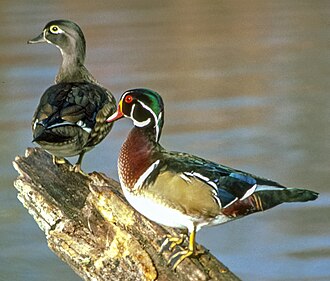
Aix – Tadorninae?
Cairina – may be paraphyletic, with one species in Tadorninae and the other closer to diving ducks
Callonetta – Tadorninae?
Chenonetta – Tadorninae?
以上节选摘自英文维基百科「Anatinae」,按 CC BY-SA 4.0 使用,去掉了参考文献、外部链接等尾部小节,公式改写成了纯文本。篇幅所限,较长的小节只摘了开头一部分,有的小节没有收;全文、配图和出处见原文。