格物
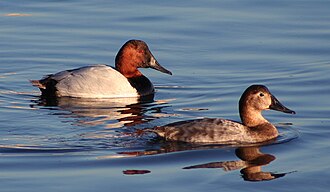
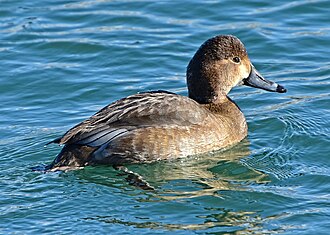
图:Calibas · CC BY-SA 4.0 · Wikimedia Commons
- 学名
- Aythya
- 分类等级
- 属
- 上级类群
- 鸭亚科
- 大类
- 鸟类
- 命名
- 弗里德里希·博伊厄,1822 年
- 数据库
- NCBI 分类 · GBIF
下级类群(12)

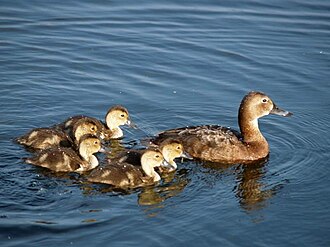


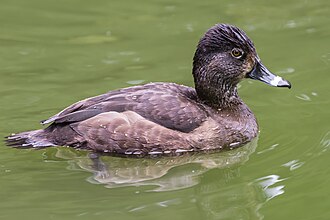
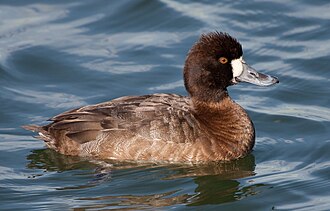
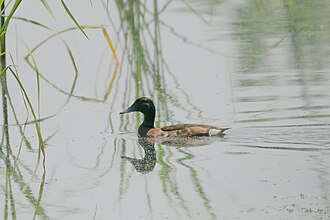

百科正文
物种
- 帆背潜鸭(A. valisineria)
- 红头潜鸭(A. ferina)
- 美洲潜鸭(A. americana)
- 环颈潜鸭(A. collaris)
- 澳洲潜鸭(A. australis)
- 青头潜鸭(A. baeri)
- 白眼潜鸭(A. nyroca)
- 马岛潜鸭(A. innotata)
- 新西兰潜鸭(A. novaeseelandiae)
- 凤头潜鸭(A. fuligula)
- 斑背潜鸭(A. marila)
- 小潜鸭(A. affinis)
于土耳其发现早更新世的化石,有可能是潜鸭属的古亚种。
中新世的"Aythya" arvernensis现已被编入Mionetta中,而"Aythya" chauvirae似乎包含了两个物种,但最少有一种已肯定不是潜鸭属。
以上内容摘自维基百科「潛鴨屬」,按 CC BY-SA 4.0 使用,去掉了参考文献、外部链接等尾部小节,公式改写成了纯文本。全文、配图和出处见原文。
英文维基百科补充中文条目比较短,下面是英文条目「Aythya」的原文
Aythya is a genus of diving ducks, with twelve species currently accepted. The genus was described in 1822 by the German zoologist Friedrich Boie, with the type species being greater scaup. The name Aythya comes from the Ancient Greek word αἴθυιᾰ (aithuia), which referred to an unknown diving-bird.
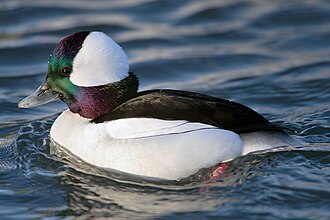
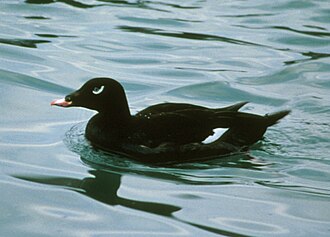
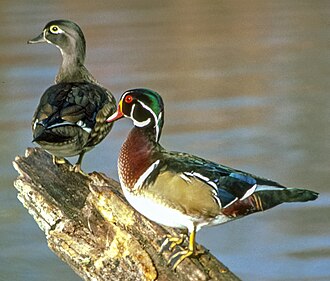
The species are plump, compact, medium-sized ducks ranging from 37–61 cm long, 60–84 cm wingspan, and weighing 410–1600 g, with canvasback the largest, and ring-necked duck and ferruginous duck marginally the smallest. The body plumage is variably white, grey, red-brown, or black, often with a finely vermiculated pattern; in several species, the flanks are white or pale grey, the back darker grey to black, and the breast and tail black. The heads are strongly coloured in the males, orange-red in some species, and black with a green to purple sheen (structural colour) in good light; the sheen colour varies with both species and angle of light incidence – in for example greater scaup, the head has a green sheen in direct light, but a purple sheen when backlit. In females, the heads are browner, sometimes with white patterning on the face. The eye colour is also variable in males, from white in ferruginous duck (leading to its archaic name of "white-eyed pochard"), through yellow in most species, to deep red in common pochard and canvasback; in females, the eye is brown in all species. The bills are short, fairly broad, and pale blue-grey to black, usually with a small black 'nail' at the tip; the pattern of blue-grey and black is important in species identification. In flight, the wings are dark grey to black, with a white to pale grey wingbar along the primary and secondary feathers; the pattern of the wingbar (whether all-white, or all-grey, or white on the secondaries and grey on the primaries) is an important identification feature. The webbed feet, used for propulsion in both swimming and diving, are 5–7 cm long, large for the size of the birds, and dark grey to blackish in all the species.
The species occur throughout Asia, Europe, North America, Australia, New Zealand, and Madagascar, and also in the northern half of Africa primarily in winter. Small numbers also reach the far north of South America in winter. In the breeding season, they are restricted to well-vegetated freshwater lakes, while in the winter they use both freshwater lakes and sheltered saltwater bays and inlets.
Aythya species
The genus contains 12 species; all are monotypic except for A. marila, which has two subspecies in the Old and New Worlds, respectively.
Hybrids
The species in the genus are all closely related, and are more prone to hybridisation than most other bird genera. Hybrids regularly seen in Europe include tufted duck × common pochard, tufted duck × ring-necked duck, greater scaup × tufted duck, and common pochard × ferruginous duck; while in North America, ring-necked duck × greater scaup, greater scaup × tufted duck, and canvasback × redhead are frequent.
Diet
The diet, mostly obtained by diving to depths of 0.5–6 m (exceptionally 10 m), but also at times from the surface without diving, consists of a mixture of plant material (including seeds, leaves and roots of water plants) and bottom-dwelling invertebrates (including worms, molluscs, insects). In urban situations, several species have learnt to take bread or birdseed fed to ducks by people.
Breeding
The nests are hidden in dense waterside vegetation, for preference on islets which give greater security from land predators. Incubation of the [2–]6–10[–18] eggs takes 3–4 weeks, and is done entirely by the female. The ducklings fledge at around 6–7 weeks old, and are cared for primarily by the female, though the male may assist with guarding the ducklings. 'Dump nesting', where more than one female lays eggs in a nest, is common, and likely accounts for nests containing more than ten eggs.
Prehistory
Aythya shihuibas was described from the Late Miocene of China, but probably belongs outside crown group Aythya. Zelenkov (2016) transferred the species Anas denesi Kessler (2013), known from the late Miocene of Hungary, to the genus Aythya. An undescribed prehistoric species is known only from Early Pleistocene fossil remains found at Dursunlu, Turkey; it might however be referrable to a paleosubspecies of an extant species considering its age (see also Greater scaup).
以上节选摘自英文维基百科「Aythya」,按 CC BY-SA 4.0 使用,去掉了参考文献、外部链接等尾部小节,公式改写成了纯文本。篇幅所限,较长的小节只摘了开头一部分,有的小节没有收;全文、配图和出处见原文。