 格物
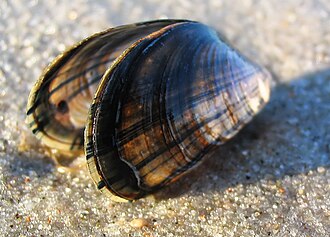
图:Benutzer:Darkone, 26. Oktober 2003 · CC BY-SA 2.0 · Wikimedia Commons
- 学名
- Mytilus edulis
- 分类等级
- 种
- 上级类群
- 贻贝属
- 大类
- 软体动物
- 命名
- 卡尔·林奈,1758 年
- 中文别名
- 紫壳菜蛤
- 特有于
- 阿根廷
- 栖息地
- 世界洋
- 数据库
- NCBI 分类 · GBIF
分类阶元
百科正文
英文维基百科补充中文条目比较短,下面是英文条目「Blue mussel」的原文
The blue mussel (Mytilus edulis), also known as the common mussel, is a medium-sized edible marine bivalve mollusc in the family Mytilidae, the only extant family in the order Mytilida, known as "true mussels". Blue mussels are subject to commercial use and intensive aquaculture. A species with a large range, the blue mussel leaves empty shells that are commonly found on beaches around the world.
Systematics and distribution
The Mytilus edulis complex
Systematically blue mussel consists of a group of (at least) three closely related taxa of mussels, known as the Mytilus edulis complex. Collectively they occupy both coasts of the North Atlantic (including the Mediterranean) and of the North Pacific in temperate to polar waters, as well as coasts of similar nature in the Southern Hemisphere. The distribution of the component taxa has been recently modified as a result of human activity.
Habitat
Blue mussels are boreo-temperate invertebrates that live in intertidal areas attached to rocks and other hard substrates by strong (and somewhat elastic) thread-like structures called byssal threads, secreted by byssal glands located in the foot of the mussel.
Description
The shape of the shell is triangular and elongated with rounded edges. The shell is smooth with a sculpturing of fine concentric growth lines but no radiating ribs. The shells of this species are purple, blue or sometimes brown in color, occasionally with radial stripes. The outer surface of the shell is covered by the periostracum which as eroded, exposes the colored prismatic calcitic layer.
Reproduction
Mussels have separate sexes. Once the sperm and eggs are fully developed they are released into the water column for fertilization. Although there are about 10,000 sperm per egg, large proportions of eggs deposited by blue mussels are never fertilized. As few as 1% of larvae that do mature ever reach adulthood. The majority are eaten by predators before completing metamorphosis.
Monitor of environmental DNA damage
Blue mussels are used for monitoring marine pollution based on their tendency to accumulate numerous pollutants from their natural environment. Upon in vivo exposure of blue mussels (Mytilus edulis) to either of two metals of environmental concern, cadmium or chromium, it was found that both of these metals induce DNA strand breakage, and also impair different DNA repair capacities in the tissues of these mussels.
Larval development
Larval development can last from 15 to 35 days depending environmental conditions including salinity and temperature, as well as location. Larvae originating from Connecticut mature normally at 15–20 °C (59–68 °F), though at 15 °C (59 °F) normal development occurs at salinities between 15 and 35 ppt and at 35 ppt at 20 °C (68 °F).
The first stage of development is the ciliated embryo, which in 24-hours for fertilization form the trochophore.
Aggregation and mussel bed formation
Blue mussels often form aggregations, where they attach to each other using byssus threads. These are collagenous protein strands used for attachment. The type of aggregation depends on population densities. When densities are low, for example in mussel fields – short-lived mussel populations – clumped distribution patterns are seen. The rate of aggregation is aided by the presence of predator cues.
Predators
Predation of blue mussels is greatest during the three weeks it spends as a planktonic larva. During this stage it is susceptible to jellyfish and fish larvae through adults. Once it metamorphoses the mussel is still restricted by predation, with smaller mussels with thinner, weaker shells most affected. Once the shells becomes stronger, blue mussels are preyed upon by sea stars such as Asterias vulgaris as well as by several species of sea gulls.
Uses and ecosystem services
Blue mussels are filter feeders and play a vital role in estuaries by removing bacteria and toxins.
Mytilus edulis is commonly harvested for food throughout the world, from both wild and farmed sources. Mussels are a staple of many seafood dishes in various cuisines including Spanish (especially Galician), Portuguese, French, British, Dutch, Belgian, Italian and Turkey as midye dolma. They are also commonly used as lab animals.
以上节选摘自英文维基百科「Blue mussel」,按 CC BY-SA 4.0 使用,去掉了参考文献、外部链接等尾部小节,公式改写成了纯文本。篇幅所限,较长的小节只摘了开头一部分,有的小节没有收;全文、配图和出处见原文。