 格物
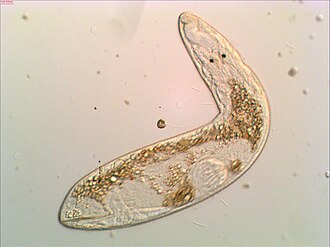
图:Christopher Laumer · CC BY 2.0 · Wikimedia Commons
生命之树 › 真核生物 › 动物总界 › 动物界 › 真后生动物亚界 › 两侧对称动物 › 原口动物 › 螺旋动物 › 扁形动物门
被杆体亚门亚门
Rhabditophora
Rhabditophora is a subphylum of flatworms. It includes all parasitic flatworms and most free-living species that were previously grouped in the now obsolete class Turbellaria. Therefore, it contains the majority of the species in the phylum Platyhelminthes, excluding only the catenulids, to which they appear to be the sister group.
摘自英文维基百科「Rhabditophora」(英文维基百科,暂无中文条目),CC BY-SA 4.0
- 学名
- Rhabditophora
- 分类等级
- 亚门
- 上级类群
- 扁形动物门
- 大类
- 其他动物
- 命名
- Ulrich Ehlers,1985 年
- 数据库
- NCBI 分类 · GBIF
分类阶元
下级类群(4)
百科正文
本条目暂无中文维基百科条目,下面是英文维基百科原文。
The clade Rhabditophora was originally erected by Ulrich Ehlers in 1985 based on morphological analyses and its monophyly was later confirmed by molecular studies.
Description
Rhabditophorans are characterized by the presence of lamellated rhabdites, rodlike granules secreted in the cells of the epidermis and consisted of concentric lamellae. They are absent in the clade Neodermata, most likely due to a secondary loss of this feature because their epidermis is turned into a syncytium in adult forms.
Another important synapomorphy of the group is the duo-glandular adhesive system. It is a structure of the epidermis containing three different cell types: anchor cells, adhesive glands and releasing glands. The adhesive glands secrete an adhesive substance that attaches the anchor cells to a surface, while the releasing glands secrete a substance able to release the anchor cells from surfaces. This systems allows rhabditophorans to adhere and release quickly from the substrate, even several times in a second.
The secretory organs of rhabditophorans, the protonephridia, also have a unique anatomy in which the flame cells and tube cells present a series of cytoplasmic projections that overlap, forming a two-cell 'weir'.
Systematics
- The following orders are recognised in the subphylum Rhabditophora:
- Order Bothrioplanida
- Order Fecampiida
- Order Gnosonesimida
- Order Polycladida
- Order Prolecithophora
- Order Prorhynchida
- Order Proseriata
- Order Rhabdocoela
- Order Tricladida
- Superorder Macrostomorpha
- Genus Bradynectes
- Genus Myozona
- Family Haplopharyngidae
- Family Macrostomidae
- Order Dolichomicrostomida
- Superclass Neodermata (parasites)
- Class Cestoda
- Subclass Cestodaria
- Order Amphilinidea
- Order Gyrocotylidea
- Subclass Eucestoda
- Order Bothriocephalidea
- Order Caryophyllidea
- Order Cathetocephalidea
- Order Cyclophyllidea
- Order Diphyllidea
- Order Diphyllobothriidea
- Order Lecanicephalidea
- Order Litobothriidea
- Order Onchoproteocephalidea
- Order Phyllobothriidea
- Order Rhinebothriidea
- Order Spathebothriidea
- Order Tetrabothriidea
- Order Tetraphyllidea
- Order Trypanorhyncha
- Class Monogenea
- Subclass Monopisthocotylea
- Order Capsalidea
- Order Dactylogyridea
- Order Gyrodactylidea
- Order Monocotylidea
- Order Montchadskyellidea
- Subclass Polyopisthocotylea
- Order Chimaericolidea
- Order Diclybothriidea
- Order Lagarocotylidea
- Order Mazocraeidea
- Order Polystomatidea
- Class Trematoda
- Subclass Aspidogastrea
- Order Aspidogastrida
- Order Stichocotylida
- Subclass Digenea
- Order Diplostomida
- Order Plagiorchiida
以上内容摘自英文维基百科「Rhabditophora」,按 CC BY-SA 4.0 使用,去掉了参考文献、外部链接等尾部小节,公式改写成了纯文本。全文、配图和出处见原文。