 格物
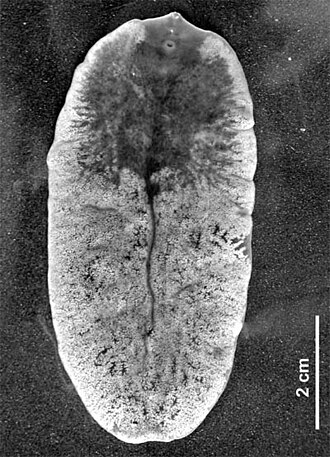
图:Flukeman · CC BY 2.5 · Wikimedia Commons
- 学名
- Neodermata
- 分类等级
- 总纲
- 上级类群
- 被杆体亚门
- 大类
- 其他动物
- 命名
- Ulrich Ehlers,1985 年
分类阶元
下级类群(3)

百科正文
说明
所有的新皮虫都是寄生虫,许多类型都有自由游动的幼体阶段。所有新皮虫最显著的特征是成虫的纤毛表皮(大多数扁平虫的典型表皮)会脱落,取而代之的是称为皮膜或新皮膜的合胞体。在所有新皮虫身上发现的其他特征与原肾管的解剖结构及表皮运动纤毛的细根有关。
系统演化
目前,新皮总纲的单系是无可争议的,并得到形态与分子资料的支持。很明显,它们是由自由生活的扁虫 (涡虫纲) 演变而来,但其姊妹群长期以来都是争论的议题。最早尝试以形态证据重建扁虫的系统演化时,认为Rhabdocoela是新皮总纲的姊妹群,但这只是基于微弱的形态相似性,并未获得分子研究的支持。
最新的证据将Bothrioplanida目视为新皮总纲的姊妹群,并将其合并为Bothrioneodermata支系。
以上内容摘自维基百科「新皮總綱」,按 CC BY-SA 4.0 使用,去掉了参考文献、外部链接等尾部小节,公式改写成了纯文本。全文、配图和出处见原文。
英文维基百科补充中文条目比较短,下面是英文条目「Neodermata」的原文
Neodermata is a clade of rhabditophoran flatworms containing the parasitic groups Trematoda, Monogenea and Cestoda.
Description
All neodermatans are parasites, in many groups having a free-swimming larval stage. The most striking feature uniting all neodermatans is that the ciliated epidermis (typical of most flatworms) is cast off in adult worms, being replaced by a syncytium called tegument or neodermis. Other characters found in all neodermatans are related to the anatomy of the protonephridium and the rootlets of epidermal locomotory cilia.
Relationships with other Platyhelminthes
Currently, the monophyly of Neodermata is undisputed, being supported by both morphological and molecular data. It is clear that they evolved from free-living flatworms (turbellarians), but their sister-group was for a long time a matter of debate. The first attempts to reconstruct the phylogeny of flatworms, based on morphological evidence, considered Rhabdocoela to be the sister-group of Neodermata, but this was based on weak morphological similarities and was not supported by molecular studies.
The most recent evidences put the order Bothrioplanida as the sister-group of Neodermata, uniting them in a clade called Bothrioneodermata.
Internal relationships
Many phylogenetic hypotheses have been proposed for the relationships of the major groups which constitute the Neodermata. Caña-Bozada et al. (2025) explored how different molecular markers and datasets influence phylogenetic reconstruction within the Neodermata. They generated 96 unilocus and 9 multilocus phylogenetic trees based on mitochondrial genes (nucleotides and amino acids), as well as nuclear 18S and 28S rRNA genes, using multiple inference programs. Their analyses showed that individual genes often lead to conflicting topologies, and that only certain gene combinations (especially multilocus mitochondrial or mitochondrial + rRNA) yielded more consistent support for the monophyly of the major Neodermata lineages. The monophyly of the Cestoda, Trematoda, Monopisthocotylea and Polyopisthocotylea were found in most analyses, but the monophyly of the Monogenea was not.
以上内容摘自英文维基百科「Neodermata」,按 CC BY-SA 4.0 使用,去掉了参考文献、外部链接等尾部小节,公式改写成了纯文本。全文、配图和出处见原文。