 格物
- 学名
- Lemuriformes
- 分类等级
- 下目
- 上级类群
- 曲鼻亚目
- 大类
- 哺乳动物
- 命名
- 约翰·爱德华·格雷,1821 年
- 特有于
- 马达加斯加
- 数据库
- NCBI 分类
分类阶元
- 域真核生物
- 未标等级无定形生物 Amorphea
- 演化支后鞭毛生物 Opisthokonta
- 总界动物总界 Holozoa
- 未标等级蜷丝生物 Filozoa
- 未标等级领鞭毛动物 Choanozoa
- 界动物界 Animalia
- 亚界真后生动物亚界 Eumetazoa
- 未标等级副同源异形基因动物 Parahoxozoa
- 亚界两侧对称动物 Bilateria
- 总门后口动物总门 Deuterostomia
- 门脊索动物门 Chordata
- 亚门脊椎动物亚门 Vertebrata
- 下门有颌下门 Gnathostomata
- 未标等级正真口类 Euteleostomi
- 总纲肉鳍鱼总纲 Sarcopterygii
- 未标等级扇鳍鱼类 Rhipidistia
- 亚纲四足形类 Tetrapodomorpha
- 未标等级始四足目 Eotetrapodiformes
- 下纲希望螈目 Elpistostegalia
- 未标等级坚头类 Stegocephalia
- 总纲四足总纲 Tetrapoda
- 未标等级爬行形类 Reptiliomorpha
- 未标等级羊膜动物 Amniota
- 未标等级合弓纲 Synapsida
- 未标等级真盘龙类 Eupelycosauria
- 纲哺乳动物 Mammalia
- 未标等级兽形类 Theriimorpha
- 亚纲兽型类 Theriiformes
- 下纲全兽类 Holotheria
- 亚纲兽亚纲 Theria
- 演化支真兽类 Eutheria
- 下纲有胎盘类 Placentalia
- 高目北方真兽高目 Boreoeutheria
- 总目灵长总目 Euarchontoglires
- 大目真统兽总目 Euarchonta
- 未标等级灵长形上目 Primatomorpha
- 目灵长目 Primates
- 亚目曲鼻亚目 Strepsirrhini
- 下目狐猴型下目 Lemuriformes
下级类群(3)
百科正文
英文维基百科补充中文条目比较短,下面是英文条目「Lemuriformes」的原文
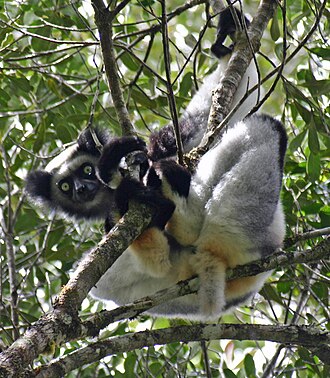
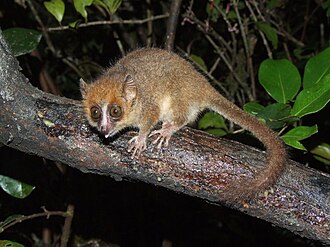
Lemuriformes is the sole extant infraorder of primate that falls under the suborder Strepsirrhini. It includes the lemurs of Madagascar, as well as the galagos and lorisids of Africa and Asia, although a popular alternative taxonomy places the lorisoids in their own infraorder, Lorisiformes.
Lemuriform primates are characterized by a toothcomb, a specialized set of teeth in the front, lower part of the mouth mostly used for combing fur during grooming.
Evolutionary history
Lemuriform origins are unclear and debated. American paleontologist Philip Gingerich proposed that lemuriform primates evolved from one of several genera of European adapids based on similarities between the front lower teeth of adapids and the toothcomb of extant lemuriforms; however, this view is not strongly supported due to a lack of clear transitional fossils. Instead, lemuriforms may be descended from a very early branch of Asian cercamoniines or sivaladapids that immigrated to northern Africa.
Until discoveries of three 40-million-year-old fossil lorisoids (Karanisia, Saharagalago, and Wadilemur) in the El Fayum deposits of Egypt between 1997 and 2005, the oldest known lemuriforms had come from the early Miocene (~20 mya) of Kenya and Uganda. These newer finds demonstrate that lemuriform primates were present during the middle Eocene in Afro-Arabia and that the lemuriform lineage and all other strepsirrhine taxa had diverged before then. Djebelemur from Tunisia dates to the late early or early middle Eocene (52 to 46 mya) and has been considered a cercamoniine, but also may have been a stem lemuriform. Azibiids from Algeria date to roughly the same time and may be a sister group of the djebelemurids. Together with Plesiopithecus from the late Eocene Egypt, the three may qualify as the stem lemuriforms from Africa.
Molecular clock estimates indicate that lemurs and the lorisoids diverged in Africa during the Paleocene, approximately 62 mya. Between 47 and 54 mya, lemurs dispersed to Madagascar by rafting. In isolation, the lemurs diversified and filled the niches often filled by monkeys and apes today. In Africa, the lorises and galagos diverged during the Eocene, approximately 40 mya. Unlike the lemurs in Madagascar, they have had to compete with monkeys and apes, as well as other mammals.
Taxonomic classification
Most of the academic literature provides a basic framework for primate taxonomy, usually including several potential taxonomic schemes. Although most experts agree upon phylogeny, many disagree about nearly every level of primate classification.
Within Strepsirrhini, two common classifications include either two infraorders (Adapiformes and Lemuriformes) or three infraorders (Adapiformes, Lemuriformes, Lorisiformes). A less common taxonomy places the aye-aye (Daubentoniidae) in its own infraorder, Chiromyiformes. In some cases, plesiadapiforms are included within the order Primates, in which case Euprimates is sometimes treated as a suborder, with Strepsirrhini becoming an infraorder, and the Lemuriformes and others become parvorders. Regardless of the infraordinal taxonomy, crown strepsirrhines are composed of 10 families, three of which are extinct. These three extinct families included the giant lemurs of Madagascar, many of which died out within the last 1,000 years following human arrival on the island.
When Strepsirrhini is divided into two infraorders, the clade containing all toothcombed primates can be called "lemuriforms". When it is divided into three infraorders, the term "lemuriforms" refers only to Madagascar's lemurs, and the toothcombed primates are referred to as either "crown strepsirrhines" or "extant strepsirrhines". Confusion of this specific terminology with the general term "strepsirrhine", along with oversimplified anatomical comparisons and vague phylogenetic inferences, can lead to misconceptions about primate phylogeny and misunderstandings about primates from the Eocene, as seen with the media coverage of Darwinius. Because the skeletons of adapiforms share strong similarities with those of lemurs and lorises, researchers have often referred to them as "primitive" strepsirrhines, lemur ancestors, or a sister group to the living strepsirrhines. They are included in Strepsirrhini, and are considered basal members of the clade. Although their status as true primates is not questioned, the questionable relationship between adapiforms and other living and fossil primates leads to multiple classifications within Strepsirrhini.
以上节选摘自英文维基百科「Lemuriformes」,按 CC BY-SA 4.0 使用,去掉了参考文献、外部链接等尾部小节,公式改写成了纯文本。篇幅所限,较长的小节只摘了开头一部分,有的小节没有收;全文、配图和出处见原文。