 格物
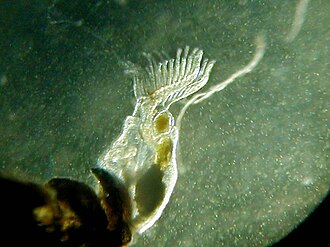
图:TheAlphaWolf · CC BY-SA 3.0 · Wikimedia Commons
- 学名
- Phylactolaemata
- 分类等级
- 纲
- 上级类群
- 苔藓动物门
- 大类
- 其他动物
- 数据库
- NCBI 分类 · GBIF
百科正文
下级分类
- 本纲包括以下目:
- 羽苔目 Plumatellida
- 地位未定的属:
- Cristellata
- Varunella Wiebach, 1974
以上内容摘自维基百科「被唇纲」,按 CC BY-SA 4.0 使用,去掉了参考文献、外部链接等尾部小节,公式改写成了纯文本。全文、配图和出处见原文。
英文维基百科补充中文条目比较短,下面是英文条目「Phylactolaemata」的原文
Phylactolaemata is a class of the phylum Bryozoa whose members live only in freshwater environments. Like all bryozoans, they filter feed by means of an extensible "crown" of ciliated tentacles called a lophophore, and like nearly all bryozoans (the only known exception being Monobryozoon), they live in colonies, each of which consists of clones of the founding member. Unlike those of some marine bryozoans, phylactolaemate colonies consist of only one type of zooid, the feeding forms known as autozooids. These are supported by an unmineralized "exoskeleton" made of gelatinous material or protein, secreted by the zooids. The class contains only one extant order, Plumatellida.
Fossil record
Phylactolaemata is regarded to have been the earliest group of bryozoans to evolve. However, because they did not have calcified skeletons, these early bryozoans would have had very low potential to fossilize. Fossils of phylactolaemate statoblasts, which consist of protective chitinous shells that serve as protection for dormant masses of cells holding the potential to grow new colonies, have been found rarely, dating back to the Permian. It is possible that the absence of statoblasts in earlier rocks is because statoblasts evolved as an adaptation for surviving in freshwater, and earlier phylactolaemates were marine.
Biology
Phylactolaemate colonies reproduce sexually, and each member is a simultaneous hermaphrodite that functions as both male and female. They also reproduce asexually by a method that is unique among bryozoans and enables a colony's lineage to survive the variable and uncertain conditions of freshwater environments. Among the classes of the bryozoans, the phylactoaemata have the most aberrant spermatozoon. Throughout summer and autumn they produce disc-shaped statoblasts, masses of cells that function as "survival pods" rather like the gemmules of sponges. Statoblasts form on the funiculus (cord) connected to the parent's gut, which nourishes them. As they grow, statoblasts develop protective bivalve-like shells made of chitin. When they mature, some types stick to the parent colony, some fall to the bottom, some contain air spaces that enable them to float, and some remain in the parent's cystid (outer casing) to re-build the colony if it dies. Statoblasts can remain dormant for considerable periods, and while dormant can survive harsh conditions such as freezing and desiccation. They can be transported across long distances by animals, floating vegetation, currents and winds. When conditions improve, the valves of the shell separate and the cells inside develop into a zooid that tries to form a new colony. A study estimated that one group of colonies in a patch 1 square meter (11 sq ft) produced 800,000 statoblasts.
以上内容摘自英文维基百科「Phylactolaemata」,按 CC BY-SA 4.0 使用,去掉了参考文献、外部链接等尾部小节,公式改写成了纯文本。全文、配图和出处见原文。