 格物
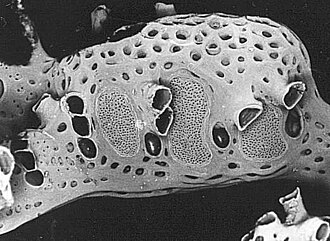
图:http://www.civgeo.rmit.edu.au/bryozoa/cyclostomata/crisinida… · Public domain · Wikimedia Commons
- 学名
- Stenolaemata
- 分类等级
- 纲
- 上级类群
- 苔藓动物门
- 大类
- 其他动物
- 命名
- Folke Borg,1926 年
- 数据库
- NCBI 分类 · GBIF
分类阶元
百科正文
本纲物种全为海生、固着生活,具有坚固的碳酸钙外骨骼,因而非常利于其形成化石。
演化史
窄唇纲苔藓虫最早出现于古生代奥陶纪,并迅速发生演化辐射,形态和物种多样性达到高峰,是奥陶纪生物大辐射中的重要组分和体现。窄唇纲在古生代时期为非常重要的造礁生物,变口目、隐口目及窗格目尤为繁盛,在部分地区形成了非常丰富的苔藓虫石灰岩。但其物种数量在之后的二叠纪-三叠纪灭绝事件期间大幅减少,除环口目外的其他目在侏罗纪开始前便完全灭绝。侏罗纪时期环口目苔藓虫发生多样化,成为中生代晚期最丰富的苔藓虫类群。白垩纪末灭绝事件后,环口目大量减少,与此同时裸唇纲的栉口目和唇口目苔藓虫发生了多样化,取代了环口目成为苔藓虫的优势类群。不过如今环口目仍然是海洋生态系统的重要生物组分。
以上内容摘自维基百科「窄唇綱」,按 CC BY-SA 4.0 使用,去掉了参考文献、外部链接等尾部小节,公式改写成了纯文本。全文、配图和出处见原文。
英文维基百科补充中文条目比较短,下面是英文条目「Stenolaemata」的原文
Stenolaemata are a class of exclusively marine bryozoans. Stenolaemates originated and diversified since the early Cambrian. All extant (living) species are in the order Cyclostomatida, the third-largest order of living bryozoans.
These animals are stationary suspension feeders that live on the ocean floor. They formed colonies with robust, calcified exoskeletons, allowing for a high potential for fossil preservation. The individual zooids in the colony may be tubular, conical, or sac-shaped. Each individual, or zooid, may extend from the colony at an angle, extending its tentacles to feed. The fossil genus Batostoma in the order Trepostomatida existed in monticular colonies.
Stenolaemates were the predominant bryozoan group during the Paleozoic, when many extinct orders proliferated within the class. Some grew as lacy or fan-like colonies that became important reef builders, and in some regions form an abundant component of limestones. The extinct Palaeozoic stenolaemate orders are placed in the superorder Palaeostomata. Their numbers were greatly reduced during the terminal Permian extinction event, and most stenolaemates were extinct by the start of the Jurassic.
However, the basal and previously rare stenolaemate order Cyclostomatida diversified in the Jurassic and became the most abundant group of bryozoans in the late Mesozoic. Cyclostomatida is no longer the most speciose bryozoan group, as the order experienced high rates of extinction during the end-Cretaceous mass extinction, while ctenostome and cheilostome bryozoans in the class Gymnolaemata diversified around the same time. Nevertheless, cyclostomates are still major components of modern marine ecosystems.
- Extant and extinct orders in this class include:
- Cyclostomatida/Cyclostomata (Ordovician-present)
- Cryptostomida/Cryptostomata † (Ordovician-Triassic)
- Cystoporida/Cystoporata † (Ordovician-Triassic)
- Esthonioporata † (Ordovician-Devonian)
- Fenestrida/Fenestrata † (Ordovician-Permian)
- Timanodictyina † (Devonian-Permian, may be a suborder of Cryptostomida)
- Trepostomatida/Trepostomata † (Ordovician-Triassic)
以上内容摘自英文维基百科「Stenolaemata」,按 CC BY-SA 4.0 使用,去掉了参考文献、外部链接等尾部小节,公式改写成了纯文本。全文、配图和出处见原文。