格物
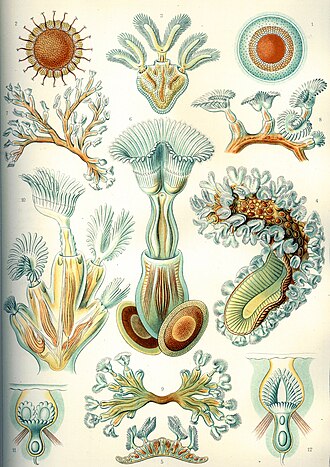
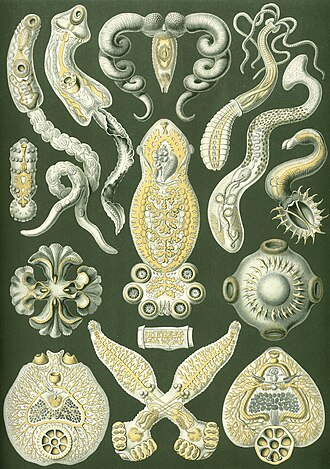
图:Ernst Haeckel · Public domain · Wikimedia Commons
- 学名
- Bryozoa
- 分类等级
- 门
- 上级类群
- 螺旋动物
- 大类
- 其他动物
- 命名
- 克里斯蒂安·戈特弗里德·埃伦贝格,1831 年
- 数据库
- NCBI 分类 · GBIF
下级类群(3)
百科正文
特征
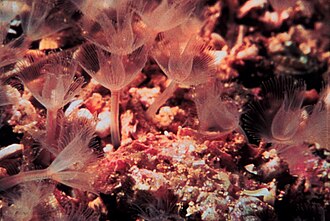
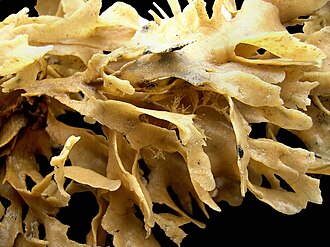
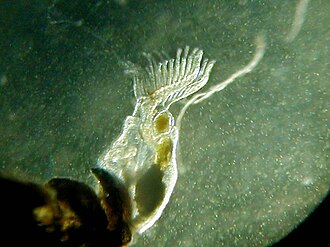
苔藓虫是行固着生活的水生群体动物。群体的形状各不相同,有的像被单一样盖在贝壳或岩石上;有的则像小树或网状复叶。每个群体都由数千个个虫组成,每个个虫都有管状或盒状的骨骼。它们的外观虽然很像植物,但具一套完整的消化器官,包括口、食道、胃、肠脏和肛门等。其个体小,不分节,具体腔。体外分泌一层胶质,形成群体的骨骼。虫体前端有口,口的周围有一冠状物,称“总担”,其上生许多触手。消化道呈U字形,口和肛门十分靠近。无排泄和循环器官。
习性
多数苔藓虫生活在海床上,是固定生活的群体动物,常和海藻伴生在一起。也有产于淡水的种类。苔藓虫喜欢生活在较洁净、富含藻类、溶氧量充足的水域中,能适应各地的温度,故广泛分布于世界各地。
苔藓虫石灰岩
苔藓虫石灰岩主要由苔藓虫群落的石灰质骨骼碎片组成,多伴有软体动物的外壳和藤壶等。在新生代时期的浅海沉积中十分常见。现今从亚热带至低温海域皆可见到正在形成的苔藓虫石灰岩,但在热带地区却很少见,热带区域有着丰富的珊瑚石灰岩。
分类
- 苔藓动物门分为3个纲:
- 被唇纲(Phylactolaemata)
- 裸唇纲(Gymnolaemata)
- 窄唇纲(Stenolaemata)
以上内容摘自维基百科「苔蘚動物門」,按 CC BY-SA 4.0 使用,去掉了参考文献、外部链接等尾部小节,公式改写成了纯文本。全文、配图和出处见原文。
英文维基百科补充中文条目比较短,下面是英文条目「Bryozoa」的原文
The Bryozoa (also known as the Polyzoa, Ectoprocta or commonly as moss animals) are a phylum of simple, aquatic invertebrate animals, nearly all living in sedentary colonies. Typically about 0.5 millimetres (1⁄64 in) long, they have a special feeding structure called a lophophore, a "crown" of tentacles used for filter feeding. The bryozoa are classified as the marine bryozoa (Stenolaemata), freshwater bryozoa (Phylactolaemata), and mostly-marine bryozoa (Gymnolaemata), a few members of which prefer brackish water. Most marine bryozoans live in tropical waters, but a few are found in oceanic trenches and polar waters. 5,869 living species of bryozoa are known. Originally all of the crown group Bryozoa were colonial, but as an adaptation to a mesopsammal (interstitial spaces in marine sand) life or to deep-sea habitats, secondarily solitary forms have since evolved. Five genera are solitary: Aethozooides, Aethozoon, Franzenella, Solella, which together make up the family Aethozoidae, and Monobryozoon, which has a statocyst-like organ with a supposed excretory function.
The terms Polyzoa and Bryozoa were introduced in 1830 and 1831, respectively. Soon after it was named, another group of animals was discovered whose filtering mechanism looked similar, so it was included in Bryozoa until 1869, when the two groups were noted to be very different internally. The new group was given the name "Entoprocta", while the original Bryozoa were called "Ectoprocta". Disagreements about terminology persisted well into the 20th century, but "Bryozoa" is now the generally accepted term.
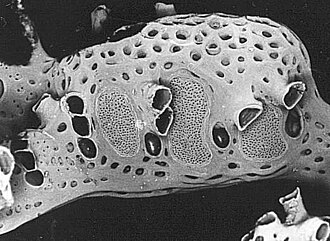
Colonies take a variety of forms, including fans, bushes and sheets. Single animals, called zooids, live throughout the colony and are not fully independent. These individuals can have unique and diverse functions. All colonies have "autozooids", which are responsible for feeding, excretion, and supplying nutrients to the colony through diverse channels. Some classes have specialist zooids like hatcheries for fertilized eggs, colonial defence structures, and root-like attachment structures. Cheilostomata is the most diverse order of bryozoan, possibly because its members have the widest range of specialist zooids. They have mineralized exoskeletons and form single-layered sheets which encrust over surfaces, and some colonies can creep very slowly by using spiny defensive zooids as legs.
Each zooid consists of a "cystid", which provides the body wall and produces the exoskeleton, and a "polypide", which holds the organs. Zooids have no special excretory organs, and autozooids' polypides are scrapped when they become overloaded with waste products; usually the body wall then grows a replacement polypide. Their gut is U-shaped, with the mouth inside the crown of tentacles and the anus outside it. Zooids of all the freshwater species are simultaneous hermaphrodites. Although those of many marine species function first as males and then as females, their colonies always contain a combination of zooids that are in their male and female stages. All species emit sperm into the water. Some also release ova into the water, while others capture sperm via their tentacles to fertilize their ova internally. In some species the larvae have large yolks, go to feed, and quickly settle on a surface. Others produce larvae that have little yolk but swim and feed for a few days before settling.
以上节选摘自英文维基百科「Bryozoa」,按 CC BY-SA 4.0 使用,去掉了参考文献、外部链接等尾部小节,公式改写成了纯文本。篇幅所限,较长的小节只摘了开头一部分,有的小节没有收;全文、配图和出处见原文。