格物

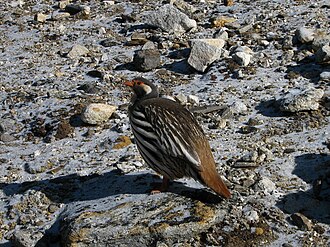
图:Imran Shah from Islamabad, Pakistan · CC BY-SA 2.0 · Wikimedia Commons
- 学名
- Alectoris
- 分类等级
- 属
- 上级类群
- 鹑亚科
- 大类
- 鸟类
- 命名
- 约翰·雅各布·考普,1829 年
- 数据库
- NCBI 分类 · GBIF
下级类群(7)
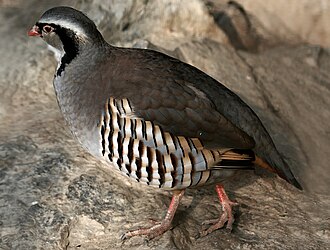
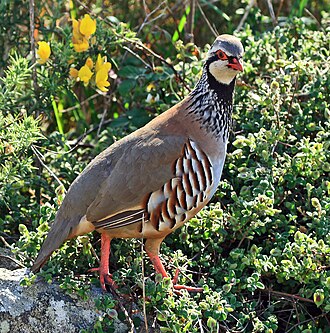
- 石鸡 Alectoris chukar 种
- 欧石鸡 Alectoris graeca 种
- 红腿石鸡 Alectoris rufa 种
- Alectoris barbara 种
- Alectoris melanocephala 种
- Alectoris philbyi 种
- 大石鸡 Alectoris magna 种
百科正文
下属种
石鸡属现有7个种。
- 黑脸石鸡或叫菲利比石鸡(Alectoris philbyi)
- 阿拉伯石鸡(Alectoris melanocephala)
- 石鸡(Alectoris chukar)
- 大石鸡(Alectoris magna)
- 欧石鸡(Alectoris graeca)
- 红腿石鸡(Alectoris rufa)
- 北非石鸡(Alectoris barbara)
以上内容摘自维基百科「石鸡属」,按 CC BY-SA 4.0 使用,去掉了参考文献、外部链接等尾部小节,公式改写成了纯文本。全文、配图和出处见原文。
英文维基百科补充中文条目比较短,下面是英文条目「Alectoris」的原文
Alectoris is a genus of partridges in the family Phasianidae, closely related to Old World quail (Coturnix and relatives), snowcocks (Tetraogallus), partridge-francolins (Pternistis), bush quail (Perdicula), and sand and see-see partridges (Ammoperdix). Members of the genus are known collectively as rock partridges (a name that also refers to one species in particular, Alectoris graeca). The genus name is derived from the Ancient Greek: αλέκτωρ, romanized: alektoris, meaning "chicken" or "farmyard fowl".
Their fossils date back to the early Pleistocene, with extant representatives in southern Europe, North Africa and Arabia, and across Asia in Pakistan to Tibet and western China.
Taxonomy
The genus Alectoris was introduced in 1829 by German naturalist Johann Jakob Kaup to accommodate a single species Perdrix petrosa, a junior synonym of Perdix barbara Bonnaterre, 1790, the Barbary partridge, which is therefore the type species by monotypy. The genus name is from Ancient Greek αλεκτορις/alektoris, αλεκτοριδος/alektoridos meaning "hen" or "chicken".
Description
These are non-migratory birds of dry, open and often hilly country. They nest in a scantily lined ground scrape laying up to 20 eggs. They feed on a wide variety of seeds and vegetation. Ants are a very important source of nutrition for the birds as are pine nuts, juniper berries and lichens.
As is typical of many galliform birds, Alectoris partridges are relatively round-bodied and small-headed. They typically have a light brown or grey back, grey breast, buff belly, and barred flanks. Several species have a whitish throat with a black border. Their specialized flank coverts give them the appearance of being more rotund than they actually are. Their legs are red, with well-developed, ball-peen hammer-like spurs. When disturbed they run very rapidly, often uphill, taking to the wing if pressed. Their wings are long and fairly sharp, shaped rather like those of ptarmigan and spruce grouse, suggesting that the birds sustain themselves in flight over substantial distances to find food. This probably occurs most often during winter.
Introduced species and hybridisation
Some members of the genus, notably the chukar and red-legged partridge, have been introduced to many locations outside their natural range; there are now established populations of chukar in western North America, Hawaii, and the South Island of New Zealand, and of red-legged partridge in the United Kingdom, the Azores, Madeira, and the Canary Islands.
The chukar readily interbreeds with the red-legged partridge and rock partridge. The practice of breeding and releasing captive-bred chukar and hybrids between chukar and red-legged partridge has been banned in the United Kingdom, as it is a threat to red-legged partridge populations.
Species
- The genus contains seven extant species:
- Two prehistoric species are known from fossils:
- A. peii Hou, 1982 China
A. baryosefi Tchernov, 1980 Early Pleistocene of El-`Ubeidiya (Jordan valley), Israel.
以上内容摘自英文维基百科「Alectoris」,按 CC BY-SA 4.0 使用,去掉了参考文献、外部链接等尾部小节,公式改写成了纯文本。全文、配图和出处见原文。