格物
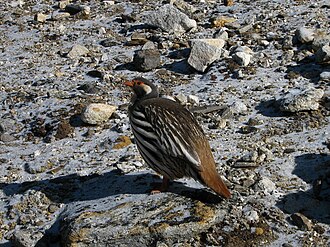
图:Mckaysavage on Flickr · CC BY 2.0 · Wikimedia Commons
- 学名
- Tetraogallus
- 分类等级
- 属
- 英文名
- Snowcock
- 上级类群
- 鹑亚科
- 大类
- 鸟类
- 命名
- 约翰·爱德华·格雷,1832 年
- 数据库
- NCBI 分类 · GBIF
下级类群(5)
百科正文
雪鸡是世界上分布最高的鸡类,一般分布3000~6000米,直至雪线以上。在中国西部高山地带常见,当地称为西藏雪鸡或喜马拉雅雪鸡。
雪鸡以植物的茎、根、叶、芽等为食,有时兼吃昆虫和小型无脊椎动物。
下属物种
本属包括以下物种:
阿尔泰雪鸡 Tetraogallus altaicus (Gebler, 1836)
里海角鸡 Tetraogallus caspius (S.G.Gmelin, 1784)
高加索雪鸡 Tetraogallus caucasicus (Pallas, 1811)
暗腹雪鸡 Tetraogallus himalayensis G.R.Gray, 1843
藏雪鸡 Tetraogallus tibetanus Gould, 1854,淡腹雪鸡
以上内容摘自维基百科「雪鸡属」,按 CC BY-SA 4.0 使用,去掉了参考文献、外部链接等尾部小节,公式改写成了纯文本。全文、配图和出处见原文。
英文维基百科补充中文条目比较短,下面是英文条目「Snowcock」的原文
The snowcocks or snowfowl are a group of bird species in the genus Tetraogallus of the pheasant family, Phasianidae. They are ground-nesting birds that breed in the mountain ranges of southern Eurasia from the Caucasus to the Himalayas and western China. Some of the species have been introduced into the United States. Snowcocks feed mainly on plant material.
Characteristics
Snowcocks are bulky, long-necked, long-bodied partridge-like birds. Males and females are generally similar in appearance but females tend to be slightly smaller and rather duller in colouration than males. They are generally grey with varying amounts of white, black and brown according to species and with distinctive white under tail-coverts. Their plumage is thick with a downy base to the feathers which helps them to withstand severe winter temperatures that may fall to −40 °C (−40 °F). The colour of juvenile snowcocks is similar to the colour of the females and the young are not fully grown until their second year of life.
Snowcocks are heavy birds and are unable to fly far with flapping flight. Instead they run to a high point, launch themselves into the air and glide, gradually losing altitude. They are to be found on open slopes above the tree line where they feed on leaves, shoots, roots, fruits, berries and insects.
Distribution
The snowcocks are each endemic to different mountain ranges in Asia where they are normally found on open slopes above the tree line. Only in the case of the Himalayan snowcock and the Tibetan snowcock do their ranges overlap.
The Caucasian snowcock occurs in the Caucasus Mountains in Azerbaijan, Georgia and the Russian Federation. It has been introduced into the United States. The Caspian snowcock is native to eastern Turkey, Armenia, Azerbaijan, Iran, Iraq and Georgia and has been introduced into the United States. The Tibetan snowcock is native to mountain ranges in India, Nepal, Bhutan, Tajikistan and China. The Himalayan snowcock occurs in mountainous areas of Afghanistan, Tajikistan, Turkmenistan, Uzbekistan, Kazakhstan, Kyrgyzstan, Pakistan, Nepal, India and China and has been introduced into the United States. The Altai snowcock is endemic to high altitudes in Kazakhstan, Mongolia, China and the Russian Federation.
以上内容摘自英文维基百科「Snowcock」,按 CC BY-SA 4.0 使用,去掉了参考文献、外部链接等尾部小节,公式改写成了纯文本。全文、配图和出处见原文。