格物

图:Rhododendrites · CC BY-SA 4.0 · Wikimedia Commons
- 学名
- Fulica
- 分类等级
- 属
- 上级类群
- 秧鸡科
- 大类
- 鸟类
- 命名
- 卡尔·林奈,1758 年
- 数据库
- NCBI 分类 · GBIF · IUCN 红色名录
下级类群(12)
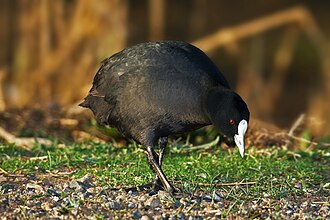
- 白骨顶 Fulica atra 种
- 美洲骨顶 Fulica americana 种
- 红瘤白骨顶 Fulica cristata 种
- Fulica gigantea 种
- 角骨顶 Fulica cornuta 种
- 夏威夷骨顶 Fulica alai 种
- Fulica ardesiaca 种
- Fulica armillata 种
- Fulica rufifrons 种
- Fulica leucoptera 种
- 马斯卡林瓣蹼鹬 Fulica newtonii 种
- 加勒比骨顶 Fulica caribaea 种
百科正文
下属物种
本属包括以下物种:
红额骨顶 Fulica rufifrons Philippi & Landbeck, 1861
角骨顶 Fulica cornuta Bonaparte, 1853
大骨顶 Fulica gigantea Eydoux & Souleyet, 1841
- 黄腿骨顶 Fulica armillata Vieillot, 1817
- 白骨顶 Fulica atra Linnaeus, 1758
- 红瘤白骨顶 Fulica cristata Gmelin, JF, 1789
马岛白骨顶 Fulica newtonii Milne-Edwards, 1867
- 夏威夷骨顶 Fulica alai Peale, 1849
- 美洲骨顶 Fulica americana Gmelin, JF, 1789
- 安第斯骨顶 Fulica ardesiaca Tschudi, 1843
- 白翅骨顶 Fulica leucoptera Vieillot, 1817
以上内容摘自维基百科「骨顶鸡属」,按 CC BY-SA 4.0 使用,去掉了参考文献、外部链接等尾部小节,公式改写成了纯文本。全文、配图和出处见原文。
英文维基百科补充中文条目比较短,下面是英文条目「Coot」的原文
Coots are medium-sized water birds that are members of the rail family, Rallidae. They constitute the genus Fulica, the name being the Latin term for "coot". Coots have predominantly black plumage, and—unlike many rails—they are usually easy to see, often swimming in open water.
Taxonomy and systematics
The genus Fulica was introduced in 1758 by the Swedish naturalist Carl Linnaeus in the tenth edition of his Systema Naturae. The genus name is the Latin word for a Eurasian coot. The name was used by the Swiss naturalist Conrad Gessner in 1555. The type species is the Eurasian coot.
A group of coots is referred to as a covert or cover.
Species
The genus contains 10 extant species and one which is now extinct.
Extinct species
Recently extinct species
†Fulica newtonii Milne-Edwards, 1867 – Mascarene coot (extinct, c. 1700)
Late Quaternary species
†Fulica chathamensis Forbes, 1892 – Chatham Island coot (early Holocene of the Chatham Islands)
†Fulica montanei Alarcón-Muñoz, Labarca & Soto-Acuña, 2020 (late Pleistocene to early Holocene of Chile)
†Fulica prisca Hamilton, 1893 – New Zealand coot (early Holocene of New Zealand)
†Fulica shufeldti (Brodkorb, 1964) (late Pleistocene of Florida) possibly a paleosubspecies of Fulica americana; formerly F. minor
Fossil species
†Fulica infelix Brodkorb, 1961 – (early Pliocene of Juntura, Malheur County, Oregon, USA)
Description
Coots have prominent frontal shields or decoration on their foreheads, with red to dark red eyes and coloured bills. Many have white on the under tail. The featherless shield gave rise to the expression "as bald as a coot", which the Oxford English Dictionary cites in use as early as 1430. Coots have long toes with broad lobes of skin that allow them to kick and propel themselves through the water. The lobes of skin fold back each time the coot lifts its foot, allowing them to walk on dry land while also providing support in mucky terrain. They tend to have short, rounded wings and are weak fliers, though northern species nevertheless can cover long distances. They typically congregate in large rafts in open water. Along these rafts coots may lay eggs in their own nest or in some other bird's. Depending on the species of coot the eggs can vary in color: buff, pinkish buff or buff-gray speckled with dark brown, purplish brown, or black.
Distribution and habitat
The greatest species variety occurs in South America, and the genus likely originated there. They are common in Europe and North America. Coot species that migrate do so at night. The American coot has been observed rarely in Britain and Ireland, while the Eurasian coot is found across Asia, Australia and parts of Africa. In southern Louisiana, the coot is referred to by the French name "poule d'eau", which translates into English as "water hen".
Behaviour and ecology
Coots are omnivorous, eating mainly plant material, but also small animals, fish and eggs. They are aggressively territorial during the breeding season, but are otherwise often found in sizeable flocks on the shallow vegetated lakes they prefer.
Chick mortality occurs mainly due to starvation rather than predation as coots have difficulty feeding a large family of hatchlings on the tiny shrimp and insects that they collect. Many chicks die in the first 10 days after hatching, when they are most dependent on adults for food. Coots can be very brutal to their own young under pressure such as the lack of food, and after about three days they start attacking their own chicks when they beg for food. After a short while, these attacks concentrate on the weaker chicks, who eventually give up begging and die. The coot may eventually raise only two or three out of nine hatchlings. In this attacking behaviour, the parents are said to "tousle" their young. This can result in the death of the chick.
以上内容摘自英文维基百科「Coot」,按 CC BY-SA 4.0 使用,去掉了参考文献、外部链接等尾部小节,公式改写成了纯文本。全文、配图和出处见原文。