格物

- 学名
- Porzana
- 分类等级
- 属
- 上级类群
- 秧鸡科
- 大类
- 鸟类
- 命名
- 路易·皮埃尔·维埃约,1816 年
- 数据库
- NCBI 分类 · GBIF
下级类群(10)
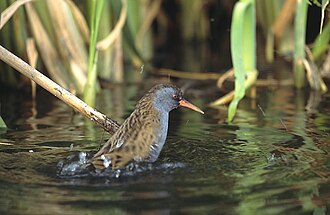
- 斑胸田鸡 Porzana porzana 种
- 白眉田鸡 Porzana cinerea 种
- 黑脸田鸡 Porzana carolina 种
- Porzana flaviventer 种
- 斑田鸡 Porzana fluminea 种
- Porzana albicollis 种
- 库岛田鸡 Porzana monasa 种
- Porzana spiloptera 种
- Porzana astrictocarpus 种
- Porzana nigra 种
百科正文
本条目暂无中文维基百科条目,下面是英文维基百科原文。
Porzana is a genus of birds in the crake and rail family, Rallidae. Its scientific name is derived from Venetian terms for small rails. The spotted crake (P. porzana) is the type species.
Taxonomy
The genus Porzana was erected by the French ornithologist Louis Pierre Vieillot in 1816 with the spotted crake (Porzana porzana) as the type species. The genus unites the typical "crakes" found essentially anywhere in the world except desert and polar regions. It contains 3 living species. In addition, a large number of prehistorically extinct species known only from fossil or subfossil remains have been discovered. The genera Coturnicops, Crex (including Crecopsis) and Laterallus have been suggested to be closely related.
However, molecular phylogenetic analyses have confirmed the suspicion, raised in the late 20th century in the first cladistic studies of morphology, that the "genus" Porzana is rather an evolutionary grade, consisting of an assemblage of unrelated plesiomorphic rails. Micropygia is maintained as monotypic genus for the ocellated crake until its relationships are fully resolved. The ash-throated crake, which was only tentatively placed in Porzana, has been united with the two former species of Neocrex in Mustelirallus; they are almost certainly closely related to Pardirallus. The white-browed crake, meanwhile, is today usually placed in a monotypic genus Poliolimnas again, as it was by various authors in the past.
The molecular data find Crex part of a more ancient lineage including Gallirallus and Rallus however; this clade (without Crex) is also well supported by the morphological data, so the similarities between Crex and the crakes seem to be due to a convergent anatomy. Coturnicops and Laterallus, meanwhile, seem closely related to each other and at least the dot-winged crake and yellow-breasted crake as well as Anurolimnas, but not to the core group of Porzana. Part of Amaurornis seems to form a complex with the remaining small species of "Porzana"; the old name Zapornia is now re-established for these. Finally, there is Porzana proper, a group of a few fairly large species which seems close to the last common ancestor of coots and moorhens; the spot-flanked gallinule, presently placed in Gallinula or separated in a monotypic Porphyriops, may be a particularly close relative.
Description and ecology
These birds are among the smaller members of their family, none being larger than a chicken and some really tiny, smaller than a starling or thrush. Their upperparts are a cryptic lighter or darker brownish hue. The underside is also brown in some, but more often buff or grey. Several species have patterns like whitish dots or black-and-white barred flanks, conspicuous close up, but at a distance providing additional camouflage in these birds' habitat. Some others are rather uniformly blackish-brown all over. The bill and feet are often brightly colored in red to yellow hues; the eyes' iris has some reddish-brownish hue, sometimes being bright red and also very conspicuous at close quarters. Porzana males and females generally differ barely if at all; in the little crake (P. parva), however, they differ so much they might be mistaken for separate species.
Most species of Porzana crakes inhabit wetlands. Some, however, are (or were) found on rocky islands with little water; even these, though, prefer places where abundant vegetation provides a dense ground-cover to hide in. They are usually reclusive and shy, but unlike the larger rails are active and inquisitive birds. When foraging, they will investigate anything that catches their attention and is not considered a predator; in some places, this even includes any humans and their food or equipment that visit these birds' habitat. Their food is mostly small invertebrates – typically arthropods and mollusks – as well as selected plants, seeds and fruit. This is complemented by any small vertebrate they can catch, such as a fish or frog. They can swim if they need to and even dive a bit, but not for extended distances; rather, they prefer to clamber through dense reeds to escape threats, or walk on floating vegetation or just passively drift around a spot when foraging.
As usual for Rallidae, their flight is rather clumsy and their navigation skills and ability to maintain course against the wind are poor; on the other hand, their stamina in the air is exception for their small size; several species migrate thousands of kilometers every spring and autumn, while others originated from wind-blown individuals swept to oceanic islands just as far away from any continent. In this regard, Porzana presently in fact stands supreme among the Rallidae, and even among birds in general it is quite remarkable for its radiation of oceanic island lineages.
Extant and recently extinct species
The genus Porzana contains 3 living species.
Prehistoric extinctions
It is to be expected that most or all of these species will be transferred to the genus Zapornia.
- "Porzana" keplerorum – Small Maui crake
- "Porzana" menehune – Liliput crake
- "Porzana" ralphorum Olson, 1973 – Great Oʻahu crake
- "Porzana" rua Steadman, 1986 – Mangaia crake
- "Porzana" severnsi Olson, 1973 – Great Maui crake
- "Porzana" ziegleri – Small Oʻahu crake
- "Porzana" sp. – Aiwa Levu crake
- "Porzana" sp. – Easter Island crake
- "Porzana" sp. – Great Big Island crake
- "Porzana" sp. – Great Kauaʻi crake
- "Porzana" sp. – Huahine crake
- "Porzana" sp. – Lesser Mangaia crake
- "Porzana" sp. – Malakula crake
- "Porzana" sp. – Marquesas crake(s) (Nuku Hiva, Ua Huka; up to 2 species)
- "Porzana" sp. – Marianas crake(s) (Aguiguan, Guam, Rota, Tinian; up to 4 species)
- "Porzana" sp. – Medium Kauaʻi crake
- "Porzana" sp. – Medium Maui crake
- "Porzana" sp. - Medium O‘ahu crake – possibly same as "P." ralphorum or "P." ziegleri
- "Porzana" sp. – Small Big Island crake
- "Porzana" sp. – Ua Huka crake
Ancient fossils
By standards of their family, the fossil record of "Porzana" is not very comprehensive and modestly old. The most ancient fossils that were placed here date from about one dozen million years ago during the Astaracian. A few older fossils of extant rail lineages are known, suggesting that older Porzana (or at least Zapornia) fossils may also eventually be found. More importantly, the comparatively abundant remains from around 4 million years ago may indicate that even Porzana proper had its near-cosmopolitan distribution at that time already. The fossils, sorted by age, are:
"Porzana" estramosi Jánossy, 1979 (Sajóvölgyi Middle? Miocene – Early Pliocene of Hungary)
"Porzana" risilla (Middle Miocene or Middle Pliocene of Mongolia)
Porzana sp. "QM F23253" (Early Pliocene of NE Australia)
Porzana sp. "Văršec/Stránská skála" (Late Pliocene of Bulgaria – Early Pleistocene of Czech Republic)
"Porzana" piercei (Shore Hills Late Pleistocene of Bermuda, W Atlantic)
Porzana cf. flaviventer (Late Pleistocene -? Holocene of Bermuda, West Atlantic)
The Middle Pleistocene fossil described as Porzana auffenbergi is now placed in Rallus.
以上节选摘自英文维基百科「Porzana」,按 CC BY-SA 4.0 使用,去掉了参考文献、外部链接等尾部小节,公式改写成了纯文本。篇幅所限,较长的小节只摘了开头一部分,有的小节没有收;全文、配图和出处见原文。