格物

图:David. S · CC BY-SA 3.0 · Wikimedia Commons
- 学名
- Gallinula
- 分类等级
- 属
- 上级类群
- 秧鸡科
- 大类
- 鸟类
- 命名
- 马蒂兰·雅克·布里松,1760 年
- 数据库
- NCBI 分类 · GBIF
下级类群(7)

百科正文
下属物种
本属包括以下物种:
黑水鸡 Gallinula chloropus (Linnaeus, 1758)
果夫岛黑水鸡 Gallinula comeri (J.A.Allen, 1892)
特岛骨顶 Gallinula nesiotis P.L.Sclater, 1861
萨摩亚水鸡 Gallinula pacifica (Hartlaub & Finsch, 1871)
- 圣岛骨顶 Gallinula silvestris (Mayr, 1933)
- 暗色水鸡 Gallinula tenebrosa Gould, 1846
- 美洲黑水鸡 Gallinula galeata
以上内容摘自维基百科「黑水鸡属」,按 CC BY-SA 4.0 使用,去掉了参考文献、外部链接等尾部小节,公式改写成了纯文本。全文、配图和出处见原文。
英文维基百科补充中文条目比较短,下面是英文条目「Moorhen」的原文
Moorhens are medium-sized water birds in the genus Gallinula, Latin for 'little hen', in the rail family Rallidae. The genus currently includes seven species, of which one is extinct, and two others probably are. Three species formerly included in Gallinula have been found to have enough differences to be placed in two separate but closely related genera, Paragallinula (with one species, lesser moorhen Paragallinula angulata), and Tribonyx, the two native hens of Australia; Tribonyx differs visually by shorter, thicker and stubbier toes and bills, and longer tails that lack the white signal pattern of typical moorhens. The moorhens are also close relatives of the coots (Fulica), but the swamphens (Porphyrio), formerly also thought to be close relatives, are now known to be less closely related.
Description
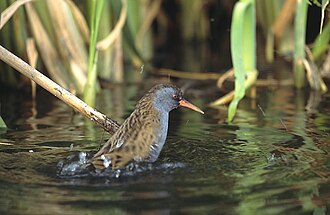
These rails are dumpy, compact birds with mostly brown and black with some white markings in their plumage; they range from 25 to 40 cm long. The bills are red, mostly with a yellow tip, and the legs are yellowish-green to yellowish-orange; the toes are long, but not webbed, nor lobed as in coots. Unlike many of the rails, they are usually easy to see because they feed in open water margins rather than hidden in reedbeds.
They have short rounded wings and are weak fliers, although usually capable of covering long distances. The common moorhen in particular migrates up to 2,000 km (1,200 mi) from some of its breeding areas in the colder parts of Siberia. Those that migrate do so at night. The Gough moorhen is almost flightless, and can fly only short distances. Loss of flight appears to have evolved independently in the moorhens of Gough and Tristan da Cunha, illustrating the repeated evolution of flightlessness among insular gallinules. More broadly, flightlessness has evolved repeatedly in island-dwelling rails, with the Rallidae showing a particular propensity for this form of evolution.
Moorhens can walk well on their strong legs, and the long toes are well adapted to soft uneven surfaces. They can swim well, despite the lack of webs on the toes.
These birds are omnivorous, consuming plant material, small rodents, amphibians and eggs. They are aggressively territorial during the breeding season, but are otherwise often found in flocks on the shallow vegetated lakes they prefer.
Systematics and evolution
The genus Gallinula was introduced by the French zoologist Mathurin Jacques Brisson in 1760 with the common moorhen (Gallinula chloropus) as the type species.
Species
The genus contains five extant, one recently extinct, and two possibly extinct species.
- Species formerly included in the genus:
- Lesser moorhen Paragallinula angulata
- Black-tailed nativehen Tribonyx ventralis
- Tasmanian nativehen Tribonyx mortierii
Other moorhens have been described from older remains. Apart from the 1–2 extinctions in more recent times, another 1–4 species have become extinct as a consequence of early human settlement; a species close to the Samoan moorhen from Buka, the Solomon Islands, which is almost certainly distinct from the Makira moorhen, as the latter cannot fly. The undescribed Viti Levu gallinule of Fiji would either be separated in Pareudiastes if that genus is considered valid, or it may be a completely new genus. Similarly, the undescribed "swamphen" of Mangaia, currently tentatively assigned to Porphyrio, may belong to Gallinula or Pareudiastes if that genus is considered valid.
Evolution
Still older fossils document the genus since the Late Oligocene onwards. The genus seems to have originated in the Southern Hemisphere, in the general region of Australia. By the Pliocene, it was probably distributed worldwide:
Gallinula sp. (Early Pliocene of Hungary and Germany)
Gallinula kansarum (Late Pliocene of Kansas, USA)
Gallinula balcanica (Late Pliocene of Varshets, Bulgaria).
Gallinula gigantea (Early Pleistocene of the Czech Republic and Israel)
The ancient "Gallinula" disneyi (Late Oligocene—Early Miocene of Riversleigh, Australia) has been separated as genus Australlus.
以上内容摘自英文维基百科「Moorhen」,按 CC BY-SA 4.0 使用,去掉了参考文献、外部链接等尾部小节,公式改写成了纯文本。全文、配图和出处见原文。