 格物
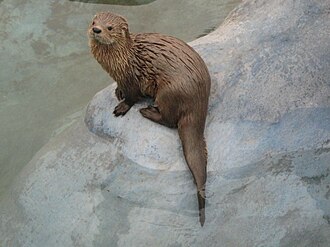
图:Sakura1994 · CC BY-SA 4.0 · Wikimedia Commons
- 学名
- Lontra felina
- 分类等级
- 种
- 英文名
- Marine otter
- 上级类群
- 美洲獭属
- 大类
- 哺乳动物
- 命名
- 胡安·伊格纳西奥·莫利纳,1782 年
- 保护状况(IUCN)
- 濒危 (保育状况)
- 数据库
- NCBI 分类 · GBIF · IUCN 红色名录
百科正文
分布
秘鲁水獭分布在南美洲西南部的滨海带。秘鲁南部、智利沿海及阿根廷的最南端是它们栖息最近岸的地方。它们最远可达福克兰群岛。
特征
秘鲁水獭长约1米及重4.5千克。背部呈深褐色,腹部呈浅褐色。护毛灰色,覆盖着保温的毛皮。它们的毛较海獭粗糙,估计是因它们栖息的环境有很多岩石的缘故。它们的前后肢都有蹼,尾巴很短。
秘鲁水獭的下颚有8对牙齿,上颚有8-9对牙齿。它们的牙齿是用来撕开食物,而多于磨碎食物。
秘鲁水獭并不是两性异形的,雌獭有4个乳头。
习性及食性
秘鲁水獭栖息在长满海草及海藻的石滩,很少会到海口及河流。它们喜欢巨浪及强风的环境,并不像其他水獭般喜欢平静的水面。它们有时会躲在洞穴内,其巢穴很多时会筑在没有陆地通道的地方。它们也会避开沙滩。
秘鲁水獭的食物不详,但相信主要吃蟹、虾、软体动物及鱼类。
行为及繁殖
秘鲁水獭是日间活动的,很多时是单独或以小群3只出没。它们会在水面浮潜,只有头部及背部露出水面,所以很难观察到它们。它们是否有领地的不得而知,有时雄獭会打斗,但交配的一对也有时会打斗。它们会在海岸线上显眼的岩石上打斗,它们也会在这里休息、进食及吼叫。它们曾有试过合作捕猎较大的鱼类,但似乎不是普遍的习性。
秘鲁水獭可能是一夫一妻制、一妻多夫制或一夫多妻制的。它们会于12月至1月间繁殖,妊娠期为60-70日,每胎约产2-5只幼獭。幼獭头10个月会待在母獭身边。父母会喂养它们,并教它们猎食的技巧。
保育状况
由于秘鲁水獭很稀有,在秘鲁、智利及阿根廷都受到保护。它们以往被大量猎杀,目的是其毛皮或阻碍渔获,在阿根廷及福克兰群岛大部分地方都看不见它们的踪影。现时野外的数目未明,而保护什么栖息地也不明。秘鲁水獭于1976年列为《濒危野生动植物种国际贸易公约》附录一的物种,在美国被列为濒危。
以上内容摘自维基百科「秘魯水獺」,按 CC BY-SA 4.0 使用,去掉了参考文献、外部链接等尾部小节,公式改写成了纯文本。全文、配图和出处见原文。
英文维基百科补充中文条目比较短,下面是英文条目「Marine otter」的原文
The marine otter (Lontra felina) is a rare and relatively unknown South American mammal of the weasel family (Mustelidae). The scientific name means "feline otter", and in Spanish, the marine otter is also often referred to as gato marino: "marine cat". The marine otter (while spending much of its time out of the water) only lives in saltwater, coastal environments and rarely ventures into fresh water or estuarine habitats. This saltwater exclusivity is unlike most other otter species, except for the almost fully aquatic sea otter (Enhydra lutris) of the North Pacific.
Description
The marine otter is one of the smallest otters and the smallest marine mammal, measuring 87 to 115 cm (34 to 45 in) from the nose to the tip of the tail and weighs 3 to 5 kg (6.6 to 11.0 lb). The tail measures 30 to 36 cm (12 to 14 in). Its fur is coarse, with guard hairs measuring up to 2 cm (0.79 in) in length covering dense, insulating underfur. The marine otter is dark brown above and on the sides, and fawn on the throat and underside.
The marine otter has webbed paws and strong claws. The ventral side (underside) of the paws are partially covered in fur. It has 36 teeth and a dental formula of 3.1.3-4.13.1.3.2.
Distribution and habitat
Marine otters are found in littoral areas of southwestern South America, close to shore and in the intertidal areas of northern Peru (from the port of Chimbote), along the entire coast of Chile, and the extreme southern reaches of Argentina. Occasional vagrant sightings still occur as far afield as the Falkland Islands.
The marine otter mainly inhabits rocky shorelines with abundant seaweed and kelp, and infrequently visits estuaries and freshwater rivers. It appears to select habitats with surprisingly high exposure to strong swells and winds, unlike many other otters, which prefer calmer waters.
Behavior and ecology
Rocky intertidal zones with natural crevices are ideal for marine otter dens and feeding areas. Because most of their time is spent hidden in caves, their behavior is difficult to observe.
Marine otters actively avoid humans. In response to human activity, they will spend less time on coasts and stray from their dens during the day to fissures inaccessible to humans. Though generally avoidant of humans, their inhabitance of fishing villages is an indicator of the marine otter's ability to adapt to urbanization.
Reproduction
Marine otters may be monogamous or polygamous, and breeding occurs in December or January.
Taxonomy
The marine otter is of the Lutrinae, a subfamily of Mustelidae. Its exact taxonomy has been debated due to lack of data. A phylogenetic study by C. G. Van Zyll De Jong in 1987 proposed the following phenogram of the lutrinae, based on morphological data.
Jong's proposed phenogram showed that the marine otter was sister to the remaining species in the genus Lontra. A 2004 study contradicted Jong's research. The following was proposed as a part of the taxonomy of the Mustelidae, based on cytochrome b sequences.
Threats
Human activity on coastlines poses disturbance to marine otters. Humans introduce domestic animals which may also disturb their dens. Humans, as well as domesticated species, may expose a marine otter population to disease. Marine otters may be entangled in fishing nets and die. A 2026 study of marine otter mortality in north-central Chile from 2003 to 2024 found that, among cases with an assigned cause, anthropogenic mortality predominated, particularly attacks by free-ranging dogs, followed by fisheries bycatch and non-specific trauma.
Microplastics have been found in the scat of marine otters. The effects of microplastics in marine mammals are still unclear.
Conservation status
Marine otters are rare and are protected under Peruvian, Chilean, and Argentine law. In the past, they were extensively hunted both for their fur and due to perceived competition with fisheries. Hunting extirpated them from most of Argentina and the Falkland Islands. Poaching is still a problem, but one of unknown magnitude. It is unknown how many marine otters exist in the wild or what habitats should be preserved to encourage their recovery. Marine otters were listed under CITES Appendix I in 1976, and are listed as endangered by the U.S. Department of the Interior.
以上节选摘自英文维基百科「Marine otter」,按 CC BY-SA 4.0 使用,去掉了参考文献、外部链接等尾部小节,公式改写成了纯文本。篇幅所限,较长的小节只摘了开头一部分,有的小节没有收;全文、配图和出处见原文。