 格物
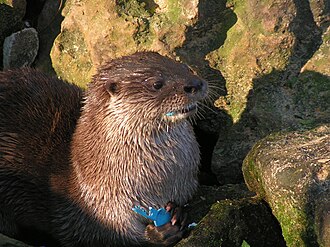
图:© 2006 Carla Antonini · CC BY-SA 2.5 ar · Wikimedia Commons
- 学名
- Lontra longicaudis
- 分类等级
- 种
- 英文名
- Neotropical otter
- 上级类群
- 美洲獭属
- 大类
- 哺乳动物
- 命名
- Ignaz von Olfers,1818 年
- 保护状况(IUCN)
- 近危物种
- 数据库
- NCBI 分类 · GBIF · IUCN 红色名录
百科正文
长尾水獭栖息在不同的河流环境,包括落叶林及常绿森林、大草原等。它们似乎较喜欢清澈的河流,较少在污浊的下游出现。它们是独居的,主要吃鱼类及甲壳类。它们受到《濒危野生动植物种国际贸易公约》附录一的保护。
以上内容摘自维基百科「長尾水獺」,按 CC BY-SA 4.0 使用,去掉了参考文献、外部链接等尾部小节,公式改写成了纯文本。全文、配图和出处见原文。
英文维基百科补充中文条目比较短,下面是英文条目「Neotropical otter」的原文
The neotropical otter or neotropical river otter (Lontra longicaudis) is a near-threatened (per the IUCN) otter species found in freshwater systems from Mexico and Central America through mainland South America, as well as the island of Trinidad. It is physically similar to the northern (L. canadensis) and southern river otter (L. provocax), which occur directly north and south of this species' range, respectively. Its head-to-body length can range from 36–66 centimetres (14–26 in), plus a tail of 37–84 centimetres (15–33 in). Body weight ranges from 5–15 kilograms (11–33 lb).
The neotropical otter is found in many different riverine habitats and riparian zones, including those in tropical and temperate deciduous to evergreen forests, savannas, llanos (of Colombia and Venezuela) and the pantanal (in Bolivia, Brazil and Paraguay). It prefers to live in clear, fast-flowing rivers and streams, preferably away from competition with the more boisterous giant otter (Pteronura brasiliensis). Unlike other otters (including the aforementioned giant species), which live in large and cohesive socio-familial units, the neotropical otter is a relatively solitary animal, feeding mostly on fish and crustaceans.
Taxonomy
The taxonomy of the genus Lontra has been debated, but the use of Lontra rather than Lutra for New World otters is generally supported. The Neotropical otter has a very wide range, covering a large portion of South America, so it is not surprising there are geographical structures separating some populations. One such geographical isolation is the Cordillera Mountains.
Description
The Neotropical otter is covered in a short, dark grayish-brown pelage. Fur color is lighter around the muzzle and throat. They possess a long wide tail, with short stout legs and fully webbed toes. Sexually dimorphic, the males are about 25% larger than the females. Its head-and-body length can range from 36–66 centimetres (14–26 in), plus a tail of 37–84 centimetres (15–33 in). Body mass of the otter generally ranges from 5 to 15 kilograms (11–33 pounds). Neotropical otters will communicate with nearby otters via scent marking.
Distribution and habitat
The Neotropical otter has the widest distribution of all the Lontra species. Their habitat can range from northwest Mexico to central Argentina. They prefer clear, fast-flowing rivers, and are rarely known to settle in sluggish, silt-laden lowland waters or boggy areas. While mostly occurring at 300–1,500 m (980–4,900 ft) above sea level, they have been found settled at 3,000 m (9,800 ft).
Ecology and behaviour
Diet
The Neotropical otter's diet consists mostly of fish and crustaceans making up 67% and 28%, respectively, of its total diet. The otter will also occasionally feed on mollusks and small mammals, as well as birds, large insects and fruits. In areas where fish and crustaceans are scarce, aquatic insects, such as dobsonfly larvae, can become its main prey. This otter is known to occasionally attack fishnets for a source of prey, hindering fishing productivity.
Conservation
The Neotropical otter is listed as Near Threatened by the IUCN. The species is currently protected in Argentina and many other South American countries. Heavy hunting for its fur in the 1950s–1970s resulted in much local extinction over the otter's range. Illegal hunting, habitat destruction through mining and ranching, and water pollution still affect the population of the Neotropical otter. Although there have been attempts at captive breeding, these attempts have been largely unsuccessful.
In captivity
One male and one female Neotropical otter were captured near Caucasia, Colombia, and taken to Santa Fe Zoological Park in 1994 and 1996, respectively. Zoo staff observed the pair mating in the water, then separated the animals. The female had three births; one was successful. The infant deaths may have been unintentionally caused by the mother. One idea suggested the mother's enclosure was too small and she had no access to water, as she would have had in the wild.
以上节选摘自英文维基百科「Neotropical otter」,按 CC BY-SA 4.0 使用,去掉了参考文献、外部链接等尾部小节,公式改写成了纯文本。篇幅所限,较长的小节只摘了开头一部分,有的小节没有收;全文、配图和出处见原文。