 格物
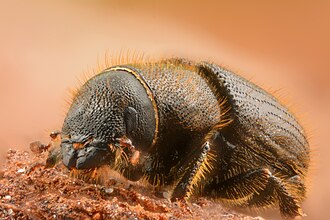
图:Gilles San Martin from Namur, Belgium · CC BY-SA 2.0 · Wikimedia Commons
- 学名
- Scolytinae
- 分类等级
- 亚科
- 上级类群
- 象甲科
- 大类
- 昆虫
- 命名
- 皮埃尔·安德烈·拉特雷耶,1804 年
- 数据库
- NCBI 分类
分类阶元
- 域真核生物
- 未标等级无定形生物 Amorphea
- 演化支后鞭毛生物 Opisthokonta
- 总界动物总界 Holozoa
- 未标等级蜷丝生物 Filozoa
- 未标等级领鞭毛动物 Choanozoa
- 界动物界 Animalia
- 亚界真后生动物亚界 Eumetazoa
- 未标等级副同源异形基因动物 Parahoxozoa
- 亚界两侧对称动物 Bilateria
- 下界原口动物 Protostomia
- 总门蜕皮动物总门 Ecdysozoa
- 门节肢动物门 Arthropoda
- 未标等级有颚类 Mandibulata
- 未标等级泛甲壳类 Pancrustacea
- 亚门六足亚门 Hexapoda
- 纲昆虫纲 Insecta
- 未标等级双髁类 Dicondylia
- 亚纲有翅亚纲 Pterygota
- 未标等级伴翅类 Metapterygota
- 下纲新翅下纲 Neoptera
- 总目Holometabola
- 目鞘翅目 Coleoptera
- 亚目多食亚目 Polyphaga
- 未标等级扁甲下目 Cucujiformia
- 总科象甲总科 Curculionoidea
- 科象甲科 Curculionidae
- 亚科小蠹亚科 Scolytinae
下级类群(3)
- 小蠹属 Scolytus 属
- 八齿小蠹属 Ips 属
- Pityogenes 属
百科正文
树皮甲虫在树木的内皮中繁殖,一些树皮甲虫,如山松甲虫会啃食完好的树木导致其死亡,但大多数树皮甲虫只是寄生在将死或死去的树中。
以上内容摘自维基百科「小蠹亞科」,按 CC BY-SA 4.0 使用,去掉了参考文献、外部链接等尾部小节,公式改写成了纯文本。全文、配图和出处见原文。
英文维基百科补充中文条目比较短,下面是英文条目「Bark beetle」的原文
A bark beetle is the common name for the subfamily of beetles Scolytinae. Previously, this was considered a distinct family (Scolytidae), but is now understood to be a specialized clade of the "true weevil" family (Curculionidae). Although the term "bark beetle" refers to the fact that many species feed in the inner bark (phloem) layer of trees, the subfamily also has many species with other lifestyles, including some that bore into wood, feed in fruit and seeds, or tunnel into herbaceous plants. Well-known species are members of the type genus Scolytus, namely the European elm bark beetle S. multistriatus and the large elm bark beetle S. scolytus, which like the American elm bark beetle Hylurgopinus rufipes, transmit Dutch elm disease fungi (Ophiostoma). The mountain pine beetle Dendroctonus ponderosae, southern pine beetle Dendroctonus frontalis, and their near relatives are major pests of conifer forests in North America. A similarly aggressive species in Europe is the spruce ips Ips typographus. A tiny bark beetle, the coffee berry borer, Hypothenemus hampei is a major pest on coffee plantations around the world.
Life cycle and morphology
Bark beetles go through four stages of life: egg, larvae, pupae, and adult, with the time to develop often relying on the species as well as the current temperature. While there is variation among species, generally adults first bore into a tree and lay their eggs in the phloem of the tree. This usually occurs in mid to late summer. Once the eggs hatch, the larvae then live in the tree, feeding on the living tissues below the bark, often leading to death of the tree if enough larvae are present.
Description and ecology
Bark beetles feed and breed between the bark and the wood of various tree species. While some species, such as the mountain pine beetle (Dendroctonus ponderosae), do attack living trees, many bark beetle species feed on weakened, dying, or dead spruce, fir, and hemlock. Most restrict their breeding area to one part of the tree: twig, branch, stem, or root collar. Some breed in trees of only one species, while others in numerous species of tree. In undisturbed forests, bark beetles serve the purpose of hastening the recycling and decomposition of dead and dying wood and renewing the forest.
Biochemistry
The bark beetle's pheromones, including kairomones, can attract other insects. The pheromones distinguished as kairomones are hormones, pheromones, or allomones of bark beetles, which in turn are used as a locator by insects that are attracted by it, such as flies, which may intend to harm the bark beetle itself. These chemicals interact with pine trees as the bark beetle's host, based on the behavioral, physiological, and biochemical effects of monoterpenes.
Monoterpenes are a chemical fragrance that plays a significant role in tree-insect interactions, specifically within pine trees.
Taxonomy
There are around 6,000 described species of bark beetles in 246 genera, placed into 26 distinct tribes.
As invasive species
Bark beetles are most commonly recognized by their impact on the lumber industry. Massive outbreaks of mountain pine beetles in western North America after about 2005 have killed millions of acres of forest from New Mexico to British Columbia. Bark beetles enter trees by boring holes in the bark of the tree, sometimes using the lenticels, or the pores plants use for gas exchange, to pass through the bark of the tree. As the larvae consume the inner tissues of the tree, they often consume enough of the phloem to girdle the tree, cutting off the spread of water and nutrients.
Hazard in Europe
According to a BBC article in August 2025, the spruce bark beetle has already devastated millions of spruce trees across Europe. The beetle has reached the UK by being blown over the English Channel, posing a threat to its forests. In order to face the threat, UK scientists are using drones, sniffer dogs, and even nuclear waste models, claiming to have eradicated it in vulnerable regions of the south and southeast. But as climate change continues and weakened trees, it’s getting harder to control the beetle.
External links and further reading
American and Mexican Bark and Ambrosia beetles
Nordhaus, Hannah. Bark Beetle Outbreaks in Western North America: Causes and Consequences. University of Utah Press: Salt Lake City, 2009. ISBN 978-0-87480-965-7
以上节选摘自英文维基百科「Bark beetle」,按 CC BY-SA 4.0 使用,去掉了参考文献、外部链接等尾部小节,公式改写成了纯文本。篇幅所限,较长的小节只摘了开头一部分,有的小节没有收;全文、配图和出处见原文。