 格物
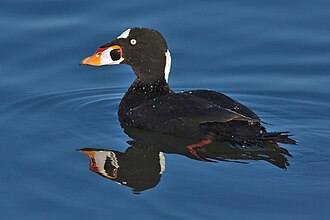
图:Alan D. Wilson · CC BY-SA 2.5 · Wikimedia Commons
- 学名
- Melanitta perspicillata
- 分类等级
- 种
- 英文名
- Surf Scoter
- 上级类群
- 海番鸭属
- 大类
- 鸟类
- 命名
- 卡尔·林奈,1758 年
- 保护状况(IUCN)
- 无危物种
- 体重
- 62 克(出生体重);1 千克(成年体重、雄性);900 克(成年体重、雌性)
- 数据库
- NCBI 分类 · GBIF · IUCN 红色名录
百科正文
特征
斑头海番鸭体重约1096.33克,翼长约226.3毫米,嘴峰长约58.8毫米,喙宽度约21.6毫米,喙厚度约15.9毫米,跗跖长约38毫米,尾长约72.8毫米。斑头海番鸭是候鸟,其栖息在开放的湖泊、沼泽等湿地环境中,食性为肉食性,主要食物来源是水生动物。
分布
北美洲北部;越冬于下加利福尼亚州和美国南部。
以上内容摘自维基百科「斑头海番鸭」,按 CC BY-SA 4.0 使用,去掉了参考文献、外部链接等尾部小节,公式改写成了纯文本。全文、配图和出处见原文。
英文维基百科补充中文条目比较短,下面是英文条目「Surf scoter」的原文
The surf scoter (Melanitta perspicillata) is a large sea duck native to North America. Adult males are almost entirely black with characteristic white patches on the forehead and the nape and adult females are slightly smaller and browner. Surf scoters breed in Northern Canada and Alaska and winter along the Pacific and Atlantic coasts of North America. They are diving ducks and mainly feed on benthic invertebrates, mussels representing an important part of their diet.
Taxonomy
In 1750 the English naturalist George Edwards included an illustration and a description of the surf scoter in the third volume of his A Natural History of Uncommon Birds. He used the English name "The great black duck from Hudson's Bay". Edwards based his hand-coloured etching on a preserved specimen that had been brought to London from the Hudson Bay area of Canada by James Isham. When in 1758 the Swedish naturalist Carl Linnaeus updated his Systema Naturae for the tenth edition, he placed the surf scoter with the ducks and geese in the genus Anas. Linnaeus included a brief description, coined the binomial name Anas perspicillata and cited Edwards' work. The surf scoter is now one of six species placed in the genus Melanitta that was introduced by the German zoologist Friedrich Boie in 1822. The genus name Melanitta combines the Ancient Greek melas meaning "black" and netta meaning "duck".
Description
The surf scoter reaches sexual maturity after 3 years. The adult male is on average 1,050 g (2.31 lb) and 48 cm (19 in) in length while the adult female averages about 900 g (2.0 lb) and 44 cm (17 in) in length, making this the smallest species of scoter on average. The surf scoter has a wingspan of 29.9–30.3 in (76–77 cm).
The male is completely velvety black except for white patches on the forehead and the nape. It has a swollen bill, appearing orange at a distance but patterned with white, red and yellow, and a black spot near the base.
The female is browner than the male, with a fairly uniform plumage, slightly darker above than below. Indistinct paler patches are present on the cheeks below the eye and sometimes a whitish patch is on the nape, a unique trait among scoters. The bill is black with green or blue colorations
Distribution and habitat
Compared to most Northern American sea ducks, the surf scoter breeds exclusively in North America, mostly in Northern Canada and Alaska. Then, they take different migration routes to spend the winter in more temperate environments.
While small numbers regularly winter in western Europe as far south as Ireland and Britain, the vast majority of surf scoters winter along the Pacific and Atlantic coasts of North America. The Pacific coast host the highest number of individuals and its large wintering range extends over 5,000 km (3,100 mi), from the Aleutian Islands in Alaska to the Baja Peninsula in Mexico.
This migratory species breeds in the boreal forests near northern freshwater lakes. Very few nests have been observed but they tend to be near spruce cover, slightly upland to wetland areas.
Behavior
Breeding
Surf scoters form pairs on wintering and staging grounds. Most pairs are formed before the arrival on the breeding grounds. Studies showed a strong fidelity in the nesting areas of surf scoters over the years.
The building of the nest usually starts in mid-May to early June and it occurs on the ground close to the sea, lakes or rivers, in woodland or tundra. Females dig a bowl-shaped nest in the ground and lines it with nearby ground debris and down. About 5 to 9 eggs are laid and each may range from 55 to 79 g (1.9–2.8 oz) and average 43.9 mm (1.73 in) in breadth and 62.4 mm (2.46 in) in length.
The incubation lasts for about 28 to 30 days and is provided by the female only. Occasional (and likely accidental) brood mixing between different females occurs in areas with high densities of nests and hatching is synchronous among the eggs.
Status
The extremely large range and population size of the surf scoter assures it a status of Least Concerned, according to the IUCN. The populations have been apparently decreasing over the last years, but this small decline is not rapid enough to consider moving the species in the Vulnerable category. The global population is estimated to be between 250,000 and 1,300,000 individuals.
以上节选摘自英文维基百科「Surf scoter」,按 CC BY-SA 4.0 使用,去掉了参考文献、外部链接等尾部小节,公式改写成了纯文本。篇幅所限,较长的小节只摘了开头一部分,有的小节没有收;全文、配图和出处见原文。