格物

图:Public domain · Wikimedia Commons
- 学名
- Dikarya
- 分类等级
- 亚界
- 上级类群
- 真菌界
- 大类
- 真菌
- 命名
- David Hibbett,2007 年
- 数据库
- NCBI 分类
下级类群(3)
百科正文
英文维基百科补充中文条目比较短,下面是英文条目「Dikarya」的原文
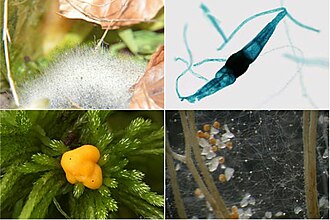
Dikarya is a subkingdom of Fungi that includes the divisions Ascomycota and Basidiomycota, both of which in general produce dikaryons, may be filamentous or unicellular, but are always without flagella. The Dikarya are most of the so-called "higher fungi", but also include many anamorphic species that would have been classified as molds in historical literature. Phylogenetically the two divisions regularly group together. In a 1998 publication, Thomas Cavalier-Smith referred to this group as the Neomycota.
Phylogeny
The 2007 classification of Kingdom Fungi is the result of a large-scale collaborative research effort involving dozens of mycologists and other scientists working on fungal taxonomy. It recognizes seven divisions within the Fungi, two of which—the Ascomycota and the Basidiomycota—are contained within a branch representing subkingdom Dikarya. The cladogram depicts the major fungal taxa and their relationship to opisthokont and unikont organisms. The lengths of the branches in this tree are not proportional to evolutionary distances.
Sexual reproduction
Ascomycota
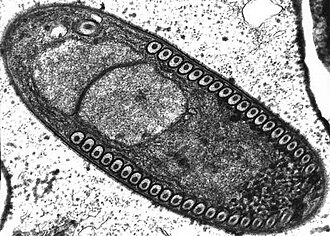
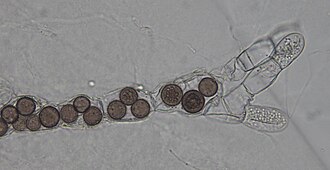
The phylum Ascomycota, or sac fungi, is characterized by formation of meiotic spores called ascospores enclosed in a special sac called an ascus. The genetic components for sexual reproduction appear to be produced by all members of this group.
Basidiomycota
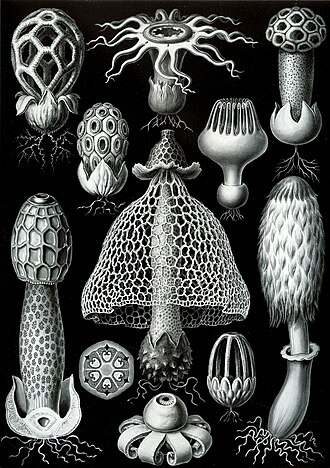
The phylum Basidiomycota can be divided into three major lineages: mushrooms, rusts and smuts. Fusion of haploid nuclei (karyogamy) occurs in the basidia, club-shaped end cells. Shortly after formation of the diploid cell, meiosis occurs and the resulting four haploid nuclei migrate into four, usually external cells called basidiospores.
Adaptive function
Sexual reproduction has been proposed to have evolved in both the Ascomycota and Basidiomycota as an adaptation for repair of DNA damage via homologous recombination under stressful conditions.
以上内容摘自英文维基百科「Dikarya」,按 CC BY-SA 4.0 使用,去掉了参考文献、外部链接等尾部小节,公式改写成了纯文本。全文、配图和出处见原文。