格物
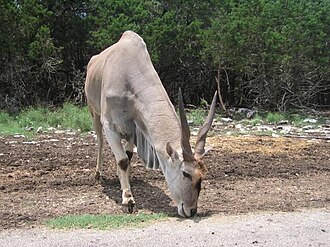
图:Lunkwill at English Wikipedia · Public domain · Wikimedia Commons
生命之树 › 真核生物 › 动物界 › 真后生动物亚界 › 两侧对称动物 › 后口动物总门 › 脊索动物门 › 脊椎动物亚门 › 有颌下门 › 肉鳍鱼总纲 › 四足形类 › 希望螈目 › 四足总纲 › 哺乳动物 › 兽型类 › 全兽类 › 兽亚纲 › 有胎盘类 › 北方真兽高目 › 劳亚兽总目 › 偶蹄目 › 牛科 › 牛亚科
大羚羊属属
Taurotragus
旋角大羚羊属 也称巨羚、大角斑羚或非洲林羚,有时也被称为伊兰羚或伊兰羚羊(Elands),是偶蹄目牛科羚羊亚科的一属,也是最大型的羚羊。分布于非洲撒哈拉沙漠以南地区的热带草原,有两个物种,分别是德氏大羚羊 以及大羚羊。
摘自维基百科「旋角大羚羊属」,CC BY-SA 4.0
- 学名
- Taurotragus
- 分类等级
- 属
- 上级类群
- 牛亚科
- 大类
- 哺乳动物
- 命名
- 约翰·安德烈亚斯·瓦格纳,1855 年
- 数据库
- NCBI 分类 · GBIF
下级类群(2)

百科正文
英文维基百科补充中文条目比较短,下面是英文条目「Taurotragus」的原文
Taurotragus is a subgenus of genus Tragelaphus. This subgenus consists of giant antelopes of the African savanna, commonly known as elands or impofu. This subgenus contains two species: the common eland Tragelaphus oryx and the giant eland Tragelaphus derbianus.
Taxonomy
The subgenus authority is the German zoologist Johann Andreas Wagner, who first mentioned it in the journal Die Säugthiere in Abbildungen nach der Natur, mit Beschreibungen in 1855. The name is composed of two Greek words: ταῦρος (taûros), meaning a "bull" or "bullock", and τράγος (trágos), meaning a "male goat"—in reference to the tuft of hair that grows in the eland's ear which resembles a goat's beard.
The subgenus consists of two species:
Although some authors, like Theodor Haltenorth, regarded the giant eland as conspecific with the common eland, they are generally considered two distinct species.
Genetics and evolution
The eland have 31 male chromosomes and 32 female chromosomes. In a 2008 phylogenomic study of spiral-horned antelopes, chromosomal similarities were observed between cattle (Bos taurus) and eight species of spiral-horned antelopes, namely: nyala (Tragelaphus angasii), lesser kudu (T. imberbis), bongo (T. eurycerus), bushbuck (T. scriptus), greater kudu (T. strepsiceros), sitatunga (T. spekei), giant eland and common eland. It was found that chromosomes involved in centric fusions in these species used a complete set of cattle painting probes generated by laser microdissection. The study confirmed the presence of the chromosome translocation known as Robertsonian translocation (1;29), a widespread evolutionary marker common to all known tragelaphid species.
An accidental mating between a male giant eland and a female kudu produced a male offspring, but it was azoospermic. Analysis showed that it completely lacked germ cells, which produce gametes. Still, the hybrid had a strong male scent and exhibited male behaviour. Chromosomal examination showed that chromosomes 1, 3, 5, 9, and 11 differed from the parental karyotypes. Notable mixed inherited traits were pointed ears as the eland's, but a bit widened like kudu's. The tail was half the length of that of an eland, with a terminal tuft of hair as in kudu. Female elands can also act as surrogates for bongos.
The bovid ancestors of the eland evolved approximately 20 million years ago in Africa; fossils are found throughout Africa and France but the best record appears in sub-Saharan Africa. The first members of the tribe Tragelaphini appear 6 million years in the past during the late Miocene. An extinct ancestor of the common eland (Taurotragus arkelli) appears in the Pleistocene in northern Tanzania and the first T. oryx fossil appears in the Holocene in Algeria. Previous genetic studies of African savanna ungulates revealed the presence of a long-standing Pleistocene refugium in eastern and southern Africa, which also includes the giant eland. The common eland and giant eland have been estimated to have diverged about 1.6 million years ago.
Differences between species
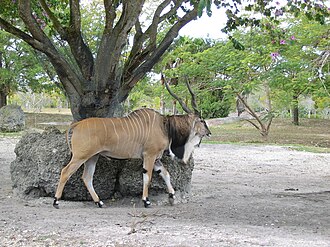
Both the species of eland are large spiral-horned antelopes. Though the giant eland broadly overlaps in size with the common eland, the former is somewhat larger on average than the latter. In fact, the giant eland is the largest species of antelope in the world. Eland are sexually dimorphic, as the females are smaller than males. The two eland species are nearly similar in height, ranging from 130–180 cm (51–71 in). In both species, males typically weigh 400 to 1,000 kg (880 to 2,200 lb) while females weigh 300 to 600 kg (660 to 1,320 lb).
The coat of the common eland is tan for females, and darker with a bluish tinge for males. The giant eland is reddish-brown to chestnut. The coat of the common eland varies geographically; the eland in southern Africa lack the distinctive markings (torso stripes, markings on legs, dark garters and a spinal crest) present in those from the northern half of the continent. Similarly, the giant eland displays 8 to 12 well-defined vertical white torso stripes. In both species the coat of the males darken with age. According to zoologist Jakob Bro-Jørgensen, the colour of the male's coat can reflect the levels of androgens (male sex hormones), which are highest during rutting.
以上内容摘自英文维基百科「Taurotragus」,按 CC BY-SA 4.0 使用,去掉了参考文献、外部链接等尾部小节,公式改写成了纯文本。全文、配图和出处见原文。