格物

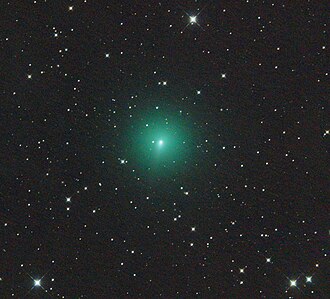
图:Mallorcasaint / Mallorcasaint at English Wikipedia · CC BY-SA 3.0 · Wikimedia Commons
- 发现 / 发明时间
- 2011 年
- 发现者 / 提出者
- 泛星计划
百科正文
观测史
泛星彗星在发现时视星等为19等。到了2012年5月,已经增亮到13.5等,可以在灯光污染较少的地方通过大型的业余望远镜观测到。2013年2月7日,泛星彗星视星等约为6等。3月的前几周从两个半球都可见,并于2013年3月5日经过近地点,距离为1.09天文单位。泛星彗星于2013年3月 10日到达近日点。最初的估计预测泛星彗星将会变亮达视星等0等。2012年10月的估计预测泛星彗星可能会增亮至−4等(相当于金星)。2013年1月,增亮速度明显放缓,表明它可能只会增亮到1等。在2月间,亮度曲线显示近日点星等约为2等。
然而,长期光变曲线的研究表明,泛星彗星在距离太阳3.6个天文单位且星等为5.6等时发生了“迟缓现象”。亮度增加率降低,近日点的估计星等预测为3.5等。 哈雷彗星在相同近日点星等为−1.0等。 同一项研究得出结论泛星彗星非常年轻,属于“婴儿彗星”(即光度年龄小于4个彗星年)。
当泛星彗星到达近日点时,跟据全球各地的观察员估计实际峰值幅度约为1等。 然而,因为彗星的高度较低使这些估计困难并受到很大的不确定性影响,因为该地区缺乏合适的参考星,又需要进行大气消光校正。2013年3月中旬,由于黄昏的亮度和天空的低海拔,泛星彗星在日落后约 40分钟内在双筒望远镜中观测效果最佳。3月17 日至18日,泛星彗星靠近2.8等恒星壁宿一。 4月22日,泛星彗星靠近仙后座王良一。5月12 日至14 日,泛星彗星位于仙王座附近。
泛星彗星可能是来源于奥尔特云,离开太阳系的行星地带后,它将继续估计约为110000年的公转周期。
以上内容摘自维基百科「C/2011 L4」,按 CC BY-SA 4.0 使用,去掉了参考文献、外部链接等尾部小节,公式改写成了纯文本。全文、配图和出处见原文。
英文维基百科补充中文条目比较短,下面是英文条目「C/2011 L4 (PanSTARRS)」的原文
C/2011 L4 (PanSTARRS), also known as Comet PANSTARRS, is a non-periodic comet discovered in June 2011 that became visible to the naked eye when it was near perihelion in March 2013. It was discovered using the Pan-STARRS telescope located near the summit of Haleakalā, on the island of Maui in Hawaii.
Observational history
Comet C/2011 L4 was still 7.9 AU from the Sun with an apparent magnitude of 19 when it was discovered in June 2011. By early May 2012, it had brightened to magnitude 13.5, and could be seen visually when using a large amateur telescope from a dark site. In October 2012, the coma (expanding tenuous dust atmosphere) was estimated to be about 120,000 kilometers (75,000 miles) in diameter. C/2011 L4 was spotted without optical aid on 7 February 2013 at a magnitude of ~6. Comet PANSTARRS was visible from both hemispheres in the first weeks of March, and passed closest to Earth on 5 March 2013 at a distance of 1.09 AU. It came to perihelion (closest approach to the Sun) on 10 March 2013. Original estimates predicted that C/2011 L4 would brighten to roughly apparent magnitude 0 (roughly the brightness of Alpha Centauri A or Vega). An estimate in October 2012 predicted that it might brighten to magnitude −4 (roughly equivalent to Venus). In January 2013 there was a noticeable brightening slowdown that suggested that it may only brighten to magnitude +1. During February the brightness curve showed a further slowdown suggesting a perihelion magnitude of around +2.
However, a study using the secular light curve indicates that C/2011 L4 had a "slowdown event" when it was 3.6 AU (540 million km) from the Sun at a magnitude 5.6. The brightness increase rate decreased and the estimated magnitude at perihelion was predicted as +3.5. Comet Halley would be magnitude −1.0 at the same perihelion distance. The same study concluded that C/2011 L4 is very young and belongs to the class of "baby comets" (i.e. those with a photometric age of less than 4 comet years).
When C/2011 L4 reached perihelion in March 2013, the actual peak magnitude turned out to be around +1, as estimated by various observers all over the planet. However, its low altitude over the horizon made these estimates difficult and subject to significant uncertainties, both because of the lack of suitable reference stars in the area and the need for differential atmospheric extinction corrections. As of mid-March 2013, due to the brightness of twilight and low elevation in the sky, C/2011 L4 was best seen in binoculars about 40 minutes after sunset. On 17–18 March, C/2011 L4 was near the 2.8-magnitude star Algenib (Gamma Pegasi). On 22 April, it was near Beta Cassiopeiae. On 12–14 May, it was near Gamma Cephei. C/2011 L4 continued moving North until 28 May. The comet may have had a sodium tail as Comet Hale–Bopp had.
Physical characteristics
Nucleus size
Dust and gas production suggests the comet nucleus is roughly 1 kilometer (0.62 mi) in diameter, while based on the absolute nuclear magnitude and a geometric albedo of 0.04 the diameter of the nucleus is over 2.4 km (1.5 mi). A method based on coma magnitude decay function estimated the effective radius at 2.317±0.190 km.
Rotation period
Light curve measurements taken while the comet was in a brief, lesser active state between July and August 2013 revealed that C/2011 L4 (PanSTARRS) is a fast rotator, spinning on its axis once every five hours.
Orbit
Comet C/2011 L4 (PanSTARRS) likely took millions of years to come from the Oort cloud. After leaving the planetary region of the Solar System, the post-perihelion orbital period (epoch 2050) is estimated to be roughly 107,000 years.
以上内容摘自英文维基百科「C/2011 L4 (PanSTARRS)」,按 CC BY-SA 4.0 使用,去掉了参考文献、外部链接等尾部小节,公式改写成了纯文本。全文、配图和出处见原文。