格物

图:NASA Ames/JPL-Caltech/T. Pyle · Public domain · Wikimedia Commons
- 发现 / 发明时间
- 2015 年
- 发现者 / 提出者
- 开普勒太空望远镜
百科正文
这颗行星距离太阳系1,400光年;以目前人类所发射最快的飞行器新视野号的速度也需要2,580万年才能到达。
特性
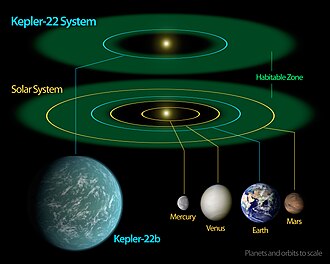
开普勒-452b行星的公转轨迹略大于地球的公转轨迹。公转一周需385天。目前没有证据证明开普勒452b上面有生命,因为开普勒望远镜只负责照相,没有办法近距离观测行星。它的直径比地球大60%,体积为地球的5倍,地表的重力是地球的两倍,跟其恒星的距离与地球和太阳的距离相约,它的恒星比太阳老15亿年,光度为太阳的1.2倍。但开普勒452正迈向死亡,若开普勒452b是一颗岩石星球的话,那么开普勒452增强散发的能量未来将把开普勒452b上可能存在的海洋和任何水分蒸发掉,地球在数十亿年之后,也可能出现类似情况。
以上内容摘自维基百科「克卜勒452b」,按 CC BY-SA 4.0 使用,去掉了参考文献、外部链接等尾部小节,公式改写成了纯文本。全文、配图和出处见原文。
英文维基百科补充中文条目比较短,下面是英文条目「Kepler-452b」的原文
Kepler-452b (sometimes quoted to be an Earth 2.0 or Earth's Cousin based on its characteristics; also known by its Kepler object of interest designation KOI-7016.01) is a disputed super-Earth exoplanet candidate. Initial reports claim it is orbiting within the inner edge of the habitable zone of the sun-like star Kepler-452 and is the only planet in the system discovered by the Kepler space telescope. It is located about 1,800 light-years (550 pc) from Earth in the constellation of Cygnus. Two subsequent reports refuted the claim but additional work has reestablished the claim.
Kepler-452b orbits its star at a distance of 1.04 AU (156 million km; 97 million mi) from its host star (nearly the same distance as Earth from the Sun), with an orbital period of roughly 385 days, has a mass at least three times that of Earth, and has a radius of around 1.63 times that of Earth, or around 63% larger than earth in size. It is the first potentially rocky super-Earth planet discovered orbiting within the habitable zone of a very Sun-like star. However, it is unknown if it is entirely habitable, as it is receiving slightly more energy from its star than Earth and could be subjected to a runaway greenhouse effect.
The Kepler space telescope identified the exoplanet, and its discovery was announced by NASA on 23 July 2015. The planet is about 1,800 light-years (550 pc) away from the Solar System. At the speed of the New Horizons spacecraft, at about 59,000 km/h (16,000 m/s; 37,000 mph), it would take approximately 30 million years to get there.
Physical characteristics
Mass, radius and temperature
Kepler-452b has a probable mass five times that of Earth, and its surface gravity is nearly twice as much as Earth's, though calculations of mass for exoplanets are only rough estimates. If it is a terrestrial planet, it is most likely a super-Earth with many active volcanoes due to its higher mass and density. The clouds on the planet would be thick and misty, covering much of the surface as viewed from space.
The planet takes 385 Earth days to orbit its star. Its radius is 60% larger than Earth's and lies within the conservative habitable zone of its parent star. It has an equilibrium temperature of 265 K (−8 °C; 17 °F), a little warmer than Earth.
Host star
The host star, Kepler-452, is a G-type and has about the same mass as the sun, only 3.7% more massive and 11% larger.
Potential habitability
It is not known if Kepler-452b is a rocky planet with it being disputed whether its radius is small enough to indicate rocky planet or too large to have not accumulated a voluminous gaseous envelope and be more Neptune-like.
It is not clear if Kepler-452b offers a habitable environment. It orbits a G2V-type star, like the Sun, which is 20% more luminous, with nearly the same temperature and mass. However, the star is roughly 6 billion years old, making it 1.5 billion years older than the Sun. At this point in its star's evolution, Kepler-452b is currently receiving 10% more energy from its parent star than Earth is currently receiving from the Sun. If Kepler-452b is a rocky planet, it may be subject to a runaway greenhouse effect similar to that seen on Venus.
Discovery and follow-up studies
In 2009, NASA's Kepler space telescope was observing stars on its photometer, the instrument it uses to detect transit events, in which a planet crosses in front of and dims its host star for a brief and roughly regular time. In this last test, Kepler observed 50000 stars in the Kepler Input Catalog, including Kepler-452; the preliminary light curves were sent to the Kepler science team for analysis, who chose obvious planetary companions from the bunch for follow-up by other telescopes. Observations for the potential exoplanet candidates took place between 13 May 2009 and 17 March 2012. Kepler-452b exhibited a transit that occurred roughly every 385 days, and it was eventually concluded that a planetary body was responsible. The discovery was announced by NASA on 23 July 2015.
Observation and exploration
Kepler-452b is 1,800 light-years (550 parsecs) from Earth. The fastest current spacecraft, the New Horizons uncrewed probe that passed Pluto in July 2015, travels at just 56,628 km/h (15,730 m/s; 35,187 mph; 0.00037853 AU/h). At that speed, it would take a spacecraft about 26 million years to reach Kepler-452b from Earth, if it were going in that direction.
以上节选摘自英文维基百科「Kepler-452b」,按 CC BY-SA 4.0 使用,去掉了参考文献、外部链接等尾部小节,公式改写成了纯文本。篇幅所限,较长的小节只摘了开头一部分,有的小节没有收;全文、配图和出处见原文。