格物
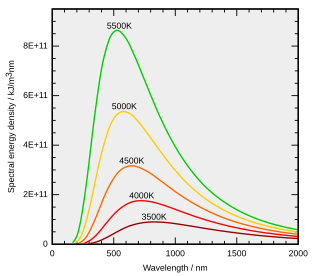
图:4C · CC BY-SA 3.0 · Wikimedia Commons
- 类型
- 物理定律
- 命名来源
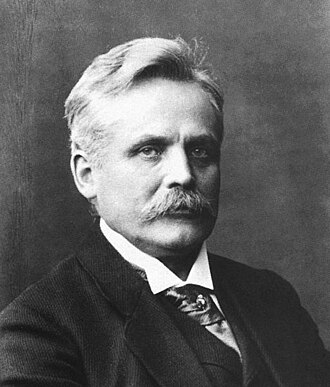
- 威廉·维恩
- 学科
- 物理学
相关科学家
百科正文
定律
1896年,威廉·维恩以古典热动力学的观点,提出黑体发出的辐射中,黑体温度与辐射波长的关系: (公式略)
其中 I(λ,T) 是每单位立体角、每单位波长的辐射强度,单位为 W m-3 sr-1。 λ 是辐射波长,单位为 m。 T 是黑体的温度,单位为 K。 a,b 是两个常数,其数值分别大约为 1.19 × 10⁻¹⁶ 和 1.44 × 10⁻²。
若以现代物理学常用的常数,则有 (公式略)
其中 I(λ,T) 是每单位立体角、每单位波长的辐射强度,单位为 W m-3 sr-1。 λ 是辐射波长,单位为 m。 T 是黑体的温度,单位为 K。 h 是普朗克常数。 c 是真空中的光速。 k 是波兹曼常数。
以上用到的普朗克常数和波兹曼常数两项常数值,于1900年由物理学家马克斯·普朗克提出。
此公式的另一个形式是以辐射的频率表示: (公式略)
其中 I(ν,T) 是每单位立体角、每单位频率的辐射强度,单位为 W m-2 sr-1 Hz-1。 ν 是辐射频率,单位为 Hz。 T 是黑体的温度,单位为 K。 h 是普朗克常数。 c 是真空中的光速。 k 是波兹曼常数。
与普朗克黑体辐射定律的关系
威廉·维恩以古典热动力学的观点,提出维恩近似公式,但这只能预测高频区域的短波辐射,长波的范围却失效。1900年,马克斯·普朗克提出的普朗克黑体辐射定律,则在全部波长的范围皆有效。普朗克黑体辐射定律形式如下: (公式略)
当 (公式略),则有 (公式略)
普朗克黑体辐射定律就能退化为维恩近似公式。
以上内容摘自维基百科「維恩近似」,按 CC BY-SA 4.0 使用,去掉了参考文献、外部链接等尾部小节,公式改写成了纯文本。全文、配图和出处见原文。
英文维基百科补充中文条目比较短,下面是英文条目「Wien approximation」的原文
Wien's approximation (also sometimes called Wien's law or the Wien distribution law) is a law of physics used to describe the spectrum of thermal radiation (frequently called the blackbody function). This law was first derived by Wilhelm Wien in 1896. The equation does accurately describe the short-wavelength (high-frequency) spectrum of thermal emission from objects, but it fails to accurately fit the experimental data for long-wavelength (low-frequency) emission.
Details
Wien derived his law from thermodynamic arguments, several years before Planck introduced the quantization of radiation.
Wien's original paper did not contain the Planck constant. In this paper, Wien took the wavelength of black-body radiation and combined it with the Maxwell–Boltzmann energy distribution for atoms. The exponential curve was created by the use of Euler's number e raised to the power of the temperature multiplied by a constant. Fundamental constants were later introduced by Max Planck.
The law may be written as (公式略)
(note the simple exponential frequency dependence of this approximation) or, by introducing natural Planck units, I(ν,x)=2ν ³e^(-x),
where:
This equation may also be written as (公式略)
where I(λ,T) is the amount of energy per unit surface area per unit time per unit solid angle per unit wavelength emitted at a wavelength λ. Wien acknowledges Friedrich Paschen in his original paper as having supplied him with the same formula based on Paschen's experimental observations.
The peak value of this curve, as determined by setting the derivative of the equation equal to zero and solving, occurs at
a wavelength (公式略)
and frequency (公式略)
Relation to Planck's law
The Wien approximation was originally proposed as a description of the complete spectrum of thermal radiation, although it failed to accurately describe long-wavelength (low-frequency) emission. However, it was soon superseded by Planck's law, which accurately describes the full spectrum, derived by treating the radiation as a photon gas and accordingly applying Bose–Einstein in place of Maxwell–Boltzmann statistics. Planck's law may be given as (公式略)
The Wien approximation may be derived from Planck's law by assuming (公式略). When this is true, then (公式略)
and so the Wien approximation gets ever closer to Planck's law as the frequency increases. Albert Einstein used this property in his 1917 quantum theory of radiation to establish a relationship between the coefficients that give the rates of spontaneous emission and stimulated emission: (公式略)
where A_(ba), B_(ba) are the Einstein coefficients and ν is the light frequency.
Other approximations of thermal radiation
The Rayleigh–Jeans law developed by Lord Rayleigh may be used to accurately describe the long wavelength spectrum of thermal radiation but fails to describe the short wavelength spectrum of thermal emission.
以上内容摘自英文维基百科「Wien approximation」,按 CC BY-SA 4.0 使用,去掉了参考文献、外部链接等尾部小节,公式改写成了纯文本。全文、配图和出处见原文。