格物
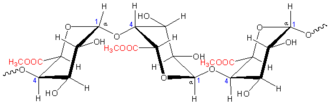
图:The original uploader was SamusAran at German Wikipedia. · Public domain · Wikimedia Commons
- 类型
- 化合物结构分类
- 发现 / 发明时间
- 1825 年
- 发现者 / 提出者
- 亨利·布拉科诺
- 属于
- pectin binding、pectin metabolic process、pectin biosynthetic process、pectin catabolic process
- 学科
- 化学
- 上级概念
- 多糖
- 组成部分
- 碳、氧、氢、D-galacturonic acid
- 用途
- 增黏剂、gelling agent
相关科学家
百科正文
果胶属于天然高分子化合物,化学式为:(C6H8O6)n 它存在于所有的高等植物细胞壁和细胞内层中,是植物细胞间质和细胞壁的重要成分。果胶沉积于初生细胞壁和细胞间层,在初生壁中与不同含量的纤维素、半纤维素、木质素的微纤丝以及某些伸展蛋白(extensin)相互交联,使各种细胞组织结构坚硬,表现出固有的形态,为内部细胞的支撑物质。它于1825年被亨利·布拉科诺第一次分离和描述。
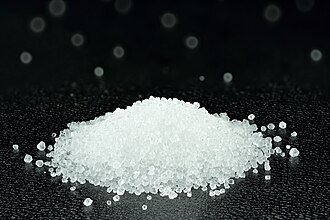
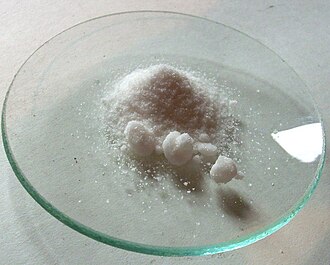
日常生活中,果胶通常从柑橘的果皮萃取,通常呈黄色或白色的粉末状,具有凝胶、增稠及乳化等作用。果胶也是一种天然的食物添加剂,为制造果酱、果冻、酸奶及雪糕等。此外,果胶也可为水果保鲜之用。
在医学上果胶增加大便的黏度与分量,这样它被用于便秘和腹泻的治疗。Kaopectate® 最初的成分是以高岭石作为吸附剂,果胶作为软化剂,但其活性成分自其最初问世以来已发生变化。自2004 起,在美国销售的产品中,活性成分已改为次水杨酸铋。果胶也被用于去除从生物系统中温和的重金属,还用在喉片作为镇痛缓和剂使用。
以上内容摘自维基百科「果胶」,按 CC BY-SA 4.0 使用,去掉了参考文献、外部链接等尾部小节,公式改写成了纯文本。全文、配图和出处见原文。
英文维基百科补充中文条目比较短,下面是英文条目「Pectin」的原文
Pectin (Ancient Greek: πηκτικός pēktikós: 'congealed' and 'curdled') is a heteropolysaccharide, a structural polymer contained in the cell walls and middle lamellae of terrestrial plants. The principal chemical component of pectin is galacturonic acid (a sugar acid derived from galactose). Commercially produced pectin is a white-to-light-brown powder, produced from citrus fruits for use as an edible gelling agent, especially in jams and jellies, dessert fillings, medications, and sweets.
Biology
Natural occurrence
Pectin was isolated and described by Henri Braconnot in 1825.He showed that it was present in the leaves, stems and fruits of many plants. Pears, apples, guavas, quince, plums, gooseberries, and oranges and other citrus fruits contain large amounts of pectin, while soft fruits, like cherries, grapes, and strawberries, contain smaller amounts.
- Typical levels of pectin in fresh fruits and vegetables are:
- Apples, 1–1.5%
- Apricots, 1%
- Cherries, 0.4%
- Oranges, 0.5–3.5%
- Carrots 1.4%
- Citrus peels, 30%
- Rose hips, 15%
Pectin is composed of complex polysaccharides that are present in the primary cell walls of a plant, and are abundant in the green parts of terrestrial plants.
Chemistry
Definition and structure
Pectin is a heteropolysaccharide with a high proportion of D-galacturonic acid (≈ 65%) in its repeat units. As the polymer's main chain contains α-L-rhamnose in addition to galacturonic acid, the systematic name for pectin is rhamno-galacturonic acid. The incorporation of rhamnose units disrupts the otherwise linear poly(galacturonic acid) chain, introducing bends (or "kinks"). Many rhamnose units in pectin carry oligomeric side chains of neutral sugars such as arabinose, galactose, or xylose. These branched sections are referred to as "hairy" regions, while the unbranched stretches composed mainly of galacturonic acid are termed "smooth" regions.
Production
The main raw materials for pectin production are dried citrus peels (85%) or apple pomace (14%), both by-products of juice production. Pomace from sugar beets is also used to a small extent (0.5%).
The conventional pectin production method uses hot acidified water extraction, followed by filtration, alcohol precipitation, washing, and drying. This process is robust and established at large scale, but requires significant amounts of mineral acid and organic solvents and may cause partial degradation of the polymer structure (protopectin loses some of its branching).
Uses
The main use for pectin is as a gelling agent, thickening agent and stabiliser in food.
In some countries, pectin is also available as a solution or an extract, or as a blended powder, for home jam making.
The classical application is giving the jelly-like consistency to jams or marmalades, which would otherwise be sweet juices. Pectin also reduces syneresis in jams and marmalades and increases the gel strength of low-calorie jams. For household use, pectin is an ingredient in gelling sugar (also known as "jam sugar") where it is diluted to the right concentration with sugar and some citric acid to adjust pH.
Legal status
At the Joint FAO/WHO Expert Committee Report on Food Additives and in the European Union, no numerical acceptable daily intake (ADI) has been set, as pectin is considered safe.
The European Union (EU) has not set a daily intake limit for two types of pectin, known as E440(i) and Amidated Pectin E440(ii). The EU has established purity standards for these additives in the EU Commission Regulation (EU)/231/2012. Pectin can be used as needed in most food categories, a concept referred to as "quantum satis". The European Food Safety Authority (EFSA) conducted a re-evaluation of Pectin E440(i) and Amidated Pectin E440(ii) in 2017.
History
Pectin was first isolated and described in 1825 by Henri Braconnot, though the action of pectin to make jams and marmalades was known long before. To obtain well-set jams from fruits that had little or only poor quality pectin, pectin-rich fruits or their extracts were mixed into the recipe.
During the Industrial Revolution, the makers of fruit preserves turned to producers of apple juice to obtain dried apple pomace that was cooked to extract pectin. Later, in the 1920s and 1930s, factories were built that commercially extracted pectin from dried apple pomace, and later citrus peel, in regions that produced apple juice in both the US and Europe.
以上节选摘自英文维基百科「Pectin」,按 CC BY-SA 4.0 使用,去掉了参考文献、外部链接等尾部小节,公式改写成了纯文本。篇幅所限,较长的小节只摘了开头一部分,有的小节没有收;全文、配图和出处见原文。