格物
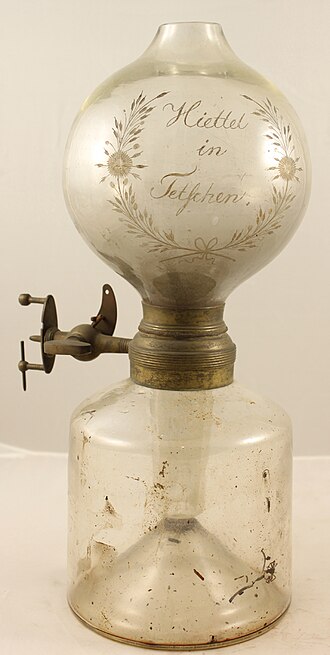
图:unbekannt, Hersteller/in · CC BY 3.0 de · Wikimedia Commons
德贝莱纳灯1823
Döbereiner's lamp
lighter invented in 1823 by J. W. Döbereiner
Döbereiner's lamp, also called a "tinderbox" ("Feuerzeug"), is a lighter invented in 1823 by the German chemist Johann Wolfgang Döbereiner. The lighter is based on the Fürstenberger lighter. Döbereiner's lamp was in production until ca. 1880. In the jar, similar to the Kipp's apparatus, zinc metal reacts with dilute sulfuric acid to produce hydrogen gas. When a valve is opened, a jet of hydrogen is released onto a platinum sponge. The sponge catalyzes a reaction with atmospheric oxygen, which heats the catalyst and ignites the hydrogen, producing a gentle flame.
摘自英文维基百科「Döbereiner's lamp」(英文维基百科,暂无中文条目),CC BY-SA 4.0
- 发现 / 发明时间
- 1823 年
- 发现者 / 提出者
- 约翰·沃尔夫冈·德贝莱纳
- 学科
- 化学
- 上级概念
- 打火机
- 用途
- 人工生火
相关科学家
百科正文
本条目暂无中文维基百科条目,下面是英文维基百科原文。
The Döbereiner's lamp is considered as the first commercial application of heterogeneous catalysis and was commercialized for lighting fires and pipes. The world's largest manufacturer of these lighters was Heinrich Gottfried Piegler from Schleiz in Thuringia (Germany). It is said that in the 1820s over a million of the "tinderboxes" were sold.
In Great Britain examples of the lighter are exhibited in the Science Museum in London, in Germany in the Deutsches Museum, the old pharmacy at Heidelberg Castle, the Kulturhistorisches Museum Schloss Merseburg, the Municipal Museum in Braunschweig, the Goethe National Museum in Weimar, the Museum Gunnar-Wester-Haus in Schweinfurt, the Astronomisch-Physikalisches Kabinett Kassel, the Regional Museum Bad Lobenstein, the Municipal Museum Zeulenroda, the Stadtmuseum Gera, the Mineralogical Collection in Jena, and at the Museum Bayerisches Vogtland in Hof, in the United States in the Amana Heritage Museum in Amana (CDP), Iowa.
以上内容摘自英文维基百科「Döbereiner's lamp」,按 CC BY-SA 4.0 使用,去掉了参考文献、外部链接等尾部小节,公式改写成了纯文本。全文、配图和出处见原文。