格物
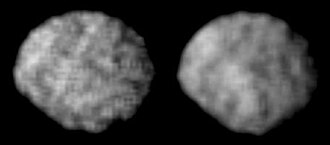
图:NASA/JPL · Public domain · Wikimedia Commons
- 类型
- 海王星的卫星
- 发现 / 发明时间
- 1981 年
- 发现者 / 提出者
- Harold Reitsema、大卫·J·苏伦、旅行者2号
- 命名来源
- Larissa
- 学科
- 物理学、天文学
相关科学家
百科正文
发现
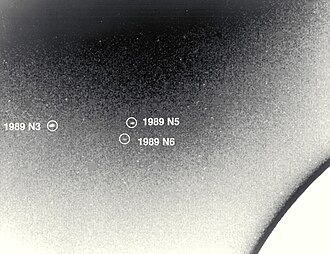
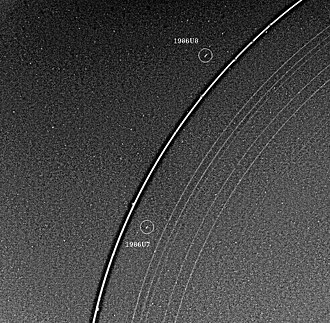
它首次被发现是由Harold J. Reitsema、William B. Hubbard、Larry A. Lebofsky和大卫·J·托伦,在1981年5月24日的一次地基恒星掩星观测中偶然发现的,给与的临时名称是 S/1981 N1,并且在1981年5月29日公布此一发现。这颗卫星在 航海家2号 于1989年飞越海王星时被再发现和获得。之后,它在1989年8月2日获得新的临时编号S/1989 N2。发言人Stephen P. Synnott宣布在7月28日之前的5天内获得10张再发现的影像资料。在1991年9月16日获得拉里萨的名称。
特征
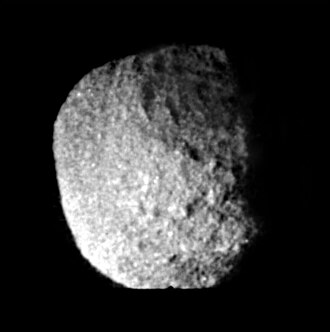
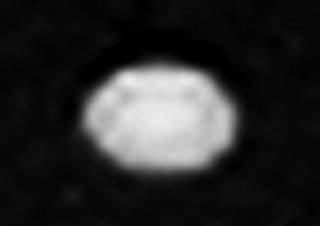
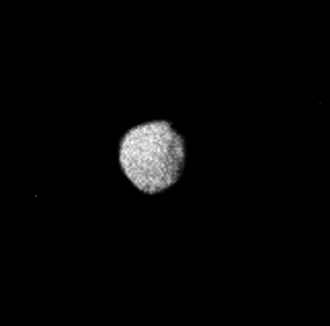
拉里萨是海王星第四大的卫星,形状不规则(非球形),并且有巨大的撞击坑,没有任何地质被修改的迹象。
但是,人们对拉里萨的所知很少。它可能像崔顿一样,是从海王星原始卫星的碎片重新堆积起来的。在初始轨道非常偏心的崔顿被捕获后,受到摄动的影响,很快的就被粉碎,再从瓦砾堆中重新生长的。
拉里萨的轨道是圆形的,但是并不完美,而且低于海王星的同步轨道半径,所以它会因为潮汐减速缓慢的以螺旋朝向海王星接近,最后可能撞入海王星的大气层,或是在进入海王星的洛希极限内之后,因为潮汐拉扯而碎裂成为行星环。
以上内容摘自维基百科「海卫七」,按 CC BY-SA 4.0 使用,去掉了参考文献、外部链接等尾部小节,公式改写成了纯文本。全文、配图和出处见原文。
英文维基百科补充中文条目比较短,下面是英文条目「Larissa (moon)」的原文
Larissa, also known as Neptune VII, is the fifth-closest inner satellite of Neptune. It is named after Larissa, a lover of Poseidon (the Greek equivalent of the Roman god Neptune). Larissa is also the eponymous nymph of the city in Thessaly, Greece.
Discovery
Larissa was first discovered by Harold J. Reitsema, William B. Hubbard, Larry A. Lebofsky and David J. Tholen, based on fortuitous ground-based stellar occultation observations on May 24, 1981. It was given the temporary provisional designation S/1981 N 1 and its supposed existence was announced on May 29, 1981. The moon was later recovered and confirmed to be the only object in its orbit during the Voyager 2 flyby in 1989 after which it received the additional designation S/1989 N 2 on August 2, 1989. The announcement by Stephen P. Synnott spoke of "10 frames taken over 5 days", which gives a recovery date sometime before July 28. The name was given and then confirmed by the International Astronomical Union on September 16, 1991.
Characteristics
Larissa is the fourth-largest satellite of Neptune. It is irregular (non-spherical) in shape and appears to be heavily cratered, with no sign of any geological modification. It is likely that Larissa, like the other satellites inward of Triton, is a rubble pile re-accreted from fragments of Neptune's original satellites, which were disrupted by perturbations from Triton soon after that moon's capture into a very eccentric initial orbit.
Larissa's orbit is nearly circular and lies below Neptune's synchronous orbit radius, which means it is slowly spiralling inward due to tidal deceleration and may eventually impact Neptune's atmosphere, or break up into a planetary ring upon passing its Roche limit due to tidal stretching, similarly to how Triton will eventually collide with Neptune or break into a planetary ring.
Larissa's surface contains hydrated materials, as evidenced by a deep 3-μm OH band, phyllosilicates, and lacks clear signatures of water ice, suggesting that its composition may resemble carbonaceous chondrites and main belt asteroids such as Ceres. The presence of phyllosilicates indicate that Larissa accreted materials which was altered by prolonged exposure to water at temperatures between less than 300 to 400 K, and the bulk of this material have never been exposed to temperatures greater than 700 K, which would have dehydrated it. Its surface albedo is 0.08 albedo at 1.4 and 2.0 microns, dropping to 0.03 at 3.0 microns, and increasing to 0.09 at 4.6 microns.
Exploration
Larissa has only been visited once by Voyager 2 in 1989. The probe was able to get some photographs with details of Larissa, showing its cratered surface; unlike the other inner moons of Neptune that only appeared as dots or smudges.
以上内容摘自英文维基百科「Larissa (moon)」,按 CC BY-SA 4.0 使用,去掉了参考文献、外部链接等尾部小节,公式改写成了纯文本。全文、配图和出处见原文。