格物
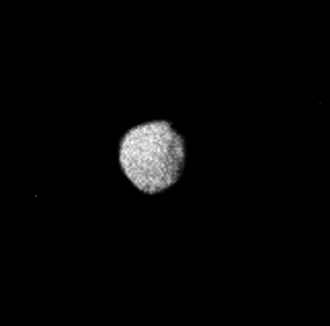
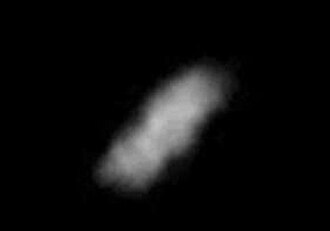
图:NASA · Public domain · Wikimedia Commons
- 类型
- 天王星的卫星、规则卫星
- 发现 / 发明时间
- 1985 年
- 发现者 / 提出者
- 斯蒂芬·辛诺特、旅行者2号
- 命名来源
- 帕克
- 学科
- 天文学
相关科学家
百科正文
发现和命名
天卫十五-天王星最大的内侧行星-是从1985年12月30日的 旅行者2号 影像中发现的,他被赋予的临时名称是S/1985 U1。
稍后,这颗卫星被以出现在莎士比亚的仲夏夜之梦中,可以在一夜之间和仙女游遍全球的小精灵。在凯尔特神话和英语的民间传说,波克是淘气的精灵,基督徒将之想像为恶魔。
它也被命名为天卫十五。
物理性质
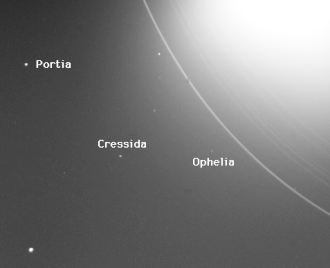
天卫十五是天王星最大的小内卫星,它的轨道位于米兰达 (天卫五) 的内侧。他的大小介于波提亚 (第二大的内侧卫星) 和 米兰达 (五大卫星中最小的)之间,是中等大小的卫星。天卫十五的轨道介于天王星环和天卫五之间,除了轨道之外,我们对它的了解很少,半径大约是81公里,此外在可见光的几何反照率大约是0.11。
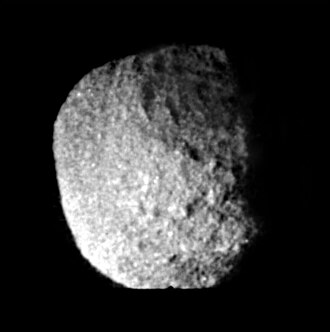
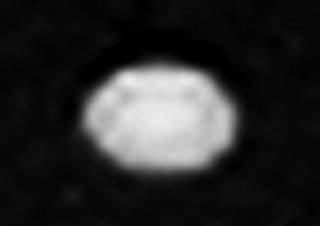
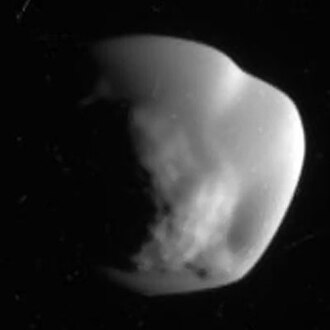
旅行者2号的影像团对所发现的卫星,只有天卫十五是很早就发现的,因此可以就探测器的程式进行设计,以获得一些较详细的影像。影像显示天卫十五的形状是略为椭的球体 (轴的比率是0.97±0.04),表面有个巨大的坑和颜色是灰色的。表面有三个陨石坑已经被命名,最大的直径大约45公里。哈勃空间望远镜和大地机望远镜的观测发现天卫十五的光谱有水冰的吸收谱线特征。
对天卫十五的内部结构一无所知。它可能是由类似于环中发现的黑暗物质与水冰组合成的混合物。这些黑暗的物质可能是岩石或有机的辐射过程造成的。缺乏有着明亮辐射线的坑穴,暗示冰和非冰的成分彼此没有分离形成核心和地幔。
以上内容摘自维基百科「天卫十五」,按 CC BY-SA 4.0 使用,去掉了参考文献、外部链接等尾部小节,公式改写成了纯文本。全文、配图和出处见原文。
英文维基百科补充中文条目比较短,下面是英文条目「Puck (moon)」的原文
Puck is the sixth-largest moon of Uranus, and its largest inner moon. It was discovered in December 1985 by the Voyager 2 spacecraft. Following the convention of naming Uranus's moons after characters from Shakespeare's literary works, its name was taken from A Midsummer Night's Dream.
The orbit of Puck lies between the rings of Uranus and the first of Uranus's large moons, Miranda. Puck is approximately spherical in shape and has diameter of about 162 km (101 mi). It has a dark, heavily cratered surface, which shows spectral signs of water ice.
Discovery and naming
Of the moons discovered by the Voyager 2 imaging team, only Puck was discovered early enough that the probe could be programmed to image it in some detail. Puck was discovered from the images Voyager 2 took on 30 December 1985. It was given the temporary designation S/1985 U 1.
The moon was later named after the character Puck who appears in Shakespeare's A Midsummer Night's Dream, a little sprite who travels around the globe at night with the fairies. In Celtic mythology and English folklore, a Puck is a mischievous sprite, imagined as an evil demon by Christians.
It is also designated Uranus XV.
Physical characteristics
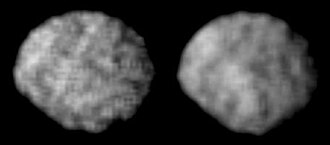
With a radius of about 81 km (50 mi), Puck is the largest inner moon of Uranus, orbiting inside the orbit of Miranda. It is intermediate in size between Portia (the second-largest inner moon) and Miranda (the smallest of the five major moons). One of the images taken by Voyager 2 had high enough resolution to constrain its shape in all three dimensions, which revealed that Puck has a shape consistent within errors to being a sphere. The ratio between its equatorial axes a/b is 0.93–1, and the polar axis c is at least 95% of b.
Its surface is heavily cratered and is grey in color. There are three named craters on the surface of Puck, the largest being about 45 km (28 mi) in diameter. It has a relatively dark geometric albedo in visible light of approximately 10%. It is about 10 or 15% brighter on its trailing hemisphere than its leading hemisphere. Observations with the Hubble Space Telescope and large terrestrial telescopes found water-ice absorption features in the spectrum of Puck.
Puck's orbit is located between the rings of Uranus and Miranda. Its surface is coated with a dark material similar to that found in the main rings. The dark material is probably made of rocks or radiation-processed organics; it is possible that material spiralling inwards from Uranus's μ ring coats Puck's leading hemisphere as well.
Little is known about the internal structure of Puck. It is probably made of a mixture of water ice and rocks, and may have been collisionally disrupted and reaccreted as a rubble pile. The presence of a 3.0 deep 3.0 micron feature attributed to the O-H stretching mode suggests that water ice or hydrated minerals are a common component on Puck's surface. Puck, as well as the other inner satellites of Uranus, is darker than the average inner Neptunian satellite, which could be either due to a higher level of solar irradiation at Uranus as opposed to Neptune, or a distinct composition. The absence of craters with bright rays implies that Puck is not differentiated, meaning that ice and non-ice components have not separated from each other into a core and mantle.
Named features
Puck has three craters named Bogle, Butz, and Lob, which are named after mischievous spirits from Scottish, German, and British folklore respectively. Details about these craters are currently unknown.
以上内容摘自英文维基百科「Puck (moon)」,按 CC BY-SA 4.0 使用,去掉了参考文献、外部链接等尾部小节,公式改写成了纯文本。全文、配图和出处见原文。