格物
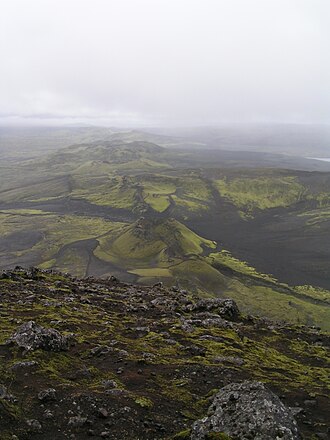
图:HansOosting at Dutch Wikipedia · CC BY-SA 3.0 · Wikimedia Commons
- 类型
- 裂缝喷发口、火山口
- 发现 / 发明时间
- 1783 年
- 发现者 / 提出者
- 冰岛人
- 命名来源
- Laki
百科正文
历史
拉基火山曾经在934年和1815年两次大规模喷发。在934年的那次喷发中,拉基火山喷出了多达24.1立方公里的玄武岩熔岩。1815年的喷发开始于1815年6月8日,直到持续到1816年2月才结束,产生14.7立方千米的熔岩,共喷出了高达一亿两千万吨的二氧化硫。导致20%-25%的冰岛人因饥荒和中毒而死亡。以至于对欧洲和北美都产生了很大的影响,比如间接促成法国大革命的爆发。
以上内容摘自维基百科「拉基火山」,按 CC BY-SA 4.0 使用,去掉了参考文献、外部链接等尾部小节,公式改写成了纯文本。全文、配图和出处见原文。
英文维基百科补充中文条目比较短,下面是英文条目「Laki」的原文
Laki (Icelandic pronunciation: [ˈlaːcɪ]) or Lakagígar ([ˈlaːkaˌciːɣar̥], Craters of Laki) is a volcanic fissure in the western part of Vatnajökull National Park, Iceland, not far from the volcanic fissure of Eldgjá and the small village of Kirkjubæjarklaustur. The fissure is properly referred to as Lakagígar, while Laki is a mountain that the fissure bisects. Lakagígar is part of a volcanic system centered on the volcano Grímsvötn, including the volcano Þórðarhyrna. It lies between the glaciers of Mýrdalsjökull and Vatnajökull, in an area of fissures that run in a southwest to northeast direction.
The system erupted violently over an eight-month period between June 1783 and February 1784 from the Laki fissure and the adjoining volcano Grímsvötn. It poured out an estimated 42 billion tonnes or 14 km3 (18×10^9 cu yd) of basalt lava, as well as clouds of poisonous hydrofluoric acid and sulfur dioxide compounds that contaminated the soil, leading to the death of over 50% of Iceland's livestock population and the destruction of the vast majority of all crops. This led to a famine, which then killed at least a fifth of the island's human population, although some have claimed a quarter.
The Laki eruption and its aftermath caused a drop in global temperatures, as 120 million tonnes of sulfur dioxide were spewed into the Northern Hemisphere. This caused crop failures in Europe and may have caused droughts in North Africa and India.
1783 eruption
On 8 June 1783, a 25 km-long (15.5 mi) fissure of at least 130 vents opened with phreatomagmatic explosions because of the groundwater interacting with the rising basalt magma. Over a few days, the eruptions became less explosive, Strombolian, and later Hawaiian in character, with high rates of lava effusion. This event is rated as 4 on the volcanic explosivity index, but the eight-month emission of sulfuric aerosols resulted in one of the most important climatic and socially significant natural events of that millennium.
The eruption, also known as the Skaftáreldar [ˈskaftˌauːrˌɛltar̥] ("Skaftá fires") or Síðueldur [ˈsiːðʏˌɛltʏr̥] produced an estimated 14 km3 (18×10^9 cu yd) of basalt lava, and the total volume of tephra emitted was 0.91 km3 (1.2×10^9 cu yd). Lava fountains were estimated to have reached heights of 800 to 1,400 m (2,600 to 4,600 ft). The gases were carried by the convective eruption column to altitudes around 15 km (50,000 ft).
The eruption continued until 7 February 1784, but most of the lava was ejected in the first five months. One study states that the event "occurred as ten pulses of activity, each starting with a short-lived explosive phase followed by a long-lived period of fire-fountaining". Grímsvötn volcano, from which the Laki fissure extends, also erupted at the time, from 1783 until 1785. The outpouring of gases, including an estimated 8 million tonnes of fluorine and an estimated 120 million tonnes of sulfur dioxide, gave rise to what has since become known as the "Laki haze" across Europe.
Consequences in Iceland
The consequences for Iceland, known as the Móðuharðindin [ˈmouːðʏˌharðɪntɪn] (mist hardships), were disastrous. An estimated 20% of the population died in the famine after the fissure eruptions ensued, with about 8,000 excess deaths. About 80% of sheep (190,500 head), 50% of cattle (11,500 head), and 50% of horses (28,000 head) died because of dental and skeletal fluorosis from the 8 million tons of fluorine that were released. Milk yields halved. The livestock deaths were primarily caused by eating contaminated grass, while the humans' deaths were from the subsequent famine, not fluorine poisoning.
The parish minister and provost of Vestur-Skaftafellssýsla, Jón Steingrímsson (1728–1791), grew famous for the eldmessa [ˈɛltˌmɛsːa] ("fire mass") that he delivered on 20 July 1783. The church farm of Kirkjubæjarklaustur was endangered by a branch of the lava flow that halted not far from the farm, while the Rev. Jón and his parishioners were worshipping in the church. The spot at which the lava diverted away from the church became known thereafter as Eldmessutangi [ˈɛltˌmɛsːʏˌtʰauɲcɪ] ("Fire Mass Point").
This past week, and the two prior to it, more poison fell from the sky than words can describe: ash, volcanic hairs, rain full of sulfur and saltpeter, all of it mixed with sand. The snouts, nostrils, and feet of livestock grazing or walking on the grass turned bright yellow and raw. All water went tepid and light blue in color and gravel slides turned grey.
以上节选摘自英文维基百科「Laki」,按 CC BY-SA 4.0 使用,去掉了参考文献、外部链接等尾部小节,公式改写成了纯文本。篇幅所限,较长的小节只摘了开头一部分,有的小节没有收;全文、配图和出处见原文。