格物
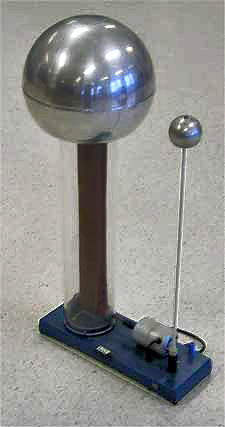
图:Jared C. Benedict · CC BY-SA 3.0 · Wikimedia Commons
范德格拉夫起电机1929
Van de Graaff generator
electrostatic generator that produces high voltages by accumulated tribocharging
范德格拉夫起电机 是一种用来产生静电的装置,该装置于1929年由荷兰裔美国物理学家罗伯特·杰米森·范德格拉夫 发明。
范德格拉夫起电机通过传送带将产生的静电荷传送到中空的金属球表面。范德格拉夫起电机非常易于获得非常高的电压,现代的范德格拉夫起电机电势可达500万伏特。
摘自维基百科「范德格拉夫起电机」,CC BY-SA 4.0
- 类型
- 物理学实验、演示
- 时间
- 1929 年
- 发现者 / 提出者
- 罗伯特·杰米森·范德格拉夫
- 学科
- 物理学
- 上级概念
- 静电发电机
- 是……的一个方面
- 物理学、电磁学、静电学
- 开始时间
- 1929 年
- 用到了
- 摩擦起电效应
相关科学家

百科正文
说明
一个简单的范德格拉夫起电机由丝绸腰带组成,或类似的有弹性的介质材料,包围在两个金属滚轮上,其中之一是中空的,2个电极(2)及(7),尖锐的金属以梳状行的形式,分别被放置在靠近底部的下滑轮和球体内滑轮。电刷(2)连接到球上,同时电刷(7)接地。
当皮带运行过在前面的低电刷,在周围的电场下,它将携带负电荷。当皮带触摸上滚轮(3),移出一些电子,使得滚轮带负电荷(如果末端是绝缘的),负电荷的电场添加使空气电离。然后从电子从皮带上离开转移到上电刷上,使皮带带正电的,因为它的电荷下降,而末端的带负电荷。球体外壳与上滚轮发生电磁感应,在它的外表面积累产生的正电荷,上滚轮的放电及皮带极性发生变化使其恢复电中性。由于皮带继续运行,通过皮带传递,球继续积累正电荷,直到充满。它越是远离地面,最终的电量就越多。
以上内容摘自维基百科「范德格拉夫起电机」,按 CC BY-SA 4.0 使用,去掉了参考文献、外部链接等尾部小节,公式改写成了纯文本。全文、配图和出处见原文。
英文维基百科补充中文条目比较短,下面是英文条目「Van de Graaff generator」的原文
A Van de Graaff generator is an electrostatic generator which uses a moving belt to accumulate electric charge on an insulated, hollow metal terminal, creating electric potential. Because it moves charge mechanically, it supplies high voltage direct current at very low current.
American physicist Robert J. Van de Graaff invented the generator in 1929 and first demonstrated it in 1931. He conceived of the generator as a power source for particle accelerators, as high potentials can be used to accelerate subatomic particles to high energies in an evacuated accelerator tube. Beginning with Van de Graaff’s Round Hill machine in 1933, Van de Graaff accelerators were widely used in nuclear science research through the 1970s. Several high-energy Van de Graaff accelerators remain in scientific use and have inspired related electrostatic accelerator designs. Lower-energy Van de Graaff generators have been used to generate energetic particle beams for nuclear science, nuclear medicine, and ion implantation.
In open air, Van de Graaff generators can reach a potential difference of as much as 5 megavolts (MV); generators enclosed in pressurized tanks reach potentials of 25 MV. An inexpensive tabletop version can produce on the order of 100 kV, enough energy to discharge visible electric sparks. Because they are simple to build and produce only microamperes of current, small Van de Graaff generators are used for science demonstrations and personal entertainment; larger demonstration models are displayed in some science museums.
History
Background
The concept of an electrostatic generator in which charge is mechanically transported in small amounts into the interior of a high-voltage electrode originated with the Kelvin water dropper, invented in 1867 by William Thomson (Lord Kelvin), in which charged drops of water fall into a bucket with the same polarity charge, adding to the charge.
In a machine of this type, the gravitational force moves the drops against the opposing electrostatic field of the bucket. Kelvin himself first suggested using a belt to carry the charge instead of water.
Description
A simple Van de Graaff generator consists of a belt of rubber (or a similar flexible dielectric material) moving over two rollers of differing material, one of which is surrounded by a hollow metal sphere. A comb-shaped metal electrode with sharp points (2 and 7 in the diagram), is positioned near each roller. The upper comb (2) is connected to the sphere, and the lower one (7) to ground. When a motor is used to drive the belt, the triboelectric effect causes the transfer of electrons from the dissimilar materials of the belt and the two rollers.
Use as a particle accelerator
The initial motivation for the development of the Van de Graaff generator was as a source of high voltage to accelerate particles for nuclear physics experiments. The high potential difference between the surface of the terminal and ground results in a corresponding electric field. When an ion source is placed near the surface of the sphere (typically within the sphere itself) the field will accelerate charged particles of the appropriate sign away from the sphere.
Entertainment and educational generators
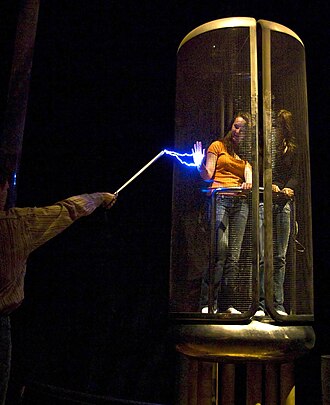
The Round Hill generator, the largest air-insulated Van de Graaff generator in the world, completed by Dr. Van de Graaff in 1933, is now displayed permanently at Boston's Museum of Science. With two conjoined 4.5 m (15 ft) aluminium spheres standing on columns 22 ft (6.7 m) tall, this generator can often obtain 2 MV (2 million volts). Shows using the Van de Graaff generator and several Tesla coils are conducted two to three times a day.
Comparison with other electrostatic generators
Other electrostatic machines such as the Wimshurst machine or Bonetti machine work similarly to the Van De Graaff generator; charge is transported by moving plates, disks, or cylinders to a high voltage electrode. For these generators, however, corona discharge from exposed metal parts at high potentials and poorer insulation result in smaller voltages. In an electrostatic generator, the rate of charge transported (current) to the high-voltage electrode is very small.
Patents
U.S. patent 1,991,236 — "Electrostatic Generator"
U.S. patent 2,922,905 — "Apparatus For Reducing Electron Loading In Positive-Ion Accelerators"
以上节选摘自英文维基百科「Van de Graaff generator」,按 CC BY-SA 4.0 使用,去掉了参考文献、外部链接等尾部小节,公式改写成了纯文本。篇幅所限,较长的小节只摘了开头一部分,有的小节没有收;全文、配图和出处见原文。