格物
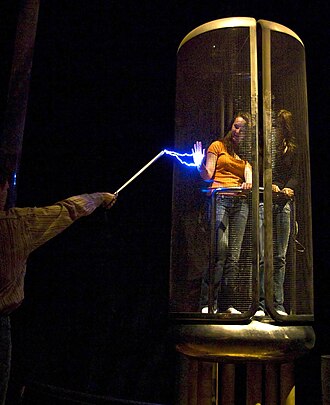
图:Antoine Taveneaux · CC BY-SA 3.0 · Wikimedia Commons
- 类型
- 实验
- 发现者 / 提出者
- 麦可·法拉第
- 命名来源
- 麦可·法拉第
- 学科
- 物理学
- 上级概念
- 容器
- 用途
- electrostatic shielding
- 用到了
- 电场屏蔽
相关科学家

百科正文
由于金属的静电等势性,可以有效遮蔽外电场的电磁干扰。法拉第遮罩无论被加上多高的电压内部也不存在电场。而且由于金属的导电性,即使笼子通过很大的电流,内部的物体通过的电流也微乎其微。
在面对电磁波时,屏蔽效果与电磁波的频率有关。阻挡频率较低(波长较长)的电磁波需要用较厚的法拉第笼,借此增加集肤效应。若要阻挡频率较高(波长较短)的电磁波,则需要缩小笼子的孔洞尺寸,通常孔的直径要小于电磁波的波长。
由于法拉第遮罩的静电屏蔽原理,在汽车、飞机等交通工具中的人是不会被雷击的。
以上内容摘自维基百科「法拉第笼」,按 CC BY-SA 4.0 使用,去掉了参考文献、外部链接等尾部小节,公式改写成了纯文本。全文、配图和出处见原文。
英文维基百科补充中文条目比较短,下面是英文条目「Faraday cage」的原文
A Faraday cage or Faraday shield is an enclosure used to block some electromagnetic fields. A Faraday shield may be formed by a continuous covering of conductive material, or in the case of a Faraday cage, by a mesh of such materials. Faraday cages are named after the scientist Michael Faraday, who first constructed one in 1836.
Faraday cages work because an external electrical field will cause the electric charges within the cage's conducting material to be distributed in a way that cancels out the field's effect inside the cage. This phenomenon can be used to protect sensitive electronic equipment (for example RF receivers) from external radio frequency interference (RFI), often during testing or alignment of the device. Faraday cages are also used to protect people and equipment against electric currents such as lightning strikes and electrostatic discharges, because the cage conducts electrical current around the outside of the enclosed space and none passes through to the interior.
Faraday cages cannot block stable or slowly varying magnetic fields, such as the Earth's magnetic field (a compass will still work inside one). To a large degree, however, they shield the interior from external electromagnetic radiation if the conductor is thick enough and any hole is significantly smaller than the wavelength of the radiation. For example, certain computer forensic electronic systems test procedures that require an electromagnetic interference free environment can be carried out within a screened room. These rooms are spaces that are completely enclosed by one or more layers of a fine metal mesh or perforated sheet metal. The metal layers are grounded to dissipate any electric currents generated from external or internal electromagnetic fields, and thus they block a large amount of the electromagnetic interference (see also electromagnetic shielding). They provide less attenuation of outgoing transmissions than incoming: they can block electromagnetic pulse (EMP) waves from natural phenomena very effectively, but especially in upper frequencies, a tracking device may be able to penetrate from within the cage (e.g., some cell phones operate at various radio frequencies, so while one frequency may not work, another one will).
The reception or transmission of radio waves, a form of electromagnetic radiation, to or from an antenna within a Faraday cage is heavily attenuated or blocked by the cage; however, a Faraday cage has varied attenuation depending on wave form, frequency, or the distance from receiver or transmitter, and receiver or transmitter power. Near-field, high-powered frequency transmissions like HF RFID are more likely to penetrate. Solid cages generally attenuate fields over a broader frequency range than mesh cages.
History
In 1754, Jean-Antoine Nollet published an account of the cage effect in his Leçons de physique expérimentale.
In 1755, Benjamin Franklin observed the effect by lowering an uncharged cork ball suspended on a silk thread through an opening in an electrically charged metal can. The behavior is that of a Faraday cage or shield.
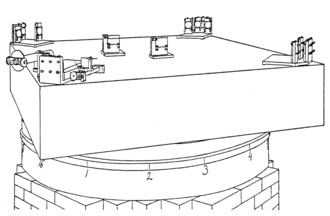
In 1836, Michael Faraday observed that the excess charge on a charged conductor resided only on its exterior and had no influence on anything enclosed within it.
Operation
Continuous
A continuous Faraday shield is a hollow conductor. Externally or internally applied electromagnetic fields produce forces on the charge carriers (usually electrons) within the conductor; the charges are redistributed accordingly due to electrostatic induction. The redistributed charges greatly reduce the voltage within the surface, to an extent depending on the capacitance; however, full cancellation does not occur.
Examples
Faraday cages are routinely used in analytical chemistry to reduce noise while making sensitive measurements.
Faraday cages, more specifically dual-paired seam Faraday bags, are often used in digital forensics to prevent remote wiping and alteration of criminal digital evidence.
Faraday bags are shielded security bags fabricated with metallic materials that are used to contain devices to protect them from electromagnetic transmissions for a wide range of applications, from enhancing digital privacy of cell telephones to protecting credit cards from RFID skimming.
以上节选摘自英文维基百科「Faraday cage」,按 CC BY-SA 4.0 使用,去掉了参考文献、外部链接等尾部小节,公式改写成了纯文本。篇幅所限,较长的小节只摘了开头一部分,有的小节没有收;全文、配图和出处见原文。