格物
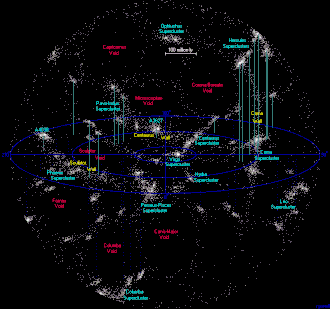
图:Richard Powell · CC BY-SA 2.5 · Wikimedia Commons
- 类型
- 大尺度纤维状结构
- 发现 / 发明时间
- 1987 年
- 发现者 / 提出者
- 布伦特·塔利
- 属于
- 可观测宇宙
- 学科
- 天文学
- 组成部分
- 拉尼亚凯亚超星系团
相关科学家
百科正文
发现
夏威夷大学天文学学院的天文学家R·布伦特·塔利在1987年确认了这个复合体。
范围
双鱼-鲸鱼座超星系团复合体的尺度是10亿光年长,1亿5千万光年宽。它是到目前为止在宇宙中发现的最大结构之一,但不及个别的史隆长城(13亿7千万光年)、克劳斯-坎普萨诺超大类星体群(20亿光年)、U1.11 LQG (25亿光年)、巨型超大类星体群(40亿光年)和武仙-北冕座长城(100亿光年)长。
这个复合体有60个群集,并且估计总质量为 ×1018M☉。
- 据发现者描述,这个复合体由5个部分组成:
- 双鱼-鲸鱼超星系团
- 包括英仙-双鱼超星系团的英仙-飞马链,
- 飞马-双鱼链
- 包括玉夫座超星系团和武仙座超星系团的玉夫座长城,
拉尼亚凯亚超星系团,其包括我们所在的室女座超星系团(本超星系团)以及长蛇-半人马超星系团。
这个复合体是依据最富足的双鱼-鲸鱼座超星系团命名。相较之下,我们所属的室女座超星系团的质量只有1015 M☉,只是复合体总质量的0.1%。
以上内容摘自维基百科「雙魚-鯨魚座超星系團複合體」,按 CC BY-SA 4.0 使用,去掉了参考文献、外部链接等尾部小节,公式改写成了纯文本。全文、配图和出处见原文。
英文维基百科补充中文条目比较短,下面是英文条目「Pisces–Cetus Supercluster Complex」的原文
The Pisces–Cetus Supercluster Complex (Pisces–Cetus SCC) or the local superstructure is a galaxy supercluster complex (SCC) that includes the Virgo Supercluster as its outlying member (later confirmed to be part of the Laniakea supercluster), which in turn contains the Local Group and thus the Milky Way. The complex was named after the Pisces–Cetus Superclusters, its richest and most prominent members, which reside in its core and main plane, located at roughly 200 megaparsecs (652 million light-years; 6.17×10²¹ kilometres) away from Earth.
Observational history
Astronomer R. Brent Tully of the University of Hawaii's Institute of Astronomy discovered a very massive agglomeration that includes the Local and Pisces–Cetus Superclusters in 1986, and identified it as the "extended Pisces–Cetus Supercluster", and later the Pisces–Cetus Supercluster Complex in 1987. In addition, four more other nearby supercluster complexes within a redshift of z = 0.1 (roughly 340 megaparsecs) have also been discovered, including Ursa Major, Hercules-Corona Borealis, Leo, and Aquarius Supercluster Complexes. The Aquarius Supercluster Complex was known to contain 25 rich galaxy clusters and is composed of two parts, which are both the Aquarius Region and the Aquarius-Capricornus Region. It along with Pisces–Cetus Supercluster Complex have been shown to contains most of the 114 southern Abell clusters. Only 28 are not associated with these two main complexes, with no other association having more than four members.
Following the discovery of those supercluster complexes at the end of the 20th century, other supercluster complexes were later identified such as Sloan and BOSS Great Walls.
Extent
The Pisces–Cetus Supercluster Complex is estimated to be about 380 megaparsecs (1.24 billion light-years; 1.17×10²² kilometres) long and 160 megaparsecs (520 million light-years; 4.9×10²¹ kilometres) wide, making it one of the largest structures known in the observable universe. This brings it to roughly the theoretical limit per the Cosmological Principle. Despite that, larger sizes have been suggested for other structures such as Quipu superstructure, Clowes–Campusano LQG and U1.11, along with the disputed and unconfirmed Huge-LQG, Giant GRB Ring, and Hercules–Corona Borealis Great Wall.
61 rich clusters comprise the complex, which is estimated to have a total mass of approximately 1018 times that of the mass of the Sun (M☉). According to the discoverer, the complex is composed of 5 parts:
- The Pisces–Cetus Superclusters
- The Perseus–Pegasus chain, including the Perseus–Pisces Supercluster
- The Pegasus–Pisces chain
- The Sculptor region, including the Sculptor Superclusters
The Laniakea, which contains our Virgo Supercluster (Local Supercluster) as well as the Hydra–Centaurus Supercluster.
With its mass of 1015 M☉, our Virgo Supercluster accounts for only 0.1 percent of the total mass of the complex. Coma Supercluster was also considered to be part of this complex by the time of its discovery in 1986, which forms the heart of Coma Filament and the larger CfA2 Great Wall.
Latest observations of basins of attraction suggested a basin of attraction around Ophiuchus Cluster may be associated with Laniakea, and also have found both, along with Apus and Coma Superclusters, are moving toward the greater Shapley Attractor and may be thus part of the Shapley Concentration.
以上内容摘自英文维基百科「Pisces–Cetus Supercluster Complex」,按 CC BY-SA 4.0 使用,去掉了参考文献、外部链接等尾部小节,公式改写成了纯文本。全文、配图和出处见原文。